10-K: Annual report [Section 13 and 15(d), not S-K Item 405]
Published on March 2, 2026
UNITED STATES SECURITIES AND EXCHANGE COMMISSION
Washington, D.C. 20549
FORM 10-K
ANNUAL REPORT PURSUANT TO SECTION 13 OR 15(d) OF THE SECURITIES EXCHANGE ACT OF 1934 | |||||
For the fiscal year ended | |||||
| or | |||||
TRANSITION REPORT PURSUANT TO SECTION 13 OR 15(d) OF THE SECURITIES EXCHANGE ACT OF 1934 | |||||
For the transition period from _______ to ________ | |||||
COMMISSION FILE NUMBER:
(Exact name of registrant as specified in its charter)
| (State or other jurisdiction of incorporation or organization) | (I.R.S. Employer Identification No.) | |||||||
(Address of principal executive offices, including Zip Code) | ||||||||
Registrant's telephone number, including area code
(770 ) 240-7200
Securities registered pursuant to Section 12(b) of the Act:
| Title of Each Class | Trading Symbol(s) | Name of Each Exchange on Which Registered | ||||||||||||
Securities registered pursuant to Section 12(g) of the Act:
None
Indicate by check mark if the registrant is a well-known seasoned issuer, as defined in Rule 405 of the Securities Act. Yes ☑ No ☐
Indicate by check mark if the registrant is not required to file reports pursuant to Section 13 or Section 15(d) of the Act. Yes ☐ No ☑
Indicate by check mark whether the registrant (1) has filed all reports required to be filed by Section 13 or 15(d) of the Securities Exchange Act of 1934 during the preceding 12 months (or for such shorter period that the registrant was required to file such reports), and (2) has been subject to such filing requirements for the past 90 days. Yes ☑ No ☐
Indicate by check mark whether the registrant has submitted electronically every Interactive Data File required to be submitted and posted pursuant to Rule 405 of Regulation S-T during the preceding 12 months (or for such shorter period that the registrant was required to submit and post such files). Yes ☑ No ☐
Indicate by check mark whether the registrant is a large accelerated filer, an accelerated filer, a non-accelerated filer, a smaller reporting company or an emerging growth company. See the definitions of "large accelerated filer," "accelerated filer," "smaller reporting company" and "emerging growth company" in Rule 12b-2 of the Exchange Act.
| ☑ | Accelerated filer | ☐ | Smaller reporting company | ||||||||||||||||||||
Non-accelerated filer | ☐ | Emerging growth company | |||||||||||||||||||||
If an emerging growth company, indicate by check mark if the registrant has elected not to use the extended transition period for complying with any new or revised financial accounting standards provided pursuant to Section 13(a) of the Exchange Act. ☐
Indicate by check mark whether the registrant has filed a report on and attestation to its management's assessment of the effectiveness of its internal control over financial reporting under Section 404(b) of the Sarbanes-Oxley Act (15 U.S.C. 7262(b)) by the registered public accounting firm that prepared or issued its audit report. ☑
If securities are registered pursuant to Section 12(b) of the Act, indicate by check mark whether the financial statements of the registrant included in the filing reflect the correction of an error to previously issued financial statements. ☐
Indicate by check mark whether any of those error corrections are restatements that required a recovery analysis of incentive-based compensation received by any of the registrant's executive officers during the relevant recovery period pursuant to §240.10D-1(b). ☐
Indicate by check mark whether the registrant is a shell company (as defined in Rule 12b-2 of the Act). Yes ☐ No ☑
The aggregate market value of voting and non-voting common equity held by non-affiliates at June 30, 2025 was approximately $6.2 billion.
As of February 27, 2026 there were approximately 295,740,911 shares of the registrant's Common Stock, $0.01 par value per share outstanding.
DOCUMENTS INCORPORATED BY REFERENCE:
Portions of the registrant's definitive Proxy Statement for the 2026 Annual Meeting of Stockholders are incorporated by reference into Part III of this Annual Report on Form 10-K.
TABLE OF CONTENTS OF FORM 10-K
Item 2. | ||||||||
Item 6. | ||||||||
Information Concerning Forward-Looking Statements
Certain statements regarding the expectations of Graphic Packaging Holding Company ("GPHC" and, together with its subsidiaries, the "Company"), including, but not limited to, capital expenditures in 2026 and 2027 to maintain compliance with environmental laws and regulations, the Company's Vision 2030 plan targets, future acquisitions, material cash requirements and primary sources of liquidity and the sufficiency thereof, amortization expenses, the deductibility of goodwill, pension contributions and postretirement healthcare plan expenses, the reclassification of pre-tax losses from Other Comprehensive Loss to earnings, and total charges for exit activities in this report constitute "forward-looking statements" as defined in the Private Securities Litigation Reform Act of 1995. Such statements are based on currently available operating, financial and competitive information and are subject to various risks and uncertainties that could cause actual results to differ materially from the Company's historical experience and its present expectations. These risks and uncertainties include, but are not limited to, inflation of and volatility in raw material and energy costs, changes in consumer buying habits and product preferences, competition with other paperboard manufacturers and converters, product substitution, the Company's ability to implement its business strategies, including acquisitions, productivity initiatives, cost reduction plans and integration activities, the Company's debt level, currency movements and other risks of conducting business internationally, the impact of regulatory and litigation matters, including those that could impact the Company's ability to utilize its U.S. federal income tax attributes to offset taxable income or U.S. federal income taxes and the timing related to the Company’s future U.S. federal income tax payments, and those that impact the Company's ability to protect and use its intellectual property. Undue reliance should not be placed on such forward-looking statements, as such statements speak only as of the date on which they are made and the Company undertakes no obligation to update such statements, except as may be required by law.
3
PART I
Item 1. Business
Overview
Graphic Packaging Holding Company ("GPHC" and, together with its subsidiaries, the "Company") is committed to creating consumer packaging that makes a world of difference. The Company is a leading producer of consumer goods packaging made from renewable or recycled materials. The Company designs and manufactures sustainable packaging solutions including cartons, multipack cartons, trays, carriers, paperboard canisters, as well as cups and bowls made primarily from recycled paperboard, unbleached paperboard and bleached paperboard.
The Company serves a wide variety of consumer markets, from food and beverage, to foodservice, household products, beauty and health care. The Company produces packaging solutions at over 100 locations in 20 countries around the world, serving customers ranging from local to multinational consumer products companies and retailers. The Company offers one of the most comprehensive ranges of packaging design, manufacturing and execution capabilities available. The Company currently manufactures most of the paperboard it consumes in the Americas and purchases the majority of the paperboard it consumes in its International Paperboard Packaging operations from third parties.
Graphic Packaging works closely with its customers to understand their needs and goals and to create new and innovative designs customized to their specific needs. The Company's approach serves to build and strengthen long-term relationships with purchasing, brand management, marketing and other key customer functions. The Company is organized to bring the full resources of its global and local innovation, design and manufacturing capabilities to all of its customers with the goal of delivering packaging solutions that are more circular, more functional and more convenient.
Acquisitions, Closures and Dispositions
In May 2025, the Company closed its Middletown, Ohio, recycled paperboard manufacturing facility. For more information, see Note 18. Exit Activities in the Notes to Consolidated Financial Statements.
In December 2025, the Company closed its East Angus, Québec, recycled paperboard manufacturing facility. For more information, see Note 18. Exit Activities in the Notes to Consolidated Financial Statements.
In May 2024, the Company completed the sale of its Augusta, Georgia bleached paperboard manufacturing facility (the "Augusta Divestiture") to Clearwater Paper Corporation for a total consideration of $711 million. For more information, see Note 19. Divestitures in the Notes to Consolidated Financial Statements.
During 2024 and 2023, the Company decided to close multiple packaging facilities. Production from these facilities has been consolidated into other existing packaging facilities. Current Assets on the Consolidated Balance Sheet include $8 million and $15 million related to multiple paperboard manufacturing and packaging facilities that met the held for sale criteria as of December 31, 2025 and 2024, respectively. For more information, see Note 18. Exit Activities in the Notes to Consolidated Financial Statements.
In January 2023, the Company completed the acquisition of Tama Paperboard, LLC ("Tama"), a recycled paperboard manufacturing facility located in Tama, Iowa, from Greif Packaging LLC for approximately $100 million. Tama is reported within Corporate and Other. Subsequently, in the second quarter of 2023, the Company closed this facility. For more information, see Note 4. Business Combinations in the Notes to Consolidated Financial Statements.
In September 2023, the Company completed the acquisition of Bell Incorporated ("Bell") for $262 million, adding three packaging facilities in Sioux Falls, South Dakota and Groveport, Ohio. Bell is reported within the Americas Paperboard Packaging reportable segment. For more information, see Note 4. Business Combinations in the Notes to Consolidated Financial Statements.
During the third quarter of 2023, the Company decided to discontinue its project in Texarkana to modify an existing paperboard machine to add swing capacity between bleached and unbleached paperboard in order to focus growth investments in the strategic expansion of recycled paperboard capacity. For more information, see Note 18. Exit Activities in the Notes to Consolidated Financial Statements.
During the third quarter of 2023, the Company announced its decision to permanently decommission the K3 recycled paperboard machine in Kalamazoo, Michigan as part of its recycled paperboard network optimization plan that the Company initiated in 2019. For more information, see Note 18. Exit Activities in the Notes to Consolidated Financial Statements.
In November 2023, the Company completed the sale of its two packaging facilities in Russia. For more information, see Note 19. Divestitures in the Notes to Consolidated Financial Statements.
4
Share Repurchases and Dividends
On April 30, 2025, the Company's Board of Directors authorized an additional share repurchase program to allow the Company to purchase up to $1.5 billion of the Company's issued and outstanding shares of common stock through open market purchases, privately negotiated transactions and Rule 10b5-1 plans (the "2025 share repurchase program"). The previous $500 million share repurchase program was authorized on July 27, 2023 (the "2023 share repurchase program"), in addition to the $500 million share repurchase program that was authorized on January 28, 2019 (the "2019 share repurchase program"), which was completed in May 2024. At December 31, 2025, the Company had $1.715 billion available for additional repurchases under the 2025 and 2023 share repurchase programs.
Share repurchases are reflected as a reduction of common stock for the par value of the shares, with any excess of share repurchase price over par value allocated between capital in excess of par value and retained earnings.
The following table presents the Company's share repurchases for the years ended December 31, 2025, 2024 and 2023:
| In millions, except share and per share amounts | Amount Repurchased | Number of Shares Repurchased | Average Price per Share | ||||||||
2025(a) | $ | 150 | 6,765,249 | $ | 22.17 | ||||||
2024(a)(b) | $ | 200 | 7,243,734 | $ | 27.61 | ||||||
| 2023 | $ | 54 | 2,389,224 | $ | 22.80 | ||||||
(a) Excluding $1 million and $2 million of excise taxes incurred in 2025 and 2024, respectively.
(b) Includes $65 million shares repurchased under the 2019 share repurchase program, thereby completing that program.
During 2025, 2024 and 2023 GPHC paid cash dividends of $128 million, $122 million and $123 million, respectively. Though the decision to distribute cash dividends rests solely with the Board of Directors, the Company presently intends to maintain a quarterly cash dividend, subject to earnings and liquidity considerations.
Products
During the first quarter of 2025, the Company realigned its financial reporting structure under two reportable segments, Americas Paperboard Packaging and International Paperboard Packaging.
The Company's reportable segments are described as follows:
Americas Paperboard Packaging includes paperboard packaging sold primarily to consumer packaged goods ("CPG") companies serving the food, beverage and consumer product markets and cups, lids and food containers sold primarily to foodservice companies and quick-service restaurants in the Americas.
International Paperboard Packaging includes paperboard packaging sold primarily to CPG companies serving the food, foodservice, beverage and consumer product markets, including healthcare and beauty, outside of the Americas.
The Company operates primarily in three geographic areas: the Americas, Europe and Asia Pacific.
For reportable segment and geographic area information for each of the last three fiscal years, see Note 15. Business Segment and Geographic Area Information in the Notes to Consolidated Financial Statements.
Paperboard Packaging
The Company's paperboard packaging products deliver brand, marketing, sustainability and performance benefits at a competitive cost. The Company supplies paperboard cartons, carriers and containers designed to protect and hold products while providing:
•Convenience through ease of carrying, storage, delivery, dispensing of product and food preparation for consumers;
•A smooth surface printed with high-resolution, multi-color graphic images that help improve brand awareness and visibility of products on store shelves; and
•Durability, stiffness and wet and dry tear strength; leak, abrasion and heat resistance; barrier protection from moisture, oxygen, oils and greases, as well as enhanced microwave heating performance.
5
The Company provides a wide range of innovative, paperboard packaging solutions for the following end-use markets:
•Food, including dry foods and food ingredients, frozen, refrigerated and microwavable prepared foods, and desserts;
•Beverage, including beer, seltzer, soft drinks, energy drinks, teas, water and juices;
•Foodservice, including cups, trays and containers for food and drinks for quick-service restaurants, and other food service providers;
•Household products, including cleaning products, tissues products, home air filters and pet care products; and
•Health and beauty products.
Paperboard Manufacturing and Packaging Operations Facilities
The Company produces paperboard at its manufacturing facilities; prints, cuts, folds and glues ("converts") the paperboard into cartons, containers and other packaging at its packaging facilities; and designs and manufactures specialized, proprietary packaging machines that package bottles and cans and, to a lesser extent, non-beverage consumer products. The Company also installs its packaging machines at customer plants and provides support, service and advanced performance monitoring of the machines.
The majority of the paperboard the Company produces is consumed internally in its packaging facilities. The Company elects to produce its own paperboard where it believes that doing so allows it to generate a higher return on capital and deliver better results for customers. The Company also purchases paperboard from external sources. The various bleached, unbleached and recycled grades of paperboard that the Company produces internally and buys externally offer distinctly different combinations of strength, printability, appearance and recycled content, as well as other functional and non-functional characteristics of importance to customers.
The Company converts paperboard into cartons, containers and other packaging for consumer goods products at packaging facilities the Company operates in various locations globally, including a packaging facility associated with the Company's joint venture in Japan, and at licensees outside the U.S. The Company's packaging facilities convert paperboard into cartons and containers designed to meet customer specifications.
Joint Venture
The Company is a party to a Japanese joint venture, Rengo Riverwood Packaging, Ltd., in which it holds a 50% ownership interest. The joint venture agreement covers unbleached paperboard supply, use of proprietary carton designs and marketing and distribution of packaging systems.
Sales and Marketing
The Company markets its products principally to multinational beverage, food, quick-service restaurants, health/beauty and other well-recognized consumer products companies. The beverage companies include Anheuser-Busch Inbev, MillerCoors LLC, PepsiCo, Inc. and The Coca-Cola Company, among others. Consumer product customers include The Kraft Heinz Company, General Mills, Inc., Nestlé USA, Inc., Mars, Inc., Ferrero Group and Kimberly-Clark Corporation, among others. Quick-service restaurant customers include Chick-fil-A, McDonald's, Wendy's, Panda Express, Dairy Queen, Chipotle, Panera and KFC. Health/beauty customers include GlaxoSmithKline, Bayer, Johnson & Johnson, Abbott, Novartis, L'Oréal S.A., Procter & Gamble and Colgate-Palmolive. The Company also sells paperboard in the open market to independent and integrated paperboard packaging producers.
Sales of the Company's principal products are primarily accomplished through sales offices in the U.S., Australia, Brazil, China, France, Germany, Italy, Japan, Mexico, Spain, the Netherlands and the United Kingdom, and, to a lesser degree, through broker arrangements with third parties.
During 2025, 2024 and 2023, the Company did not have any one customer that represented 10% or more of its net sales.
Competition
Although a relatively small number of large competitors hold a significant portion of the paperboard packaging market, the Company's business is subject to strong competition within paperboard packaging, and from plastic and other packaging materials. Smurfit WestRock plc is the Company's largest competitor within paperboard packaging.
In non-beverage consumer packaging and foodservice, the Company competes with packaging utilizing a wide range of paperboard, plastic, foam, molded fiber and other materials. Packaging suppliers compete on the basis of design and execution capabilities, price, functionality, appearance, quality and customer service.
6
In beverage packaging, the Company competes with other paperboard-based containers, plastic and shrink-wrap, and corrugated packaging. The Company believes that packaging made from unbleached paperboard offers advantages over alternative materials in areas including recyclability, design flexibility, distribution, brand awareness, carton designs, package performance and package line speed.
Raw Materials
The Company's main raw materials are pine and hardwood trees and recovered fiber. Pine pulpwood, hardwood pulp, paper and recovered fiber and energy used in the manufacture of paperboard, as well as poly sheeting, plastic resins and various chemicals used in the coating of paperboard, represent the largest components of the Company's variable costs of paperboard production (other than labor).
For the West Monroe, Louisiana, Macon, Georgia and Texarkana, Texas paperboard manufacturing facilities, the Company relies on private landowners and the open market for all of its pine and hardwood pulp and recovered fiber requirements, supplemented by clippings that are obtained from its packaging operations. The Company follows a due diligence process to ensure virgin fiber inputs are sourced from sustainably managed forests and do not contribute to deforestation or habitat loss for ecosystems with high conservation value. The Company believes that adequate supplies from both private landowners and open market fiber sellers currently are available in close proximity to its paperboard manufacturing facilities to meet its raw material needs.
The paperboard grades produced at the Kalamazoo, Michigan and Waco, Texas paperboard manufacturing facilities are made from recovered fiber. The Company procures its recovered fiber from external suppliers and internal packaging operations. The market price of each of the various recovered fiber types fluctuates with supply and demand. The Company's internal recovered fiber procurement function enables the Company to pay lower average prices for its recovered fiber needs. The Company believes there are adequate supplies of recovered fiber to serve its paperboard manufacturing facilities.
In North America, the Company also utilizes a variety of other paperboard grades in its packaging operations, in addition to paperboard that is supplied to its packaging operations from its own paperboard manufacturing facilities. The Company purchases such paperboard requirements, including additional recycled and bleached paperboard, from outside vendors. The majority of external paperboard purchases are acquired through long-term arrangements with other major industry suppliers. The Company's European packaging operations consume unbleached paperboard supplied from the Company's paperboard manufacturing facilities and also utilize paperboard purchased from external suppliers in its packaging facilities.
Energy
Energy, including natural gas, fuel, oil and electricity, represents a significant portion of the Company's manufacturing and distribution costs. The Company has entered into contracts designed to manage risks associated with future variability in cash flows and price risk related to future energy cost increases for a portion of its natural gas requirements at its U.S. paperboard manufacturing facilities. The Company's hedging program for natural gas is discussed in Note 10. Financial Instruments, Derivatives and Hedging Activities in the Notes to Consolidated Financial Statements.
Seasonality
The Company's net sales, income from operations and cash flows from operations are subject to moderate seasonality, with demand usually increasing in the late spring through early fall due to increases in demand for beverage and food products.
Research and Development
The Company's research and development team works directly with its sales, marketing and consumer insights personnel to understand long-term consumer and retailer trends and create relevant new packaging. These innovative solutions provide customers with differentiated packaging to meet consumer preferences. The Company's development efforts include, but are not limited to, developing sustainable consumer packaging made from renewable resources, packaging alternatives to replace plastic packaging, extending the shelf life of customers' products, reducing production and waste costs, enhancing the heat-managing characteristics of food packaging, improving the sturdiness and compression strength of packaging to allow goods to ship in their own branded container and to meet store display needs, and refining packaging appearance through new printing techniques and materials.
Consumer concerns regarding growing plastic packaging waste represents one of the strongest trends in the packaging industry, and the Company focuses on developing innovative, sustainable consumer packaging solutions that are recyclable and help customers achieve their packaging sustainability goals. The Company's strategy is to combine functionality and innovative packaging design with a focus on packaging end of life to create circular packaging solutions for customers and consumers.
For more information on research and development expenses see Note 1. Nature of Business and Summary of Significant Accounting Policies in the Notes to Consolidated Financial Statements.
7
Patents and Trademarks
As of December 31, 2025, the Company had a large patent portfolio, presently owning, controlling or holding rights to more than 3,100 U.S. and foreign patents, with more than 900 U.S. and foreign patent applications currently pending. The Company's patent portfolio consists primarily of patents relating to packaging machinery, manufacturing methods, structural carton designs, active microwave packaging technology and barrier protection packaging. These patents and processes are significant to the Company's operations and are supported by trademarks such as Boardio™, Fridge Vendor™, IntegraPak™, KeelClip™, MicroFlex-Q™, MicroRite™, Quilt Wave™, Qwik Crisp™, Tite-Pak™, and Z-Flute™. The Company takes significant steps to protect its intellectual property and proprietary rights.
Human Capital
The Company believes that its greatest asset is its workforce. Solving day-to-day operational and business challenges in order to drive positive results for stakeholders requires attracting, developing and retaining talented individuals with different skills, ideas and experiences. The Company's Vision 2030 outlines how to lead in innovation, build a world-class culture, protect the planet and deliver results for all of the Company's stakeholders.
Culture is one of the pillars of the Company's Vision 2030 and the safety and wellbeing of employees is a top priority. Employee engagement is key to a safe and stable workforce. The Company is putting programs and initiatives in place to drive engagement to the 75% percentile (using the Gallup Q12® framework). In 2024 and 2025, the Company conducted an employee engagement survey and executed a robust communication plan to ensure each employee heard results and a commitment for action from their leaders. Action plans have been developed at the local level in locations around the globe as the Company strives to further engage its employees. The Company also considers its talent acquisition, development and succession strategies to be critical components of its multi-year plan to focus on people and culture.
The Company is enhancing the capabilities of its workforce as its business and strategy evolve. The Company has invested in innovation, research and development, and digital capabilities to position it to capture organic sales growth supported by consumer preferences for low impact, recyclable packaging. As its business continues to evolve, the Company will continue to invest in capability development areas that serve as a competitive advantage and will adapt its workforce and invest in its employees to ensure that it has the necessary human capital capabilities in place to support its growth strategy.
As of December 31, 2025, the Company had more than 23,000 employees based in more than 100 locations in over 25 different countries around the world. Approximately 66% of its employees are in the Americas and 34% are in Europe and the rest of the world. Approximately 59% of the Company's employees were represented by labor unions and covered by collective bargaining agreements or covered by works councils in Europe. As of December 31, 2025, 1,056 of the Company's employees were working under expired contracts, which are currently being negotiated, and 1,901 were covered under collective bargaining agreements that expire within one year. The Company considers its employee relations to be satisfactory.
Employee Health and Safety
Maintaining a safe work environment is vital to the Company, and the Company is committed to the health, safety and wellness of its employees. The Company's Total Recordable Incident Rate, which is the annual rate of workplace injuries per 100 full-time employees, is 0.86, reflecting significantly better performance than the industry average. The Company strives to achieve an injury-free workplace through various safety initiatives and programs, and the Company's Vision 2030 goal is zero life injuries.
Company Culture
Graphic Packaging works to enable a safe, engaged, and customer-focused culture, and has a solid record of delivering outstanding results for its customers across the globe. As a leading innovator in consumer packaging, a deep understanding of the widest range of consumers is essential to the success of the Company's designs and product execution. As such, the Company seeks to recruit and retain talented employees whose perspectives and experience are broadly representative of the consumers its customers serve.
Similarly, strong relationships with the communities in which the Company operates have a substantial impact on hiring costs, retention rates, employee engagement, operating performance and safety. The Company therefore seeks to build and maintain strong and capable teams broadly representative of those communities. The Company believes that its recent safety performance is among the best in the industry, and considers employee engagement to be critical to maintaining and improving upon that level of safety performance. The Company has a number of initiatives underway to drive employee engagement higher.
The Compensation and Management Development Committee of the Company's Board of Directors annually reviews the processes and practices related to talent and engagement to ensure the equitable treatment of all employees, and alignment with the Company's strategic objectives.
8
Community Engagement
Building connections between the Company's employees, their families and their communities creates a more meaningful, fulfilling and enjoyable workplace. The Company's employees around the world dedicate their time and talents to improve the communities in which they live and work. Driven by the Company's core values, making a difference for its customers, its consumers and its community is at the root of its community engagement strategy. The Company focuses on three pillars that guide the strategy for its community service activities and philanthropic commitments: (i) putting food on the table, (ii) preserving the environment, and (iii) investing in education.
Environmental and Regulatory Matters
The Company is subject to a broad range of foreign, federal, state and local environmental, health and safety, and other governmental regulations and employs a team of professionals in order to maintain compliance at each of its facilities. In 2025, the Company spent $61 million of capital on projects to maintain compliance with environmental laws, regulations and the Company's permits granted thereunder. In 2026 and 2027, the Company estimates it will spend $65 million and $147 million respectively, primarily for projects such as upgrades to and new wastewater treatment systems at certain of its paperboard manufacturing facilities. For additional information on such regulation and compliance, see Environmental Matters in Item 7. Management's Discussion and Analysis of Financial Condition and Results of Operations and Note 14. Environmental and Legal Matters in the Notes to Consolidated Financial Statements.
Climate change presents both challenges and opportunities for the Company and its communities. Climate change challenges for the Company are likely to be driven by changes in the physical climate where its facilities are located, as well as changes in laws and regulations, including restrictions on greenhouse gas ("GHG") emissions, cap and trade systems, and taxes on GHG emissions, fuel and energy. Climate change also presents opportunities for the Company as it drives growth in demand for lower-carbon footprint products and manufacturing technologies. The Company believes it is well-positioned to take advantage of opportunities that may arise from increased consumer demand for and/or legislation mandating or incentivizing the use of products and technologies necessary to achieve a lower-carbon, lower-waste economy. The costs of complying with complex environmental laws and regulations, as well as voluntary certification and disclosure programs, are significant and will continue to be significant for the foreseeable future. These laws and regulations and stakeholder driven voluntary certification and disclosure programs could become more stringent over time, which could result in significant additional compliance costs. Additionally, significant national or state differences in the imposition and enforcement of such laws and regulations could present competitive challenges in a global marketplace. By tracking and taking action to reduce the Company's GHG emissions and energy use through efficiency programs and focused GHG management efforts, it can decrease the potential future impact of these regulatory matters.
The Company's Core Values underpin its commitment to stakeholders and strategy to deliver sustainable, recyclable packaging solutions. The Company's Vision 2030 plan outlines its targets for protecting the environment and include: achieving its approved 2032 Science Based Targets for Scope 1, 2, and 3 GHG emissions reductions; achieving 90% renewable fuel use in wood fiber paperboard manufacturing facilities; raising its purchased renewable electricity percentage to 50%; and ensuring that 100% of its purchased forest products come from sustainably managed sources.
Available Information
The Company's website is located at http://www.graphicpkg.com. The Company makes available, free of charge through its website, its Annual Report on Form 10-K, Quarterly Reports on Form 10-Q, Current Reports on Form 8-K, Proxy Statements and amendments to those reports filed or furnished pursuant to Section 13(a) or 15(d) of the Securities Exchange Act of 1934, as soon as reasonably practicable after such materials are electronically filed or furnished to the Securities and Exchange Commission (the "SEC"). The Company also makes certain investor presentations and access to analyst conference calls, as well as certain environmental, social, and governance information is available through its website. The information contained or incorporated into the Company's website is not a part of this Annual Report on Form 10-K.
The SEC maintains website that contains reports, proxy and information statements, and other information regarding issuers like the Company that file electronically with the SEC at http://www.SEC.gov.
9
Item 1A. Risk Factors
Our operations and financial results could be affected by various risks, many of which are beyond our control. The following risks could affect (and in some cases have affected) the Company's actual results and could cause such results to differ materially from current estimates or expectations:
Industry Risks
The Company's financial results could be adversely impacted if there are significant increases in prices for raw materials, energy, transportation and other necessary supplies and services, and the Company is unable to raise prices or improve productivity to reduce costs.
Increases in the costs of raw materials, including secondary fiber, petroleum-based materials, energy, wood, transportation, electricity and other necessary goods and services, could have an adverse effect on the Company's financial results. Paperboard manufacturing processes require significant energy and raw materials, the costs of which are subject to worldwide supply and demand factors, supply chain disruptions that can affect availability and result in increased prices, as well as trade regulations and tariffs, GHG emissions-based regulations, and other factors beyond our control. Variations in the cost of energy, which primarily reflect market prices for oil and natural gas, and for raw materials may significantly affect our operating results from period to period. Because negotiated sales contracts and the market largely determine the pricing for our products, the Company is at times limited in its ability to raise prices and pass through to its customers any inflationary or other cost increases that the Company may incur.
The Company uses productivity improvements and other initiatives to reduce costs, offset inflation and maintain adequate raw material supplies. These actions include global continuous improvement initiatives that use best practice industry methodologies and statistical process control to help design and manage many types of activities, including planning, procurement, production and maintenance. These efforts result not only in cost reductions, but also build resilience in the overall supply chain. The Company's ability to realize anticipated savings from these improvements is subject to significant operational, economic and competitive uncertainties and contingencies, many of which are beyond the Company's control. If the Company cannot successfully implement cost savings plans, it may not be able to continue to compete successfully against other manufacturers. In addition, any failure to generate the anticipated efficiencies and savings could adversely affect the Company's financial results.
Competition and product substitution could have an adverse effect on the Company's financial results.
The Company competes with consumer packaging companies, both domestically and internationally, including paperboard packaging producers. The Company's products compete with those made from other manufacturers' paperboard, as well as consumer packaging made primarily from plastic, shrink film, paper, corrugated containers, bio-based materials and other packaging materials. Paperboard packaging competitors may expand their existing facilities or build new paperboard manufacturing or converting capacity, which could negatively impact our business. In addition, product substitution by customers may occur in response to price, quality and service issues, as well as environmental and social concerns.
In addition, to the extent the Company's operations are subject to labor, safety and climate change regulations and requirements that are not stringently imposed in the states and countries in which our competitors operate, our competitors could gain cost or other competitive advantages. While the Company has long-term relationships with many of its customers, the underlying contracts may be re-bid or renegotiated from time to time, and the Company may not be successful in renewing such contracts on favorable terms or at all. The Company works to maintain market share through efficiency, product innovations and strategic sourcing to its customers; however pricing and other competitive pressures, such as providing the lowest-carbon footprint packaging solution or delivering on GHG emissions reduction targets, may occasionally result in the loss of a customer relationship.
Changes in buying habits and preferences for products by customers and consumers could have an effect on our sales volumes.
Changing dietary habits and preferences have impacted sales growth for many of the food and beverage products the Company packages. Customer and consumer preferences are constantly changing based on, among other factors, the economy, convenience, cost and health considerations, changes in dietary recommendations, as well as environmental, social concerns and perceptions, such as pressure to reduce packaging waste by switching to reusable containers versus single-use packaging options. If these trends continue and the Company is unable to adapt to them, then the Company's financial results could be adversely affected.
10
Operational Risks
The Company's information technology systems could suffer interruptions, failures, unauthorized access, or breaches and our business operations could be disrupted, adversely affecting results of operations and the Company's reputation.
The Company's information technology systems, some of which are dependent on services provided by third parties, serve an important role in the operation of the business. These systems could be damaged or cease to function properly due to any number of causes, such as catastrophic events, power outages, security breaches, computer viruses or cyber-based attacks. The Company has contingency plans in place to prevent or mitigate the impact of these events, however, if they are not effective on a timely basis, business interruptions could occur which may adversely impact results of operations.
The Company has been, and likely will continue to be, subject to computer hacking, acts of vandalism or theft, malware, ransomware, computer viruses or other malicious codes, phishing, malicious use of artificial intelligence for sophisticated attacks, employee error or malfeasance or other cyber-attack. To date, the Company has experienced no material impact on our business or operations from these types of attacks or events. Any future significant compromise or breach of data security, whether external or internal, or misuse of customer, employee, supplier or Company data, could result in significant costs, interrupted operations, lost sales, fines, lawsuits and damage to the Company's reputation. These ever-evolving threats mean the Company and its third-party service providers and vendors must continually evaluate and adapt their respective systems and processes and overall security environment, as well as those of any business we acquire. There is no guarantee that these measures will be adequate to safeguard against all data security breaches, system compromises or misuses of data, and insurance may not fully cover the costs of cyber incidents. In addition, the regulatory environment related to information security, data collection and use, and privacy is becoming increasingly rigorous, with new requirements applicable to the Company's business. Compliance with such requirements could also result in additional costs.
The Company could experience material disruptions at our facilities that could adversely impact the Company's financial results and could increase the cost of insurance and level of deductibles.
Although the Company takes appropriate measures to minimize the risk and effect of material disruptions to the business conducted at our facilities, natural disasters such as hurricanes, tornadoes, heat waves, freezing events, floods, droughts, fire and other extreme weather events, (all of which may be exacerbated by climate change), and our employees' inability to get to our facilities as a result of such events, as well as other unexpected disruptions such as disruptions related to our ability to obtain and renew appropriate environmental contracts and permits, the unavailability of critical raw materials, power outages, and equipment breakdowns or failures can reduce production and increase manufacturing costs. These types of disruptions, whether caused by climate change or other events, could materially adversely affect our earnings, depending upon the duration and magnitude of the disruption and our ability to shift business to other facilities or find other sources of materials or energy. In addition, given the Company's integrated supply chain, managing board supply and properly planning for paperboard manufacturing outages and downtime must be integrated with the packaging facilities' forecasts. Any inability to do so could adversely affect the Company's financial results. Any losses due to these events may not be covered by our existing insurance policies and may be subject to significant deductibles. The premiums for insurance coverage have recently increased and may continue to increase, along with the level of deductibles.
Preparedness plans have been developed for vulnerable facilities and detail the actions needed in the event of unforeseen events or severe weather. We also obtain insurance coverage to mitigate losses from physical damages and business interruptions. These measures have historically been in place and such activities and associated costs are driven by normal operational preparedness. However, there can be no assurance that such measures will be effective for a particular event that we may experience.
In addition to the possible disruptions to our facilities' production as discussed above, because approximately 59% of the Company's employees are represented by unions, the Company could experience disruptions such as work slowdowns or strikes from time to time. If the Company is unable to prevent prolonged interruptions of the Company's operations at any of its facilities due to slowdowns, strikes or other work interruptions, the Company may experience a negative impact to its financial results and customer relationships.
11
The Company may face a shortage of skilled workers and key management personnel.
The Company's ability to maintain or expand its business depends on our ability to attract, develop and retain a skilled workforce at all levels within our organization, including production employees, professionals, leaders and key managers. Changing demographics and workforce trends may result in a loss of knowledge and skills as experienced workers retire or resign. The Company may incur higher costs to hire and retain new and existing workers due to changes to the Company's needs relative to the size of skilled labor pools and increased demand for skilled workers by other manufacturing industries. The failure to attract and retain sufficient skilled workers may result in operational inefficiencies or require additional capital investments and increased costs to reduce reliance on labor, which may adversely impact the Company's results.
The Company's operations and financial results could be adversely impacted by events outside the Company's control, such as pandemics or other global health emergencies, or geopolitical conflicts and other social and political unrest or change.
As a result of events, such as pandemics or other global health emergencies and widespread military and geopolitical conflicts and other social and political unrest, there could be unpredictable disruptions to the Company's operations that could limit production, reduce future revenues and negatively impact the Company's financial condition. These events may result in supply chain and transportation disruptions to and from our facilities and could impact the Company's ability to operate its facilities and distribute products to its customers in a timely or cost-effective fashion. In addition, these events may result in extreme volatility and disruptions in the capital and credit markets as well as widespread furloughs and layoffs for workers in the broader economy. This volatility and loss of employment as well as general economic downturns may negatively impact consumer buying habits, which could adversely affect the Company's financial results.
The Company is subject to the risks of doing business in foreign countries.
The Company has manufacturing facilities in over 20 countries outside of the U.S. and sells its products worldwide. For 2025, before intercompany eliminations, net sales from operations outside of the U.S. represented approximately 31% of the Company's net sales. The Company's revenues from foreign sales fluctuate with changes in foreign currency exchange rates. In addition, at December 31, 2025, approximately 27% of the Company's total assets were denominated in currencies other than the U.S. dollar. The Company pursues a currency hedging program in order to reduce a portion of the impact of foreign currency exchange fluctuations on financial results.
The Company is also subject to the following significant risks associated with operating in foreign countries:
•Export compliance;
•Compliance with and enforcement of environmental, health and safety, labor laws and data privacy and other regulations of the foreign countries in which the Company operates;
•Difficulties moving funds from certain countries back to the U.S.;
•Imposition of tariffs on packaging materials moved across borders;
•Imposition or increase of withholding and other taxes on remittances and other payments by foreign subsidiaries; and
•Imposition of new or increases in capital investment requirements and other financing requirements by foreign governments.
The Company's capital spending may not achieve the desired benefits, which could adversely impact future financial results.
The Company invests significant amounts of cash each year in capital projects, which have expected returns to the Company. The Company's ability to execute on these projects in order to achieve planned outcomes, including completing the projects on time and within budget and obtaining expected returns and strategic long-term goals within a reasonable period of time, is an important factor in the Company's financial results and commitments. As these investments start up, the Company may experience unanticipated business disruptions and not achieve the desired benefits or timelines. In addition, the Company's acquisitions may require more capital than expected to achieve synergies or expected operating results. Additional spending and unachieved benefits may adversely affect the Company's cash flow and results of operations. Also, the Company may not achieve or make satisfactory progress on its Vision 2030 goals, thereby harming its reputation with customers, investors and other stakeholders.
Additionally, the Company may fail to identify, prioritize or effectively execute digital and/or artificial intelligence ("AI") transformation initiatives across its operations or may fail to capitalize on opportunities arising from increasing demand for smart products. Inadequate implementation of digital and data programs, or failure to identify or prioritize emerging digital and/or AI initiatives, could place the Company at a competitive disadvantage with respect to speed to market, smart product offerings, manufacturing capacity and service levels. Any such deficiencies could have a material adverse effect on our business, financial condition, results of operations or future prospects.
12
The Company could be adversely impacted if the Company is unable to successfully integrate acquired businesses, or unable to make changes to optimize our business portfolio.
The Company has made a significant number of acquisitions throughout its history and expects to make additional acquisitions in the future. The Company's ability to successfully integrate the acquired businesses, including obtaining anticipated cost savings or synergies and expected operating results within a reasonable period of time, is an important factor in the Company's future performance. If the Company is unable to realize desired benefits from its acquisitions, the Company may be required to spend additional time or money on integration efforts that would otherwise have been spent on the development and expansion of its core business.
The Company may decide to close or sell certain facilities or businesses to optimize its portfolio of operations. Such actions could result in disruptions to operations, customer service issues, reduced revenue or unanticipated costs. Any delay, difficulty, or failure in executing such changes could adversely affect the Company’s financial condition and business performance.
The Company may not be able to develop and introduce new products and adequately protect its intellectual property and proprietary rights, which could harm its future success and competitive position.
The Company works to increase market share and profitability through product innovation and the introduction of new products. The inability to develop, in a timely manner, new or better products that satisfy customer and consumer preferences for packaging that is more functional and more convenient and comply with evolving regulations may impact the Company's competitive position. The Company's future success and competitive position also depends, in part, upon its ability to obtain and maintain protection for certain proprietary carton and packaging machine technologies used in its value-added products, particularly those incorporating the Fridge Vendor, IntegraPak, KeelClip, MicroFlex-Q, MicroRite, Opti-Cycle, PaperSeal Slice and PaperSeal Wedge, PaperSeal Shapes, Boardio, Produce Pack, Quilt Wave, Qwik Crisp, Tite-Pak, and Z-Flute technologies. Failure to protect the Company's existing intellectual property rights may result in the loss of valuable technologies or may require the Company to license other companies' intellectual property rights. It is possible that any of the patents owned by the Company may be invalidated, rendered unenforceable, circumvented, challenged or licensed to others or any of its pending or future patent applications may not be issued within the scope of the claims sought by the Company, if at all. Further, others may develop technologies that are similar or superior to the Company's technologies, duplicate its technologies or design around its patents, and steps taken by the Company to protect its technologies may not prevent misappropriation of such technologies.
Legal and Regulatory Risks
The Company is subject to a broad range of foreign, federal, state and local laws and regulations, including environmental, health and safety, sustainability, data privacy, labor and employment, corruption, tax, supply chain, human rights and healthcare. Costs to comply with such laws and regulations, or any liability or obligation imposed under new laws or regulations, could negatively impact its financial condition and results of operations.
The Company must comply with a wide variety of laws and regulations, including but not limited to those governing environmental matters. GHG emissions, and their product lifecycle; impacts of discharges to air, soil and water; the management, treatment and disposal of hazardous substances; the investigation and remediation of contamination resulting from releases of hazardous substances; waste disposal; recycling of packaging; extended producer responsibilities; labor and human rights and the health and safety of employees. These laws and regulations, as well as the permits governing discharges to air and water at many of our facilities, particularly those that relate to emissions, supply chain due diligence, and reporting on sustainability-related matters, are evolving and expected to become more stringent over time, which could result in significant additional compliance costs, increased costs of purchased energy or other raw materials, increased transportation costs, restrictions on our operations, or other costs associated with air and water emissions, including fines for any non-compliance. The Company is tracking and taking actions to reduce our GHG and other air and water emissions to decrease the potential future impact of these regulatory matters. However, the Company cannot currently assess the impact that future emission standards, climate control initiatives, regulation changes and enforcement practices will have on the Company's operations and capital spending requirements.
Additionally, over the past few years, the number of data privacy laws and regulations has increased and become more complex and stringent in the U.S. and internationally. The improper handling and disclosure of or access to personal data in violation of privacy laws and regulations across multiple countries and U.S. states could cause harm to the Company's reputation, cause loss of consumer confidence, subject the Company to government enforcement actions or result in private litigation against the Company. Any of these outcomes could negatively impact the Company's financial condition and results of operations. Moreover, with no unifying standards for both U.S. and international data privacy laws and regulations, the Company could incur additional compliance cost in order to comply with the large number of data privacy laws and regulations, which could result in a negative impact to the Company's results of operations.
13
Financial Risks
The Company's indebtedness may adversely affect its financial condition and its ability to react to changes in its business.
The Company had an aggregate principal amount of $5,592 million of outstanding debt as of December 31, 2025.
As a result of the Company's debt level, a portion of its cash flows from operations is dedicated to payments on indebtedness and the Company's ability to obtain additional financing for working capital, capital spending, acquisitions or general corporate purposes may be restricted in the future.
Additionally, the Company's Fifth Amended and Restated Credit Agreement (as amended, the "Current Credit Agreement") and the indentures governing the 1.512% Senior Notes due 2026, 4.75% Senior Notes due 2027, 3.50% Senior Notes due 2028, 3.50% Senior Notes due 2029, 2.625% Senior Notes due 2029, 3.75% Senior Notes due 2030 and 6.375% Senior Notes due 2032 (the "Indentures"), limit the Company's ability to incur additional indebtedness. Additional covenants contained in the Current Credit Agreement and the Indentures may, among other things, restrict the ability of the Company to dispose of assets, incur guarantee obligations, prepay other indebtedness, repurchase stock, pay dividends and make other restricted payments, create liens, make equity or debt investments, make acquisitions, modify terms of the Indentures, engage in mergers or consolidations, change the business conducted by the Company and its subsidiaries, and engage in certain transactions with affiliates. Such restrictions could limit the Company's ability to respond to changing market conditions, fund its capital spending program, provide for unexpected capital investments or take advantage of business opportunities. These restrictions could limit the Company's flexibility to respond to changing market conditions and competitive pressures. The debt obligations and restrictions may also leave the Company more vulnerable to a downturn in general economic conditions or its business, or unable to carry out capital spending that is necessary or important to its growth strategy and productivity improvement programs.
As of December 31, 2025, approximately 28% of the Company's debt is subject to variable rates of interest and exposes the Company to increased debt service obligations in the event of increased market interest rates.
A write-down of goodwill may adversely affect the Company’s operating results.
The Company had goodwill of $2,065 million as of December 31, 2025. The Company evaluates goodwill for impairment annually, as well as whenever events or changes in circumstances suggest that the fair value of a reporting unit may no longer exceed its carrying amount. In determining fair value, management considers a number of factors in developing our forecasts of future cash flows, including but not limited to, projections of revenues and EBITDA margins, changes in working capital, capital expenditures and discount rates, and market data and analysis, including EBITDA exit multiples. Fair value determinations are sensitive to changes in the factors described above. There are inherent uncertainties related to these factors and judgments used to estimate the reporting unit fair value and the related analysis of potential goodwill impairment. Additionally, the assumptions used could also be adversely impacted by the other risks discussed in Item 1A. Risk Factors and thus could result in future goodwill impairment charges, which could adversely affect our results of operations, financial condition, and the trading price of our shares.
Item 1B. Unresolved Staff Comments
None.
Item 1C. Cybersecurity
14
Annually, the Company conducts an Enterprise Risk Assessment during which management identifies and quantifies risks to the Company's operations, financial position and strategy, including cybersecurity risks. The conclusions of the annual Enterprise Risk Assessment are shared with the Audit Committee. Working with the CIO and the Vice President, Information Security, the Audit Committee periodically reviews the strategy, priorities, and goals of the cybersecurity program and the CIO and Vice President, Information Security, provide regular updates to the Audit Committee.
Item 2. Properties
Headquarters
The Company leases its principal executive offices in Atlanta, Georgia.
Operating Facilities
A listing of the principal properties owned or leased and operated by the Company as of December 31, 2025 is set forth below. The Company's buildings are adequate and suitable for the business of the Company and have sufficient capacity to meet current requirements. The Company also leases certain smaller facilities, warehouses and office space throughout the U.S. and in foreign countries from time to time.
| Location | Related Products or Use of Facility | ||||
Paperboard Manufacturing Facilities: | |||||
Kalamazoo, MI | Recycled paperboard | ||||
Macon, GA | Unbleached paperboard | ||||
Texarkana, TX | Bleached paperboard | ||||
Waco, TX | Recycled paperboard | ||||
West Monroe, LA | Unbleached paperboard, Research and Development | ||||
Other: | |||||
Atlanta, GA(a) | Headquarters, Research and Development, Packaging Machinery and Design | ||||
Clemson, SC(a) | Research and Development | ||||
Concord, NH(a) | Research and Development, Design Center | ||||
Crosby, MN | Packaging Machinery Engineering, Design and Manufacturing | ||||
Louisville, CO(a) | Research and Development | ||||
Menomonee Falls, WI | Foodservice Rebuild Center | ||||
(a) Leased facility. | |||||
15
North American Packaging Facilities: | |||||||||||
Carol Stream, IL | Kendallville, IN | Newton, IA | St. Paul, MN | ||||||||
Centralia, IL | Kenton, OH | North Portland, OR | Staunton, VA | ||||||||
Chicago, IL | Kingston Springs, TN | Omaha, NE | Stone Mountain, GA(a) | ||||||||
Clarksville, TN | Lancaster, TX | Oroville, CA | Sturgis, MI | ||||||||
Cobourg, Ontario(a) | Lawrenceburg, TN | Pacific, MO | Tijuana, Mexico(a) | ||||||||
Elgin, IL | Lebanon, TN(a) | Perry, GA | Tuscaloosa, AL | ||||||||
Elk Grove, IL(a)(b) | Lumberton, NC | Pineville, NC | Valley Forge, PA | ||||||||
Fort Smith, AR(b) | Marietta, GA | Pittston, PA | Vancouver, WA(a) | ||||||||
Gordonsville, TN | Marion, OH | Prosperity, SC | Visalia, CA | ||||||||
Gresham, OR(a) | Mississauga, Ontario(a) | Querétaro, Mexico(a) | Wausau, WI | ||||||||
Groveport, OH(a) | Mitchell, SD | Shelbyville, IL | Wayne, NJ | ||||||||
Hamel, MN | Monroe, LA(a) | Sioux Falls, SD(a)(b) | West Monroe, LA | ||||||||
Irvine, CA | Monterrey, Mexico(a) | Solon, OH | Winnipeg, Manitoba | ||||||||
Kalamazoo, MI | New Albany, IN | St.-Hyacinthe, Québec(a) | Winston Salem, NC | ||||||||
International Packaging Facilities: | |||||||||||
Aachen, Germany | Graz, Austria | Leeds, UK | Requejada, Spain | ||||||||
Auckland, New Zealand(a) | Halmstad, Sweden(a) | Lund, Sweden(a)(b) | Rotherham, UK(a) | ||||||||
Augsburg, Germany | Hannover, Germany | Magdeburg, Germany(a) | Sneek, Netherlands | ||||||||
Bardon, UK | Highbridge, UK(a) | Maliaño, Spain | St. Gallen, Switzerland(a) | ||||||||
Bawen, Indonesia | Hoogerheide, Netherlands | Masnières, France(a) | Sydney, Australia(a) | ||||||||
Berlin, Germany | Ibadan, Nigeria | Melbourne, Australia(a) | Tabasalu, Estonia | ||||||||
Bristol, UK(a) | Igualada, Spain | Munich, Germany(a) | Tibro, Sweden | ||||||||
Cambridge, UK(a) | Ingerois, Finland(a) | Newcastle Upon Tyne, UK(a) | Winsford, UK(a) | ||||||||
Cholet, France(a) | Jundiai, Sao Paulo, Brazil | Perth, Australia | |||||||||
Frankfurt, Germany(a) | Kanfanar, Croatia | Portlaoise, Ireland(a) | |||||||||
Gateshead, UK(a) | Krakow, Poland | Poznan, Poland | |||||||||
(a) Leased facility. | |||||||||||
(b) Multiple facilities in this location. | |||||||||||
Item 3. Legal Proceedings
The Company is a party to a number of lawsuits arising in the ordinary conduct of its business. Although the timing and outcome of these lawsuits cannot be predicted with certainty, the Company does not believe that disposition of these lawsuits will have a material adverse effect on the Company's consolidated financial position, results of operations or cash flows. See Note 14. Environmental and Legal Matters in the Notes to Consolidated Financial Statements for additional information.
Item 4. Mine Safety Disclosures
Not Applicable.
16
Executive Officers of the Registrant
Pursuant to General Instruction G.(3) of Form 10-K, the following list is included as an unnumbered item in Part I of this Report in lieu of being included in the definitive proxy statement that will be filed within 120 days after December 31, 2025.
Robbert Rietbroek, 52, is the President and Chief Executive Officer of Graphic Packaging Holding Company. Mr. Rietbroek brings a distinguished record of delivering strategic value creation and more than 25 years of global leadership experience across some of the world’s largest consumer products companies. Prior to joining Graphic Packaging, he served as inaugural Chief Executive Officer and Director of Primo Brands Corporation, a publicly traded, leading North American branded bottled water company. Before serving as CEO of Primo Brands, Mr. Rietbroek was Chief Executive Officer at Primo Water Corporation, a publicly traded provider of sustainable drinking water solutions. He led Primo Water’s transformative merger with BlueTriton Brands, Inc., forming the combined entity Primo Brands in November 2024. Prior to that, he served as Senior Vice President and General Manager of Quaker Foods North America, a division of PepsiCo, where he oversaw end-to-end operations and P&L, directing brand management, operational excellence and strategic growth initiatives. He also served as Senior Vice President and General Manager for PepsiCo Australia and New Zealand. His extensive global tenure also encompasses leadership positions at Kimberly-Clark, where he led Global Baby and Child Care, and Kimberly-Clark Australia & New Zealand. Mr. Rietbroek started his career at Procter & Gamble, where he worked for 15 years and served in a variety of positions driving strategic initiatives and brand development across Europe, South America and the United States. He has a master’s degree from Maastricht University in The Netherlands.
Scott Fallan, 48, oversees international operations and guides continued business growth as Senior Vice President and President, International, of Graphic Packaging Holding Company. Shortly before this, he successfully led the international beverage business as General Manager, uniting teams across regions, integrating recent acquisitions and deepening customer partnerships. Before joining Graphic Packaging, Mr. Fallan spent nearly 15 years at DS Smith, progressing through roles from Operations Director to Divisional Managing Director, Site General Manager, Head of Operations, and finally Cluster Director. His industry track record of success began at International Paper, where he led as Continuous Improvement Manager, Shift Manager, Logistics/Supply Chain Manager and later as Operations Manager/General Manager. Mr. Fallan holds an MBA from Manchester Metropolitan University Business School.
Scott LeBeau, 55, is Executive Vice President of Paperboard Manufacturing at Graphic Packaging Holding Company. Mr. LeBeau has 15 years of proven operational excellence at the Company, where he led the startup of both the K2 expansion in Kalamazoo, Michigan, and the recycled paperboard manufacturing facility in Waco, Texas. Prior to his current role, Mr. LeBeau led Paperboard Manufacturing as Senior Vice President after his tenure as Vice President of Recycled Mills. He started his career at the Company as Mill Manager at Kalamazoo and Middletown, Ohio, facilities. Mr. LeBeau’s 30-year pulp and paper experience also includes Vice President and General Manager of a Containerboard Mill for Forest Resources. Prior to that, Mr. LeBeau held positions of increasing responsibility for The Newark Group.
Charles D. Lischer, 57, is the Senior Vice President, Chief Accounting Officer and Interim Chief Financial Officer of Graphic Packaging Holding Company. Mr. Lischer has been Senior Vice President, Chief Accounting Officer since 2019, and during that time also held the positions of Senior Vice President, Finance – Americas from 2022 to 2023 and Senior Vice President, Finance – International in 2025. He was named Interim Chief Financial Officer in November 2025. Prior to joining the Company, he served as Senior Vice President, Finance and Chief Accounting Officer for Teradata Corporation. Prior to joining Teradata, Mr. Lischer held various positions in finance and accounting at The Coca-Cola Company, including Vice President of Finance, North America Brands, and at Coca-Cola Enterprises, including Vice President of Finance, European Group and Vice President, Controller and Chief Accounting Officer. Prior to working in the Coca-Cola system, Mr. Lischer held various roles with Deloitte, most recently serving as a National Office Partner.
Nikhil Narvekar, 53, is the Senior Vice President and Chief Information Officer at Graphic Packaging Holding Company. Prior to January 1, 2026, he served as the Vice President of Infrastructure, Operations and Architecture from July 2020 to December 2025, and as the Senior Director of Global Infrastructure from February 2016 to June 2020. In addition to his global role, he also served as the IT leader for Graphic Packaging’s European business unit from November 2021 to March 2023. Before joining Graphic Packaging, Mr. Narvekar held senior leadership roles of increasing responsibility from 2009 to 2016 at AGCO Corporation. Prior to AGCO, Mr. Narvekar was with AT&T (BellSouth) from 2002 to 2008 and with Global Crossing from 1997 to 2002. He also worked for Syntel Software Pvt. Ltd. from 1994 to 1996. Mr. Narvekar serves on the Board of Directors for Inspiredu, a nonprofit dedicated to expanding access to technology and digital literacy in underserved communities.
Elizabeth Spence, 46, joined Graphic Packaging Holding Company in April 2022, as Executive Vice President, Human Resources. Prior to this she was Chief Human Resources Officer at Gypsum Management and Supply, following her role as Vice President of Human Resources at Assurant. Ms. Spence is a seasoned human resources executive, having also spent time at The Coca-Cola Company and AT&T. Ms. Spence earned a Bachelor of Science and Master of Education from Vanderbilt University as well as an MBA from Georgia State University’s Robinson College of Business.
Joseph P. Yost, 58, is the Executive Vice President and President, Americas, of Graphic Packaging Holding Company. Prior to May 2025, Mr. Yost served as Executive Vice President and President, International since January 2022, following his role as Executive Vice President and President, Americas from January 2017 to January 2022. Prior to 2017, Mr. Yost served as Senior Vice President, Global Beverage and Europe, and in numerous other management positions with the Company and its subsidiaries and predecessors from 1997 through August 2015.
17
PART II
Item 5. Market for Registrant's Common Equity, Related Stockholder Matters and Issuer Purchases of Equity Securities
Market Information and Holders
The Company's common stock is traded on the New York Stock Exchange under the symbol "GPK."
As of February 27, 2026, there were 838 stockholders of record and approximately 100,000 beneficial holders of the Company's common stock.
Dividends
During 2025, 2024 and 2023, Graphic Packaging Holding Company ("GPHC" and, together with its subsidiaries, the "Company") paid cash dividends of $128 million, $122 million and $123 million, respectively. Though the decision to distribute cash dividends rests solely with the Board of Directors, the Company presently intends to maintain a quarterly cash dividend, subject to earnings and liquidity considerations.
Securities Authorized for Issuance Under Equity Compensation Plans
For information regarding the securities authorized for issuance under the Company's equity compensation plans, refer to Note 7. Stock Incentive Plans in the Notes to Consolidated Financial Statements.
Purchases of Equity Securities by the Issuer
On April 30, 2025, the Company's Board of Directors authorized an additional share repurchase program to allow the Company to purchase up to $1.5 billion of the Company's issued and outstanding shares of common stock through open market purchases, privately negotiated transactions and Rule 10b5-1 plans (the "2025 share repurchase program"). The previous $500 million share repurchase program was authorized July 27, 2023 (the "2023 share repurchase program"), in addition to the $500 million share repurchase program that was authorized January 28, 2019 (the "2019 share repurchase program"), which was completed in May 2024. At December 31, 2025, the Company had $1.715 billion available for additional repurchases under the 2025 and 2023 share repurchase programs.
Share repurchases are reflected as a reduction of common stock for the par value of the shares, with any excess of share repurchase price over par value allocated between capital in excess of par value and retained earnings.
The following presents the Company's share repurchases for the years ended December 31, 2025, 2024 and 2023:
| Amount repurchased in millions, except share and per share amounts | Amount Repurchased | Number of Shares Repurchased | Average Price per Share | ||||||||
2025(a) | $ | 150 | 6,765,249 | $ | 22.17 | ||||||
2024(a)(b) | $ | 200 | 7,243,734 | $ | 27.61 | ||||||
| 2023 | $ | 54 | 2,389,224 | $ | 22.80 | ||||||
(a) Excluding $1 million and $2 million of excise taxes incurred in 2025 and 2024, respectively.
(b) Includes $65 million shares repurchased under the 2019 share repurchase program, thereby completing that program.
18
Total Return to Stockholders
The following graph compares the total returns (assuming reinvestment of dividends) of the common stock of GPHC, the Standard & Poor's ("S&P") 500 Stock Index and the Dow Jones U.S. Container & Packaging Index. The graph assumes $100 invested on December 31, 2020 in GPHC's common stock and each of the indices. The stock price performance on the following graph is not necessarily indicative of future stock price performance.
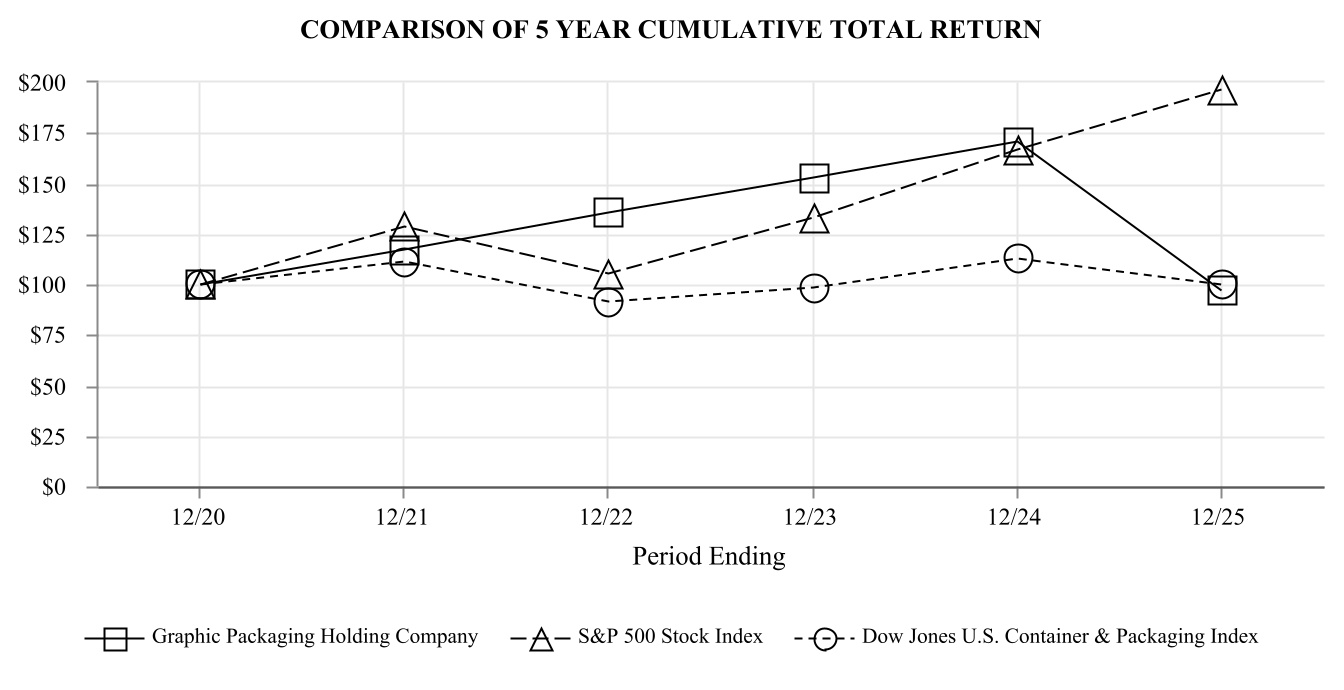
| 12/31/2020 | 12/31/2021 | 12/31/2022 | 12/31/2023 | 12/31/2024 | 12/31/2025 | ||||||||||||||||||||||||||||||
Graphic Packaging Holding Company | $ | 100.00 | $ | 116.98 | $ | 135.54 | $ | 152.63 | $ | 170.55 | $ | 96.66 | |||||||||||||||||||||||
S&P 500 Stock Index | 100.00 | 128.71 | 105.40 | 133.10 | 166.40 | 196.16 | |||||||||||||||||||||||||||||
Dow Jones U.S. Container & Packaging Index | 100.00 | 110.96 | 91.21 | 98.16 | 112.83 | 99.86 | |||||||||||||||||||||||||||||
Item 6. [Reserved]
19
Item 7. Management's Discussion and Analysis of Financial Condition and Results of Operation
Introduction
This management's discussion and analysis of financial conditions and results of operations is intended to assist you in understanding the Company's past performance, financial condition and prospects. A detailed discussion of fiscal 2025 year-over-year changes can be found below and a detailed discussion of fiscal 2024 year-over-year changes can be found in Item 7. Management's Discussion and Analysis of Financial Condition and Results of Operations in the Company's Annual Report on Form 10-K for the fiscal year ended December 31, 2024.
Overview of Business
Graphic Packaging is a leading global provider of consumer goods packaging made from renewable or recycled materials. The Company designs and manufactures sustainable packaging solutions including cartons, multipack cartons, trays, carriers and paperboard canisters, as well as cups and bowls, made primarily from recycled paperboard, unbleached paperboard and bleached paperboard. Paperboard used in its packaging solutions comes from wood fiber, a renewable resource, and from recovered (reused) fiber. Graphic Packaging's consumer packaging is designed to be recycled, and the Company works across the value chain to make it easier for people to recycle. With this focus, the Company plays an active role in support of the move to a more circular economy and a sustainable future for generations to come. Graphic Packaging's commitment to reducing the environmental impact of everyday consumer packaging is fundamental to the Company's strategy, goals and business purpose.
The Company serves a wide variety of consumer markets, from food and beverage, to foodservice, household products, beauty and heath care. Graphic Packaging produces packaging solutions at over 100 locations in 20 countries around the world, serving customers and brands ranging from local to multinational consumer products companies and retailers. The Company offers one of the most comprehensive ranges of packaging design, manufacturing and execution capabilities available. Graphic Packaging manufactures a significant amount of the paperboard that it uses to produce packaging solutions, primarily where it believes that self-manufacture provides it with a competitive advantage and allows the Company to deliver better, more consistent results for customers. The Company currently manufactures most of the paperboard it consumes in the Americas and purchases the majority of the paperboard it consumes in its International Paperboard Packaging operations from third parties.
Graphic Packaging works closely with its customers to understand their needs and goals and to create new and innovative designs customized to their specific needs. The Company's approach serves to build and strengthen long-term relationships with purchasing, brand management, marketing and other key customer functions. The Company is organized to bring the full resources of its global and local innovation, design and manufacturing capabilities to all of its customers with the goal of delivering packaging solutions that are more circular, more functional and more convenient.
The Company competes with a wide range of packaging companies whose primary raw materials are paperboard, plastic, multi-layer laminates, shrink film, paper, corrugated board, bio-based materials and other packaging materials. While circularity and sustainability are increasingly important to customers' purchase decisions, the Company also competes on the basis of product innovation, price and execution capabilities. Many of the Company's multi-year supply contracts include terms which provide for the pass through of certain costs including raw materials, energy, labor and other manufacturing costs with the intention of reducing exposure to the volatility of these costs, many of which are outside of the Company's control.
The Company is implementing strategies to (i) develop and market innovative packaging products and applications that benefit from consumer-led sustainability trends; (ii) expand market share in its current markets and to identify and penetrate new markets; (iii) capitalize on the Company's customer relationships, business competencies and manufacturing facilities; and (iv) continue to reduce costs and drive productivity through operational improvements. The Company's ability to fully implement its strategies and achieve its objectives may be influenced by a variety of factors, many of which are beyond its control. Graphic Packaging cannot predict with any certainty the impact that rising interest rates, a global or regional recession or higher inflation may have on its customers or suppliers. Additionally, it is unable to predict the potential effects that any future pandemic or other global health emergency, widespread military and geopolitical conflicts, or other social and political unrest or change, including in Eastern Europe, Africa and the Middle East and related sanctions or market disruptions, may have on its business.
20
Acquisitions and Dispositions
•In May 2025, the Company closed its Middletown, Ohio, recycled paperboard manufacturing facility.
•In December 2025, the Company closed its East Angus, Québec, recycled paperboard manufacturing facility.
•In May 2024, the Company completed the sale of its Augusta, Georgia bleached paperboard manufacturing facility (the "Augusta Divestiture") to Clearwater Paper Corporation for a total consideration of $711 million.
•During 2024 and 2023, the Company decided to close multiple packaging facilities. Production from these facilities has been consolidated into other existing packaging facilities. Current Assets on the Consolidated Balance Sheet include $8 million and $15 million relating to multiple paperboard manufacturing and packaging facilities that met the held for sale criteria as of December 31, 2025 and 2024, respectively.
•In January 2023, the Company completed the acquisition of Tama Paperboard, LLC ("Tama"), a recycled paperboard manufacturing facility located in Tama, Iowa, from Greif Packaging LLC for approximately $100 million. Tama is reported within Corporate and Other. Subsequently, in the second quarter of 2023, the Company closed this facility.
•In September 2023, the Company completed the acquisition of Bell Incorporated ("Bell"), adding three packaging facilities in Sioux Falls, South Dakota and Groveport, Ohio for $262 million. Bell is reported within the Americas Paperboard Packaging reportable segment.
•During the third quarter of 2023, the Company decided to discontinue the project in Texarkana to modify an existing paperboard machine to add swing capacity between bleached and unbleached paperboard in order to focus growth investments in the strategic expansion of recycled paperboard capacity.
•During the third quarter of 2023, the Company announced its decision to permanently decommission the K3 recycled paperboard machine in Kalamazoo, Michigan as part of its recycled paperboard network optimization plan that the Company initiated in 2019. As of December 31, 2024, the Company has completed the decommissioning of the K3 recycled paperboard machine.
•During the fourth quarter of 2023, the Company completed the sale of its two packaging facilities in Russia for total consideration of $67 million. The Company incurred $10 million of impairment losses associated with these facilities, which is included in the Business Combinations, Exit Activities and Other Special Items, Net line in the Consolidated Statement of Operations.
Results of Operations
| Year Ended December 31, | |||||||||||
| In millions | 2025 | 2024 | 2023 | ||||||||
Net Sales | $ | 8,617 | $ | 8,807 | $ | 9,428 | |||||
| Income from Operations | 804 | 1,119 | 1,174 | ||||||||
| Nonoperating Pension and Postretirement Benefit Expense | (2) | (3) | (3) | ||||||||
Interest Expense, Net | (220) | (230) | (239) | ||||||||
| Income before Income Taxes and Equity Income of Unconsolidated Entity | 582 | 886 | 932 | ||||||||
| Income Tax Expense | (139) | (229) | (210) | ||||||||
| Income before Equity Income of Unconsolidated Entity | 443 | 657 | 722 | ||||||||
| Equity Income of Unconsolidated Entity | 1 | 1 | 1 | ||||||||
| Net Income | $ | 444 | $ | 658 | $ | 723 | |||||
21
2025 Compared to 2024
Net Sales
The components of the change in Net Sales are as follows:
| Year Ended December 31, | |||||||||||||||||||||||
| Variances | |||||||||||||||||||||||
| In millions | 2024 | Price/ Volume/ Mix | M&A | Exchange | 2025 | Decrease | Percent Change | ||||||||||||||||
Consolidated | 8,807 | $ | (103) | $ | (144) | $ | 57 | $ | 8,617 | (190) | (2) | % | |||||||||||
The Company's Net Sales in 2025 decreased by $190 million or (2)%, to $8,617 million from $8,807 million for the same period in 2024 due to the Augusta divestiture in 2024, and reduced open market paperboard volumes and pricing of bleached paperboard and lower pricing, partially offset by favorable foreign currency exchange of $57 million. Packaging volumes were flat. Innovation sales growth was $213 million, driven by conversions to the Company's sustainable consumer packaging solutions. There were higher packaging sales in the health and beauty market, while packaging sales in the food, beverage, foodservice and household markets were relatively flat.
Income from Operations
Income from Operations for 2025 decreased $315 million or (28)%, to $804 million from $1,119 million for the same period in 2024, due to lower packaging price and volume-related decreases, the Augusta Divestiture in 2024 (which included a gain of $75 million) and related bleached paperboard price and volume declines ($30 million), commodity inflation (including logistics, energy, and purchased materials, partially offset by secondary fiber) of $47 million and other inflation (primarily labor and benefits) of $106 million, partially offset by savings from continuous improvement and other programs and productivity improvements and a $10 million favorable foreign currency exchange. Income from Operations was also favorably impacted by a reduction in accelerated depreciation of $9 million related to the closures of several packaging and paperboard manufacturing facilities (refer to Note 18. Exit Activities in the Notes to Consolidated Financial Statements for additional information), and by the weather and power issues in 2024 that did not recur in 2025. Excluding the gain from the Augusta Divestiture in 2024, Income from Operations was favorably impacted by a reduction in charges for Business Combinations, Exit Activities and Other Special Items of $39 million. See Note 1. Business Combinations, Exit Activities and Other Special Items, Net in the Notes to Consolidated Financial Statements.
Interest Expense, Net
Interest Expense, Net was $220 million and $230 million in 2025 and 2024, respectively. Interest Expense, Net decreased primarily due to an increase in capitalized interest primarily due to the Waco project. The Company capitalized interest of $52 million and $34 million in 2025 and 2024, respectively. As of December 31, 2025, approximately 28% of the Company's total debt was subject to floating interest rates.
Income Tax Expense
During 2025 and 2024, the Company recognized Income Tax Expense of $139 million and $229 million, respectively, on Income before Income Taxes of $582 million and $886 million, respectively.
The effective tax rate for 2025 is different from the statutory rate primarily due to the impact of state taxes and non-deductible expenses, as well as tax benefits of $8 million related to U.S. federal income tax credits.
The effective tax rate for 2024 was different from the statutory rate primarily due to the write off of non-deductible book goodwill associated with the Augusta divestiture as well as tax benefits of $16 million related to U.S. federal, state and foreign income tax credits, including purchased tax credits.
Equity Income of Unconsolidated Entity
Equity Income of Unconsolidated Entity was $1 million in 2025 and less than $1 million in 2024 and is related to the Company's equity investment in the Rengo Riverwood Packaging, Ltd. joint venture.
22
Segment Reporting
During the first quarter of 2025, the Company realigned its financial reporting structure under two reportable segments, Americas Paperboard Packaging and International Paperboard Packaging. This structure aligns with how the Chief Operating Decision Maker ("CODM") measures segment operating results, allocates resources among the segments and assesses segment performance.
The Company's reportable segments are described as follows:
Americas Paperboard Packaging includes paperboard packaging sold primarily to consumer packaged goods ("CPG") companies serving the food, beverage and consumer product markets and cups, lids and food containers sold primarily to foodservice companies and quick-service restaurants in the Americas.
International Paperboard Packaging includes paperboard packaging sold primarily to CPG companies serving the food, beverage and consumer product markets, including healthcare and beauty, primarily in Europe.
The Company allocates internally sourced paperboard margin and corporate costs to the reportable segments to appropriately represent the economics of these segments. The Corporate and Other caption, which does not meet the criteria of a reportable segment, includes the unallocated corporate costs and the Paperboard Manufacturing operating segment. The effect of intercompany transfers to the paperboard packaging segments has been eliminated from the Corporate and Other caption to reflect the economics of the integration of these segments.
The Company's CODM evaluates each segment based primarily on Income from Operations. The accounting policies of the reportable segments are the same as those described in Note 1. Nature of Business and Summary of Significant Accounting Policies in the Notes to Consolidated Financial Statements.
| Year Ended December 31, | |||||||||||
| In millions | 2025 | 2024 | 2023 | ||||||||
Net Sales: | |||||||||||
| Americas Paperboard Packaging | $ | 5,889 | $ | 6,101 | $ | 6,200 | |||||
| International Paperboard Packaging | 2,208 | 2,130 | 2,280 | ||||||||
Corporate/Other/Eliminations(a) | 520 | 576 | 948 | ||||||||
| Total | $ | 8,617 | $ | 8,807 | $ | 9,428 | |||||
Income (Loss) from Operations: | |||||||||||
Americas Paperboard Packaging(b)(c) | $ | 818 | $ | 1,072 | $ | 1,088 | |||||
International Paperboard Packaging(c)(d)(e) | 139 | 174 | 193 | ||||||||
Corporate and Other(b)(c)(f) | (153) | (127) | (107) | ||||||||
Total | $ | 804 | $ | 1,119 | $ | 1,174 | |||||
(a) Includes revenue from the sale of paperboard to third parties.
(b) Includes accelerated depreciation related to exit activities in 2025, 2024 and 2023. See Note 18. Exit Activities in the Notes to Consolidated Financial Statements for further information.
(c) Includes expenses related to business combinations, exit activities and other special items in 2025, 2024 and 2023. See Note 1. Business Combinations, Exit Activities and Other Special Items, Net in the Notes to Consolidated Financial Statements for further information.
(d) Includes impairment charges related to Russia in 2023. See Note 19. Divestitures in the Notes to Consolidated Financial Statements for further information.
(e) Includes accelerated depreciation related to exit activities in 2024. See Note 18. Exit Activities in the Notes to Consolidated Financial Statements for further information.
(f) Includes gain from Augusta Divestiture in 2024. See Note 19. Divestitures in the Notes to Consolidated Financial Statements for further information.
23
2025 Compared to 2024
Americas Paperboard Packaging
Net Sales decreased due to lower pricing, lower packaging volumes and unfavorable foreign currency exchange, partially offset by innovation sales growth driven by conversions to the Company's sustainable consumer packaging solutions. Packaging sales were lower in the food, beverage and household markets, while packaging sales in the foodservice market were relatively flat.
Income from Operations decreased due to lower pricing, lower packaging volumes and higher commodity cost and other inflation (primarily labor and benefits), partially offset by net performance, including cost savings from continuous improvement and other programs and productivity improvements. Income from Operations was also favorably impacted by reductions in accelerated depreciation and charges related to the closures of several packaging facilities (refer to Note 18. Exit Activities in the Notes to Consolidated Financial Statements for additional information) and by the weather and power issues in 2024 that did not recur in 2025.
International Paperboard Packaging
Net Sales increased due to innovation sales growth driven by conversions to the Company's sustainable consumer packaging solutions, higher packaging volumes and favorable foreign currency exchange, partially offset by lower pricing and mix. Packaging sales were higher in the food, foodservice, household, health and beauty and beverage markets.
Income from Operations decreased due to lower pricing and commodity inflation and other inflation (primarily labor and benefits), partially offset by higher packaging volumes and cost savings from continuous improvement and other programs, including benefits from capital projects and productivity improvements. The impact of foreign currency exchange was relatively flat.
Financial Condition, Liquidity and Capital Resources
The Company broadly defines liquidity as its ability to generate sufficient funds from both internal and external sources to meet its obligations and commitments. In addition, liquidity includes the ability to obtain appropriate debt and equity financing and to convert those assets that are no longer required to meet existing strategic and financial objectives into cash. Therefore, liquidity cannot be considered separately from capital resources that consist of current or potentially available funds for use in achieving long-range business objectives and meeting debt service commitments.
Cash Flows
| Years Ended December 31, | ||||||||
| In millions | 2025 | 2024 | ||||||
Net Cash Provided by Operating Activities | $ | 841 | $ | 840 | ||||
Net Cash Used in Investing Activities | (732) | (342) | ||||||
| Net Cash Used in Financing Activities | (18) | (489) | ||||||
Net cash provided by operating activities in 2025 totaled $841 million, compared to $840 million in 2024. The increase was primarily due to a decrease in payments for income taxes, partially offset by the decrease in income from operations in 2025 as compared to 2024. Pension contributions in 2025 and 2024 were $11 million and $12 million, respectively.
Net cash used in investing activities in 2025 totaled $732 million, compared to $342 million in 2024. The Company had capital spending of $922 million ($803 million was capitalized of which $737 million was for adding capacity and improving process capabilities, $32 million for capital spares and $34 million for manufacturing packaging machinery) and $1,203 million ($1,256 million was capitalized) in 2025 and 2024, respectively. The elevated levels of capital spending were driven by the construction of the Company's new recycled paperboard manufacturing facility in Waco, Texas. For more information on the construction of the new recycled paperboard manufacturing facility in Waco, Texas, and continued investments made as part of the integration of acquisitions, see Note 18. Exit Activities in the Notes to Consolidated Financial Statements. Net cash receipts related to the accounts receivable securitization and sale programs were $171 million and $152 million in 2025 and 2024, respectively. In the prior year the Company completed the Augusta Divestiture for total cash consideration of $711 million. For further discussion of the Augusta Divestiture, see Note 19. Divestitures in the Notes to Consolidated Financial Statements.
24
Net cash used in financing activities in 2025 totaled $18 million compared to $489 million in 2024. Current year financing activities included the Company completing a $100 million tax-exempt green bond transaction on May 29, 2025 through Mission Economic Development Corporation's Private Activity Bond Program (the "Green Bonds"). The net proceeds of $99 million were used to fund a portion of the construction of the Company's new recycled paperboard manufacturing facility in Waco, Texas. For more information on the Green Bonds, see Note 5. Debt in the Notes to Consolidated Financial Statements. Current year activities also include borrowings under revolving credit facilities primarily for capital spending, repurchase of common stock of $150 million and payments on debt of $14 million. The Company also paid dividends of $128 million and withheld $34 million of restricted stock units to satisfy tax withholding obligations related to the payout of restricted stock units. Prior year financing activities included a debt drawing of the new incremental term facilities which consist of a $50 million Incremental Term A-5 Facility, a $200 million Incremental Term A-6 Facility, an offering of $500 million aggregate principal amount of 6.375% Senior Unsecured Notes due 2032. The net proceeds were used by the Company to repay a portion of the outstanding borrowings under its senior secured revolving credit facility. The Company also drew $400 million from the senior secured domestic revolving credit facilities and used the proceeds, together with cash on hand, to redeem it's 0.821% Senior Notes due in 2024. The Company also drew $300 million from the senior secured domestic revolving credit facilities on August 14, 2024 and used the proceeds to redeem its 4.125% Senior Notes due in 2024. For further discussion of the Company's newly acquired debt and redemptions, see Note 5. Debt in the Notes to Consolidated Financial Statements. Other prior year activities include borrowings under revolving credit facilities primarily for capital spending, repurchase of common stock of $200 million and payments on debt of $23 million. The Company also paid dividends of $122 million and withheld $25 million of restricted stock units to satisfy tax withholding obligations related to the payout of restricted stock units.
Supplemental Guarantor Financial Information
As discussed in Note 5. Debt in the Notes to Consolidated Financial Statements, the Senior Notes issued by Graphic Packaging International, LLC ("GPIL") are guaranteed by Graphic Packaging International Partners, LLC, a Delaware limited liability company and a wholly-owned subsidiary of the Company ("GPIP") and certain domestic subsidiaries (the "Subsidiary Guarantors"), which consist of all material 100% owned subsidiaries of GPIL other than its foreign subsidiaries and foreign subsidiary holding companies (collectively "the Guarantors"). GPIL's remaining subsidiaries (the "Nonguarantor Subsidiaries") include all of GPIL's foreign subsidiaries, foreign subsidiary holding companies and immaterial domestic subsidiaries. The Subsidiary Guarantors are jointly and severally, fully and unconditionally liable under the guarantees.
Because GPHC and GPIP have no independent assets or operations other than ownership of GPIL, the results of operations, assets and liabilities for GPHC and GPIL are substantially the same. The summarized financial information below is presented on a combined basis, consisting of the Issuer (GPIL) and Subsidiary Guarantors, and is presented after the elimination of: (i) intercompany transactions and balances among the Issuer and Subsidiary Guarantors, and (ii) equity in earnings from and investments in the Nonguarantor Subsidiaries.
| In millions | Year Ended December 31, 2025 | ||||
| Summarized Statements of Operations | |||||
Net Sales(a) | $ | 6,572 | |||
| Cost of Sales | 5,309 | ||||
| Income from Operations | 692 | ||||
| Net Income | 357 | ||||
(a) Includes Net Sales to Nonguarantor Subsidiaries of $631 million.
| In millions | December 31, 2025 | ||||
| Summarized Balance Sheet | |||||
| Current assets (excluding intercompany receivable from Nonguarantors) | $ | 1,569 | |||
| Noncurrent assets | 6,967 | ||||
| Intercompany receivables from Nonguarantors | 222 | ||||
| Current liabilities | 1,739 | ||||
| Noncurrent liabilities | 5,885 | ||||
25
Liquidity and Capital Resources
The Company expects its material cash requirements for the next twelve months will be for: capital spending, periodic required income tax payments, periodic interest and debt service payments on associated debt (refer to Note 5. Debt in the Notes to Consolidated Financial Statements for additional information), lease agreements which have fixed lease payment obligations (refer to Note 6. Leases in the Notes to Consolidated Financial Statements for additional information), and minimum purchase commitments (refer to Note 13. Commitments in the Notes to Consolidated Financial Statements for additional information) along with ongoing operating costs, working capital, share repurchases and dividend payments. The Company expects its primary sources of liquidity to be cash flows from sales and operating activities in the normal course of operations and availability from its revolving credit facilities, as needed. The Company expects that these sources will be sufficient to fund its ongoing cash requirements for the foreseeable future, including at least the next twelve months.
Principal and interest payments under the term loan facilities and the revolving credit facilities, together with principal and interest payments on the Company's 4.00% Green Bonds due 2026, 5.00% Green Bonds due 2030, 1.512% Senior Notes due 2026, 4.75% Senior Notes due 2027, 3.50% Senior Notes due 2028, 3.50% Senior Notes due 2029, 2.625% Senior Notes due 2029, 3.75% Senior Notes due 2030 and 6.375% Senior Notes due 2032 (the "Notes"), represent liquidity requirements for the Company. Based upon current levels of operations, anticipated cost savings and expectations as to future growth, the Company believes that cash generated from operations, together with amounts available under its revolving credit facilities and other available financing sources, will be adequate to permit the Company to meet its debt service obligations, necessary capital spending program requirements and ongoing operating costs and working capital needs, although no assurance can be given in this regard. The Company's future financial and operating performance, ability to service or refinance its debt and ability to comply with the covenants and restrictions contained in its debt agreements (see "Covenant Restrictions" below) will be subject to future economic conditions, including conditions in the credit markets, and to financial, business and other factors, many of which are beyond the Company's control, and will be substantially dependent on the selling prices and demand for the Company's products, raw material and energy costs, and the Company's ability to successfully implement its overall business and profitability strategies.
Accounts receivable are stated at the amount owed by the customer, net of an allowance for estimated uncollectible accounts, returns and allowances, and cash discounts. The allowance for doubtful accounts is estimated based on historical experience, current economic conditions, reasonable and supportable forecasts of future economic conditions and the creditworthiness of customers. Receivables are charged to the allowance when determined to be no longer collectible.
The Company engages with third-party financial institutions to sell certain trade accounts receivable from customers. Transfers under these agreements meet the requirements to be accounted for as sales of receivables in accordance with the Transfers and Servicing topic of the Financial Accounting Standards Board ("FASB") Accounting Standards Codification (the "Codification"). The receivables sold are reflected as a reduction of accounts receivable on the Consolidated Balance Sheets at the time of sale. The corresponding proceeds are reflected in Cash Flows from Operating Activities within the Consolidated Statements of Cash Flows. Receivables related to the Company's European program are sold in exchange for cash and a Beneficial Interest, therefore, a portion of the proceeds are reflected as "Beneficial Interest on Sold Receivables" and "Beneficial Interest Obtained in Exchange for Proceeds" in Cash Flows from Investing Activities within the Consolidated Statements of Cash Flows. The loss on sale for all programs is included in Other Expense, Net in the Consolidated Statements of Operations. The following table summarizes the activity under these programs for the years ended December 31, 2025 and 2024:
| Year Ended December 31, | ||||||||
| In millions | 2025 | 2024 | ||||||
| Receivables Sold and Derecognized | $ | 3,606 | $ | 3,572 | ||||
| Proceeds Collected on Behalf of Financial Institutions | 3,572 | 3,562 | ||||||
| Net Proceeds Received from Financial Institutions | 24 | 15 | ||||||
Deferred Purchase Price at December 31(a) | 1 | 5 | ||||||
| Pledged Receivables at December 31 | 121 | 131 | ||||||
(a) Included in Other Current Assets on the Consolidated Balance Sheets and represents a beneficial interest in the receivables sold to the financial institutions, which is a Level 3 fair value measure.
Receivables sold under all programs subject to continuing involvement, which consists principally of collection services, were $814 million and $778 million as of December 31, 2025 and 2024, respectively.
The Company also participates in supply chain financing arrangements offered by certain customers that qualify for sale accounting in accordance with the Transfers and Servicing topic of the FASB Codification. As of December 31, 2025 and 2024, the Company sold receivables of $1,138 million and $1,104 million, respectively, related to these arrangements.
The fees associated with the sale of receivables for all programs were $57 million and $64 million as of December 31, 2025 and 2024, respectively, and are included in Other Expense, Net in the Consolidated Statements of Operations.
26
The Company has arranged a supplier finance program ("SFP") with a financial intermediary, which provides certain suppliers the option to be paid by the financial intermediary earlier than the due date on the applicable invoice. The transactions are at the sole discretion of both the suppliers and financial institution, and the Company is not a party to the agreements and has no economic interest in the supplier's decision to sell a receivable. The range of payment terms negotiated by the Company with its suppliers is consistent, irrespective of whether a supplier participates in the program. The agreement with the financial intermediary does not require the Company to provide assets pledged as security or other forms of guarantees for the SFP. Amounts due to the Company's suppliers that elected to participate in the SFP are included in Accounts Payable on the Company's Consolidated Balance Sheets and payments made under the SFP are reflected in Cash Flows from Operating Activities in the Consolidated Statements of Cash Flows.
The activity of the Company's outstanding obligations confirmed as valid under its SFP for the years ended December 31, 2025 and 2024, is as follows:
| Year Ended December 31, | ||||||||
| In millions | 2025 | 2024 | ||||||
| Confirmed Obligations Outstanding at the Beginning of the Year | $ | 30 | $ | 30 | ||||
| Invoices Confirmed During the Year | 105 | 108 | ||||||
| Confirmed Invoices Paid During the Year | (108) | (108) | ||||||
| Confirmed Obligations Outstanding at the End of the Year | $ | 27 | $ | 30 | ||||
Non-cash additions to Property, Plant and Equipment, Net included within Accounts Payable on the Company's Consolidated Balance Sheets were $79 million, $198 million and $145 million as of December 31, 2025, 2024 and 2023, respectively.
Covenant Restrictions
Covenants contained in the Company's Fifth Amended and Restated Credit Agreement (the "Current Credit Agreement") and the Indentures may, among other things, limit the Company's ability to incur additional indebtedness, dispose of assets, incur guarantee obligations, prepay other indebtedness, repurchase shares, pay dividends and make other restricted payments, create liens, make equity or debt investments, make acquisitions, modify terms of the Indentures under which the Notes are issued, engage in mergers or consolidations, change the business conducted by the Company and its subsidiaries, and engage in certain transactions with affiliates. Such restrictions, as well as disruptions in the credit markets, could limit the Company's ability to respond to changing market conditions, fund its capital spending program, provide for unexpected capital investments or take advantage of business opportunities.
Under the terms of the Current Credit Agreement, the Company must comply with a maximum Consolidated Total Leverage Ratio covenant and a minimum Consolidated Interest Expense Ratio covenant. The Current Credit Agreement requires that the Company maintain a maximum Consolidated Total Leverage Ratio of less than 4.25 to 1.00. At December 31, 2025, the Company was in compliance with such covenant and the ratio was 3.63 to 1.00. The Company must also comply with a minimum Consolidated Interest Expense Ratio of 3.00 to 1.00. At December 31, 2025, the Company was in compliance with such covenant and the ratio was 6.33 to 1.00.
On February 26, 2026, the Current Credit Agreement was amended to increase the maximum Consolidated Total Leverage Ratio from March 31, 2026 to December 31, 2026 to 5.00 to 1.00 and from March 31, 2027 to June 30, 2027 to 4.75 to 1.00. The Amendment also incorporates an additional pricing tier when the Consolidated Total Leverage Ratio is greater than or equal to 4.75 to 1.00; limits share repurchases to $65 million on an annual basis; and places additional restrictions on acquisitions and investments in non-guarantor subsidiaries during the period commencing on February 26, 2026 and ending on September 30, 2027.
As of December 31, 2025, the Company's credit was rated BB+ by Standard & Poor's and Ba1 by Moody's Investor Services. Standard & Poor's and Moody's Investor Services' ratings on the Company included a stable outlook.
Environmental Matters
Some of the Company's current and former facilities are the subject of environmental investigations and remediations resulting from historical operations and the release of hazardous substances or other constituents. Some current and former facilities have a history of industrial usage for which investigation and remediation obligations may be imposed in the future or for which indemnification claims may be asserted against the Company. Also, closures or sales of facilities may necessitate further investigation and may result in remediation at those facilities. The Company has established reserves for those facilities or issues where liability is probable and the costs are reasonably estimable. The Company believes that the amounts accrued for its loss contingencies, and the reasonably possible loss beyond the amounts accrued, are not material to the Company's consolidated financial position, results of operations or cash flows.
For further discussion of the Company's environmental matters, see Note 14. Environmental and Legal Matters in the Notes to Consolidated Financial Statements.
27
International Operations
The Company has packaging facilities in 20 countries outside of the U.S. and sells its products worldwide. For 2025, before intercompany eliminations, net sales from operations outside of the U.S. represented approximately 31% of the Company's net sales. The Company's revenues from export sales fluctuate with changes in foreign currency exchange rates. In addition, at December 31, 2025, approximately 27% of the Company's total assets were denominated in currencies other than the U.S. dollar. The Company has significant operations in countries that use the Euro, British pound sterling, Swedish krona, Polish zloty, the Australian dollar, the Canadian dollar, the Mexican peso or the Japanese yen as their functional currencies. The effect of changes in the U.S. dollar exchange rate against these currencies produced a net currency translation adjustment gain of $196 million, which was recorded in Other Comprehensive Income (Loss) for the year ended December 31, 2025. The magnitude and direction of this adjustment in the future depends on the relationship of the U.S. dollar to other currencies. The Company pursues a currency hedging program in order to reduce the impact of foreign currency exchange fluctuations on financial results. See Financial Instruments below.
Financial Instruments
The Company pursues a currency hedging program which utilizes derivatives to reduce the impact of foreign currency exchange fluctuations on its consolidated financial results. Under this program, the Company has previously entered into forward exchange contracts in the normal course of business to hedge certain foreign currency denominated transactions. Realized and unrealized gains and losses on these forward contracts are included in the measurement of the basis of the related foreign currency transaction when recorded. The Company also pursues a hedging program that utilizes derivatives designed to manage risks associated with future variability in cash flows and price risk related to future energy cost increases. Under this program, the Company has entered into natural gas swap contracts to hedge a portion of its forecasted natural gas usage for 2025. Realized gains and losses on these contracts are included in the financial results concurrently with the recognition of the commodity consumed. In addition, the Company has used interest rate swaps to manage interest rate risks on future interest payments caused by interest rate changes on its variable rate term loan facility. The Company does not hold or issue financial instruments for trading purposes. See Item 7A, Quantitative and Qualitative Disclosure About Market Risk for additional information.
Off-Balance Sheet Arrangements
The Company had $38 million of standby letters of credit issued under a separate unsecured facility as of December 31, 2025 as disclosed in Note 5. Debt in the Notes to Consolidated Financial Statements. The Company does not have any other off-balance sheet arrangements.
Critical Accounting Judgment and Estimates
The preparation of financial statements in conformity with accounting principles generally accepted in the United States ("U.S. GAAP") requires management to make estimates and assumptions that affect the reported amounts of assets and liabilities at the date of the financial statements and the reported amounts of net sales and expenses during the reporting period. Actual results could differ from these estimates, and changes in these estimates are recorded when known. The critical accounting policies used by management in the preparation of the Company's consolidated financial statements are those that are important both to the presentation of the Company's financial condition and results of operations and require significant judgments by management with regard to estimates used. The critical judgments by management relate to future cash flows associated with impairment testing for goodwill and long-lived assets, and deferred income taxes.
Goodwill
The Company evaluates goodwill for impairment annually as of October 1, as well as whenever events or changes in circumstances suggest that the fair value of a reporting unit may no longer exceed its carrying amount. As of October 1, 2025, the Company had five reporting units, four of which had goodwill.
The Company may perform a qualitative impairment analysis of goodwill associated with each of its reporting units to determine if it is more likely than not that the carrying value of a reporting unit exceeded its fair value. The Company performed a quantitative impairment test as of October 1, 2025 for each of its reporting units. The impairment evaluation of goodwill is measured at the reporting unit level by comparing the reporting unit's carrying amount, including goodwill, to the estimated fair value of the reporting unit. The estimated fair value of each reporting unit is determined by utilizing a cash flow analysis based on the Company's forecasts, discounted using a weighted-average cost of capital and market indicators of terminal year cash flows based upon a multiple of earnings before interest, taxes, depreciation and amortization ("EBITDA"). If the carrying amount of a reporting unit exceeds its estimated fair value, goodwill is considered impaired.
In determining fair value, management considers a number of factors in developing our forecasts of future cash flows, including but not limited to, projections of revenues and EBITDA margins, changes in working capital, capital expenditures and discount rates, and market data and analysis, including EBITDA exit multiples. These assumptions used are based on what a hypothetical market participant would use in estimating fair value. Fair value determinations are sensitive to changes in the factors described above. There are inherent uncertainties related to these factors and judgments used to estimate the reporting unit fair value and the related analysis of potential goodwill impairment.
28
The variability of the assumptions that management uses to perform the goodwill impairment test depends on a number of conditions, including uncertainty about future events and cash flows. Accordingly, the Company's accounting estimates may materially change from period to period due to changing market factors. Due to a decrease in our stock price and market capitalization in 2025, the estimated fair values of our reporting units have also decreased compared to prior year. If the Company had used other assumptions and estimates or if different conditions occur in future periods, future operating results and cash flows could be materially impacted, and judgments and conclusions about the recoverability of goodwill could change. The assumptions used in the goodwill impairment testing process could also be adversely impacted by certain of the risks discussed in Item 1A. Risk Factors and thus could result in future goodwill impairment charges.
As a result of its annual quantitative impairment test, the Company concluded that all reporting units with goodwill have a fair value that exceeded their carrying value, and thus goodwill was not impaired. The Company had goodwill totaling $2,065 million as of December 31, 2025, of which $939 million, $84 million, $497 million and $545 million is related to the Americas, Foodservice, Paperboard Manufacturing and International reporting units, respectively. Excess fair value over carrying value was approximately 2% for the International reporting unit and 18% for the Foodservice reporting unit. No other reporting units had excess fair value over carrying value below 20%. The discount rate used for each reporting unit was 8% and the Company utilized EBITDA multiples ranging from 6.0 to 9.0 times to calculate terminal period cash flows.
A material change in the fair value or carrying value of our International, Foodservice or Paperboard Manufacturing reporting units may result in impairment of the reporting units. For example, our ability to achieve our projected revenues and targeted EBITDA margins are key assumptions in our estimated future cash flows. If our actual experience in future years falls significantly below our current projections, the fair value of the reporting units could be negatively impacted. Similarly, an increase in interest rates would lower our discounted cash flows and negatively impact the fair value of the reporting units. A decline in the market price of our common stock, resulting in a decrease in our market capitalization may indicate a decline in the fair value of individual reporting units. We believe our projections and assumptions are reasonable based on current market conditions, past performance and other factors but it is possible they could change, impacting our fair value estimate, or the carrying value could change.
If we had changed the assumptions used to estimate the fair value of our International and Foodservice reporting units, which have carrying values of $2,127 million and $877 million, respectively, the impact of these isolated changes, which are reasonably possible to occur, would have led to the following fair value exceeding or being (below) the fair value of these reporting units:
| Discount Rate | EBITDA Exit Multiple | EBITDA Margin | ||||||||||||||||||
| 100-Basis-Points | 1.0x | 100-Basis-Points | ||||||||||||||||||
| Increase | Decrease | Increase | Decrease | Increase | Decrease | |||||||||||||||
| International Reporting Unit: | ||||||||||||||||||||
| % by which fair value exceeds/(below) carrying amount | (1) | % | 5 | % | 12 | % | (7) | % | 12 | % | (7) | % | ||||||||
| Foodservice Reporting Unit: | ||||||||||||||||||||
| % by which fair value exceeds carrying amount | 15 | % | 21 | % | 30 | % | 6 | % | 30 | % | 5 | % | ||||||||
Recovery of Long-Lived Assets
The Company evaluates the recovery of its long-lived assets by analyzing operating results and considering significant events or changes in the business environment that may have triggered impairment. The Company reviews long-lived assets (including property, plant and equipment and intangible assets) for impairment whenever events or changes in circumstances indicate that the carrying amount of such long-lived assets may not be fully recoverable by undiscounted cash flows. Measurement of the impairment loss, if any, is based on the fair value of the asset, which is determined by an income, cost or market approach.
Deferred Income Taxes and Potential Assessments
According to the Income Taxes topic of the FASB Codification, a valuation allowance is required to be established or maintained when, based on currently available information and other factors, it is more likely than not that all or a portion of a deferred tax asset will not be realized. The FASB Codification provides important factors in determining whether a deferred tax asset will be realized, including whether there has been sufficient taxable income in recent years and whether sufficient income can reasonably be expected in future years in order to utilize the deferred tax asset. The Company has evaluated the need to maintain a valuation allowance for deferred tax assets based on its assessment of whether it is more likely than not that deferred tax benefits would be realized through the generation of future taxable income. Appropriate consideration was given to all available evidence, both positive and negative, in assessing the need for a valuation allowance. In determining whether a valuation allowance is required, many factors are considered, including the specific taxing jurisdiction, the carryforward period, reversals of existing taxable temporary differences, cumulative pre-tax book earnings, income tax strategies and forecasted earnings for the entities in each jurisdiction.
29
As of December 31, 2025, the Company has a valuation allowance of $62 million against its net deferred tax assets in certain foreign jurisdictions and against domestic deferred tax assets related to certain federal and state tax credit carryforwards. As of December 31, 2024, a total valuation allowance of $45 million was recorded.
As of December 31, 2025, the Company has provided for deferred U.S. income taxes attributable to future withholding tax expense related to the Company's equity investment in the joint venture, Rengo Riverwood Packaging, Ltd. In addition, the Company provides deferred income taxes for future Canadian withholding tax to the extent of excess cash available for distribution after consideration of working capital needs and other debt settlement of its Canadian subsidiary, Graphic Packaging International Canada, ULC. The Company continues to assert that it is permanently reinvested in the cumulative earnings of its Canadian subsidiary in excess of the amount of cash that is on hand and available for distribution after consideration of working capital needs and other debt settlement. The Company determined that no deferred tax liability should be recorded related to the outside basis difference of its Canadian subsidiary as of December 31, 2025.
The Company has not provided for deferred U.S. income taxes on outside basis differences in its other international subsidiaries because of the Company's intention to indefinitely reinvest its earnings outside the U.S. The determination of the amount of the unrecognized deferred income tax liability (primarily withholding tax in certain jurisdictions) on the unremitted earnings or any other associated outside basis differences is not practicable because of the complexities associated with the calculation.
The Company has elected to recognize global intangible low-taxed income ("GILTI") as a period cost as incurred, therefore there are no deferred taxes recognized for basis differences that are expected to impact the amount of the GILTI inclusion upon reversal.
New Accounting Standards
For a discussion of recent accounting pronouncements impacting the Company, see Note 1. Nature of Business and Summary of Significant Accounting Policies in the Notes to Consolidated Financial Statements.
30
Item 7A. Quantitative and Qualitative Disclosures About Market Risk
The Company does not trade or use derivative instruments with the objective of earning financial gains on interest or currency rates, nor does it use leveraged instruments or instruments where there are no underlying exposures identified.
Interest Rates
The Company is exposed to changes in interest rates, primarily as a result of its short-term and long-term debt, which include both fixed and floating rate debt. The Company uses interest rate swaps to manage interest rate risks on future interest payments caused by interest rate changes on its variable rate term loan facilities. At December 31, 2025, the Company had active interest rate swap agreements with a notional amount of $500 million expiring in May 2027.
The table below sets forth interest rate sensitivity information related to the Company's debt.
| Long-Term Debt Principal Amount by Maturity-Average Interest Rate | ||||||||||||||||||||||||||
| Expected Maturity Date | ||||||||||||||||||||||||||
| In millions | 2026 | 2027 | 2028 | 2029 | 2030 | Thereafter | Total | Fair Value | ||||||||||||||||||
| Total Debt | ||||||||||||||||||||||||||
| Fixed Rate | $502 | $300 | $1,125 | $940 | $500 | $500 | $ | 3,867 | $ | 3,818 | ||||||||||||||||
| Average Interest Rate | 2.00% | 4.75% | 3.39% | 3.43% | 5.80% | 6.38% | ||||||||||||||||||||
| Variable Rate | $23 | $38 | $37 | $1,469 | $— | $— | $ | 1,567 | $ | 1,563 | ||||||||||||||||
| SOFR+ Spread | SOFR+ Spread | SOFR+ Spread | SOFR+ Spread | |||||||||||||||||||||||
Net Investment Hedge
On October 29, 2021 and November 19, 2021, the Company drew the full amount of the €210 million delayed draw term loan facility and completed a private offering of €290 million aggregate principal amount of the 2.625% senior unsecured notes due 2029, respectively. The Company designated this Euro-denominated debt as a non-derivative net investment hedge of a portion of its net investment in Euro functional currency denominated subsidiaries to offset currency fluctuations.
Foreign Exchange Rates
The Company also enters into forward exchange contracts to hedge certain other anticipated foreign currency transactions. The purpose of these contracts is to protect the Company from the risk that the eventual functional currency cash flows resulting from anticipated foreign currency transactions will be adversely affected by changes in exchange rates.
During the year ended December 31, 2025, there were no amounts reclassified to earnings in connection with forecasted transactions that were no longer considered probable of occurring and there was no amount of ineffectiveness related to changes in the fair value of foreign currency forward contracts. Additionally, there were no amounts excluded from the measure of effectiveness during the year ended December 31, 2025.
Foreign Exchange Rates Contractual Amount by Expected Maturity-Average Contractual Exchange Rate | |||||
| December 31, 2025 | |||||
| In millions | Contract Amount(a) | ||||
| Forward Exchange Agreements: | |||||
| Receive $US/Pay Euro | $ | 69 | |||
| Weighted-average contractual exchange rate | 1.2 | ||||
| Receive $US/Pay GBP | $ | 36 | |||
| Weighted-average contractual exchange rate | 1.3 | ||||
| Receive $US/Pay Yen | $ | 14 | |||
| Weighted-average contractual exchange rate | 153.6 | ||||
(a) The fair values of the forward exchange agreements were immaterial as of December 31, 2025.
31
Derivatives not Designated as Hedges
The Company enters into forward exchange contracts to effectively hedge substantially all receivables resulting from transactions denominated in foreign currencies. The purpose of these forward exchange contracts is to protect the Company from the risk that the eventual functional currency cash flows resulting from the collection of these receivables will be adversely affected by changes in exchange rates. At December 31, 2025, multiple foreign currency forward exchange contracts existed, with maturities ranging up to eight months. Those forward currency exchange contracts outstanding at December 31, 2025, when aggregated and measured in U.S. dollars at December 31, 2025 contractual rates, had net notional amounts totaling $155 million. The Company continuously monitors these forward exchange contracts and adjusts accordingly to minimize the exposure.
Natural Gas Contracts
The Company has hedged a portion of its expected natural gas usage for 2026. The carrying value and fair value of the natural gas swap contracts is a net liability of $5 million as of December 31, 2025. Such contracts are designated as cash flow hedges and are accounted for by deferring the quarterly change in fair value of the outstanding contracts in Accumulated Other Comprehensive Loss in Shareholders' Equity. The resulting gain or loss is reclassified into Cost of Sales concurrently with the recognition of the commodity consumed.
32
Item 8. Financial Statements and Supplementary Data
Index to Financial Statements
Graphic Packaging Holding Company | |||||
Report of Independent Registered Public Accounting Firm (PricewaterhouseCoopers LLP PCAOB ID No. | |||||
33
| Year Ended December 31, | |||||||||||
| In millions, except per share amounts | 2025 | 2024 | 2023 | ||||||||
Net Sales | $ | $ | $ | ||||||||
| Selling, General and Administrative | |||||||||||
| Other Expense, Net | |||||||||||
Business Combinations, Exit Activities and Other Special Items, Net | |||||||||||
| Income from Operations | |||||||||||
| Nonoperating Pension and Postretirement Benefit Expense | ( | ( | ( | ||||||||
Interest Expense, Net | ( | ( | ( | ||||||||
| Income before Income Taxes and Equity Income of Unconsolidated Entity | |||||||||||
| Income Tax Expense | ( | ( | ( | ||||||||
| Income before Equity Income of Unconsolidated Entity | |||||||||||
| Equity Income of Unconsolidated Entity | |||||||||||
| Net Income | $ | $ | $ | ||||||||
Net Income Per Share – Basic | $ | $ | $ | ||||||||
Net Income Per Share – Diluted | $ | $ | $ | ||||||||
The accompanying notes are an integral part of the consolidated financial statements.
34
| December 31, | |||||||||||
| In millions | 2025 | 2024 | 2023 | ||||||||
| Net Income | $ | $ | $ | ||||||||
| Other Comprehensive (Loss) Income, Net of Tax: | |||||||||||
| Derivative Instruments | ( | ||||||||||
| Pension and Postretirement Benefit Plans | ( | ||||||||||
| Currency Translation Adjustment | ( | ||||||||||
| Total Other Comprehensive Income (Loss), Net of Tax | ( | ||||||||||
| Total Comprehensive Income | $ | $ | $ | ||||||||
The accompanying notes are an integral part of the consolidated financial statements.
35
| December 31, | ||||||||
| In millions, except share and per share amounts | 2025 | 2024 | ||||||
Assets | ||||||||
Current Assets: | ||||||||
| Cash and Cash Equivalents | $ | $ | ||||||
| Receivables, Net | ||||||||
| Inventories, Net | ||||||||
Assets Held for Sale | ||||||||
| Other Current Assets | ||||||||
| Total Current Assets | ||||||||
| Property, Plant and Equipment, Net | ||||||||
| Goodwill | ||||||||
| Intangible Assets, Net | ||||||||
| Other Assets | ||||||||
Total Assets | $ | $ | ||||||
Liabilities | ||||||||
Current Liabilities: | ||||||||
Short-Term Debt and Current Portion of Long-Term Debt | $ | $ | ||||||
Accounts Payable | ||||||||
Compensation and Employee Benefits | ||||||||
Interest Payable | ||||||||
Other Accrued Liabilities | ||||||||
Total Current Liabilities | ||||||||
Long-Term Debt | ||||||||
Deferred Income Tax Liabilities | ||||||||
Accrued Pension and Postretirement Benefits | ||||||||
Other Noncurrent Liabilities | ||||||||
Commitments (Note 13) | ||||||||
Shareholders' Equity | ||||||||
Preferred Stock, par value $ | ||||||||
Common Stock, par value $ | ||||||||
Capital in Excess of Par Value | ||||||||
Retained Earnings | ||||||||
Accumulated Other Comprehensive Loss | ( | ( | ||||||
Total Graphic Packaging Holding Company Shareholders' Equity | ||||||||
Noncontrolling Interest | ||||||||
Total Equity | ||||||||
Total Liabilities and Shareholders' Equity | $ | $ | ||||||
The accompanying notes are an integral part of the consolidated financial statements.
36
| Common Stock | Capital in Excess of Par Value | (Accumulated Deficit) Retained Earnings | Accumulated Other Comprehensive (Loss) Income | Noncontrolling Interests | Total Equity | ||||||||||||||||||
| In millions, except share amounts | Shares | Amount | |||||||||||||||||||||
| Balances at December 31, 2022 | $ | $ | $ | $ | ( | $ | $ | ||||||||||||||||
| Net Income | — | — | — | — | — | ||||||||||||||||||
Other Comprehensive Income (Loss), Net of Tax: | |||||||||||||||||||||||
Derivative Instruments | — | — | — | — | — | ||||||||||||||||||
Pension and Postretirement Benefit Plans | — | — | — | — | ( | — | ( | ||||||||||||||||
Currency Translation Adjustment | — | — | — | — | |||||||||||||||||||
Repurchase of Common Stock | ( | — | ( | ( | — | — | ( | ||||||||||||||||
Dividends Declared | — | — | — | ( | — | — | ( | ||||||||||||||||
Recognition of Stock-Based Compensation | — | — | — | — | — | ||||||||||||||||||
| Issuance of Shares for Stock-Based Awards | — | — | — | — | — | ||||||||||||||||||
| Balances at December 31, 2023 | $ | $ | $ | $ | ( | $ | $ | ||||||||||||||||
| Net Income | — | — | — | — | — | ||||||||||||||||||
Other Comprehensive Income (Loss), Net of Tax: | |||||||||||||||||||||||
| Derivative Instruments | — | — | — | — | — | ||||||||||||||||||
| Currency Translation Adjustment | — | — | — | — | ( | ( | |||||||||||||||||
| Repurchase of Common Stock | ( | — | ( | ( | — | — | ( | ||||||||||||||||
Dividends Declared | — | — | — | ( | — | — | ( | ||||||||||||||||
Recognition of Stock-Based Compensation | — | — | — | — | — | ||||||||||||||||||
| Issuance of Shares for Stock-Based Awards | — | — | — | — | — | ||||||||||||||||||
| Balances at December 31, 2024 | $ | $ | $ | $ | ( | $ | $ | ||||||||||||||||
| Net Income | — | — | — | — | — | ||||||||||||||||||
Other Comprehensive Income (Loss), Net of Tax: | |||||||||||||||||||||||
| Derivative Instruments | — | — | — | — | ( | — | ( | ||||||||||||||||
| Pension and Postretirement Benefit Plans | — | — | — | — | — | ||||||||||||||||||
| Currency Translation Adjustment | — | — | — | — | — | ||||||||||||||||||
| Repurchase of Common Stock | ( | — | ( | ( | — | — | ( | ||||||||||||||||
Dividends Declared | — | — | — | ( | — | — | ( | ||||||||||||||||
Recognition of Stock-Based Compensation | — | — | ( | — | — | — | ( | ||||||||||||||||
| Issuance of Shares for Stock-Based Awards | — | — | — | — | — | ||||||||||||||||||
| Balances at December 31, 2025 | $ | $ | $ | $ | ( | $ | $ | ||||||||||||||||
The accompanying notes are an integral part of the consolidated financial statements.
37
| Year Ended December 31, | |||||||||||
| In millions | 2025 | 2024 | 2023 | ||||||||
Cash Flows from Operating Activities: | |||||||||||
Net Income | $ | $ | $ | ||||||||
Adjustments to Reconcile Net Income to Net Cash Provided by (Used in) Operating Activities: | |||||||||||
| Depreciation and Amortization | |||||||||||
| Amortization of Deferred Debt Issuance Costs | |||||||||||
| Deferred Income Taxes | ( | ||||||||||
| Amount of Postretirement Expense Less Than Funding | ( | ( | ( | ||||||||
| Gain on Disposal of Business | ( | ||||||||||
Asset Impairment Charges | |||||||||||
| Share-Based Compensation Expense, Net | |||||||||||
| Other, Net | ( | ||||||||||
| ( | ( | ( | |||||||||
| Net Cash Provided by Operating Activities | |||||||||||
Cash Flows from Investing Activities: | |||||||||||
Capital Spending | ( | ( | ( | ||||||||
Acquisition of Businesses, Net of Cash Acquired | ( | ( | |||||||||
Proceeds from the Sale of Business and Properties | |||||||||||
Beneficial Interest on Sold Receivables | |||||||||||
Beneficial Interest Obtained in Exchange for Proceeds | ( | ( | ( | ||||||||
Other, Net | ( | ||||||||||
| Net Cash Used in Investing Activities | ( | ( | ( | ||||||||
Cash Flows from Financing Activities: | |||||||||||
Repurchase of Common Stock | ( | ( | ( | ||||||||
Payments on Debt | ( | ( | ( | ||||||||
Proceeds from Issuance of Debt | |||||||||||
| Retirement of Long-Term Debt | ( | ||||||||||
Borrowings under Revolving Credit Facilities | |||||||||||
Payments on Revolving Credit Facilities | ( | ( | ( | ||||||||
Debt Issuance Costs | ( | ( | |||||||||
Repurchase of Common Stock related to Share-Based Payments | ( | ( | ( | ||||||||
Dividends Paid | ( | ( | ( | ||||||||
Other, Net | ( | ( | |||||||||
| Net Cash Used in Financing Activities | ( | ( | ( | ||||||||
| Increase in cash and cash equivalents, including cash classified within assets held for sale | |||||||||||
| Less: Cash reclassified to Assets Held for Sale | |||||||||||
| Effect of Exchange Rate Changes on Cash | ( | ( | |||||||||
| Net Increase (Decrease) in Cash and Cash Equivalents | ( | ||||||||||
Cash and Cash Equivalents at Beginning of Year | |||||||||||
| Cash and Cash Equivalents at End of Year | $ | $ | $ | ||||||||
Non-cash Investing Activities: | |||||||||||
| Beneficial Interest Obtained in Exchange for Trade Receivables | $ | $ | $ | ||||||||
| Right-of-Use Assets Obtained in Exchange for New Operating Lease Liabilities | $ | $ | $ | ||||||||
Non-cash Financing Activities: | |||||||||||
Right-of-Use Assets Obtained in Exchange for New Finance Lease Liabilities | $ | $ | $ | ||||||||
The accompanying notes are an integral part of the consolidated financial statements.
38
Note 1. Nature of Business and Summary of Significant Accounting Policies
Nature of Business
Graphic Packaging Holding Company ("GPHC" and, together with its subsidiaries, the "Company") is committed to creating consumer packaging that makes a world of difference. The Company, a leading sustainable consumer packaging provider, operates on a global basis, is one of the largest producers of cartons and containers for the packaging of consumer goods and paperboard-based foodservice packaging solutions in the United States ("U.S.") and Europe, and holds leading market positions in paperboard used to produce consumer packaging solutions, including recycled, unbleached and bleached paperboard.
The Company's customers include many of the world's most widely recognized companies and brands with prominent market positions in beverage, food, foodservice and other consumer products. The Company strives to provide innovative paperboard packaging solutions preferred by consumers. The Company delivers marketing and performance benefits to its customers through its global packaging network, its proprietary carton and packaging designs, and its commitment to quality, service, and environmental stewardship.
Basis of Presentation and Principles of Consolidation
The Company's Consolidated Financial Statements include all subsidiaries in which the Company has the ability to exercise direct or indirect control over operating and financial policies. Intercompany transactions and balances are eliminated in consolidation.
The Company is a party to a Japanese joint venture, Rengo Riverwood Packaging, Ltd. in which it holds a 50 % ownership interest that is accounted for using the equity method.
Use of Estimates
The preparation of financial statements in conformity with accounting principles generally accepted in the United States ("U.S. GAAP") requires management to make estimates and assumptions that affect the reported amounts of assets and liabilities at the date of the financial statements and the reported amounts of net sales and expenses during the reporting periods. Actual results could differ from these estimates, and changes in these estimates are recorded when known. Estimates are used in accounting for, among other things, pension benefits, retained insurable risks, slow-moving and obsolete inventory, allowance for doubtful accounts, useful lives for depreciation and amortization, impairment testing of goodwill and long-lived assets, fair values related to acquisition accounting, fair value of derivative financial instruments, share-based compensation, deferred income tax assets and potential income tax assessments, and loss contingencies.
Cash and Cash Equivalents
Cash and cash equivalents include bank deposits and other marketable securities that are highly liquid with maturities of three months or less.
Accounts Receivable and Allowances
Accounts receivable are stated at the amount owed by the customer, net of an allowance for estimated uncollectible accounts, returns and allowances, and cash discounts. The allowance for doubtful accounts is estimated based on historical experience, current economic conditions, reasonable and supportable forecasts of future economic conditions and the creditworthiness of customers. Receivables are charged to the allowance when determined to be no longer collectible.
39
Graphic Packaging Holding Company
Notes to Consolidated Financial Statements - (Continued)
| Year Ended December 31, | ||||||||
| In millions | 2025 | 2024 | ||||||
| Receivables Sold and Derecognized | $ | $ | ||||||
| Proceeds Collected on Behalf of Financial Institutions | ||||||||
| Net Proceeds Received from Financial Institutions | ||||||||
Deferred Purchase Price at December 31(a) | ||||||||
| Pledged Receivables at December 31 | ||||||||
(a) Included in Other Current Assets on the Consolidated Balance Sheets and represents a beneficial interest in the receivables sold to the financial institutions, which is a Level 3 fair value measure.
Receivables sold under all programs subject to continuing involvement, which consists principally of collection services, were $814 million and $778 million as of December 31, 2025 and 2024, respectively.
The Company also participates in supply chain financing arrangements offered by certain customers that qualify for sale accounting in accordance with the Transfers and Servicing topic of the FASB Codification. As of December 31, 2025 and 2024, the Company sold receivables of $1,138 million and $1,104 million, respectively, related to these arrangements.
The fees associated with the sale of receivables for all programs were $57 million and $64 million as of December 31, 2025 and 2024, respectively, and are included in Other Expense, Net in the Consolidated Statements of Operations.
Accounts Payable and Supplier Finance Program
The activity of the Company's outstanding obligations confirmed as valid under its SFP for the years ended December 31, 2025 and 2024, is as follows:
| Year Ended December 31, | ||||||||
| In millions | 2025 | 2024 | ||||||
| $ | $ | |||||||
| Invoices Confirmed During the Year | ||||||||
| Confirmed Invoices Paid During the Year | ( | ( | ||||||
| Confirmed Obligations Outstanding at the End of the Year | $ | $ | ||||||
Non-cash additions to Property, Plant and Equipment, Net included within Accounts Payable on the Consolidated Balance Sheets were $79 million, $198 million, and $145 million as of December 31, 2025, 2024 and 2023, respectively.
40
Graphic Packaging Holding Company
Notes to Consolidated Financial Statements - (Continued)
Concentration of Credit Risk
The Company's cash, cash equivalents, and accounts receivable are potentially subject to concentration of credit risk. Cash and cash equivalents are placed with financial institutions that management believes are of high credit quality. Accounts receivable are derived from revenue earned from customers located in the U.S. and internationally and generally do not require collateral. For the years ended December 31, 2025, 2024 and 2023, no
Inventories
Inventories are stated at the lower of cost and net realizable value with cost determined based on standard (which approximates actual), average or actual cost. Work in progress and finished goods inventories are valued at the cost of raw material consumed plus direct manufacturing costs (such as labor, utilities and supplies) as incurred and an applicable portion of manufacturing overhead. Inventories are stated net of an allowance for slow-moving and obsolete inventory.
Property, Plant and Equipment and Depreciation
Property, plant and equipment are recorded at cost. Improvements, renewals and extraordinary repairs that extend the life of the asset are capitalized; other repairs and maintenance charges are expensed as incurred. The Company's cost and related accumulated depreciation applicable to assets retired or sold are removed from the accounts and the gain or loss on disposition is included in income from operations.
Interest is capitalized on assets under construction for one year or longer with an estimated spending of $1 million or more. The capitalized interest is recorded as part of the asset to which it relates and is amortized over the asset's estimated useful life. Capitalized interest was $52 million, $34 million and $8 million for the years ended December 31, 2025, 2024 and 2023, respectively.
The Company assesses its long-lived assets, including certain identifiable intangibles, for impairment whenever events or circumstances indicate that the carrying value of an asset may not be recoverable. To analyze recoverability, the Company projects future cash flows, undiscounted and before interest, over the remaining life of such assets. If these projected cash flows are less than the carrying amount, an impairment would be recognized, resulting in a write-down of assets with a corresponding charge to earnings. The impairment loss is measured based upon the difference between the carrying amount and the fair value of the assets. The Company assesses the appropriateness of the useful life of its long-lived assets periodically.
Depreciation is computed using the straight-line method based on the following estimated useful lives of the related assets:
Buildings | |||||
Land improvements | |||||
Machinery and equipment | |||||
Furniture and fixtures | |||||
Automobiles, trucks and tractors | |||||
Depreciation expense, including the depreciation expense of assets under finance leases, for 2025, 2024 and 2023 was $467 million, $463 million and $528 million, respectively.
Intangible Assets and Amortization
Intangible assets with a determinable life are amortized on a straight-line or accelerated basis over their useful lives. The amortization expense for each intangible asset is recorded in the Consolidated Statements of Operations according to the nature of that asset.
41
Graphic Packaging Holding Company
Notes to Consolidated Financial Statements - (Continued)
Goodwill is the Company's only intangible asset not subject to amortization. The following table displays the intangible assets that continue to be subject to amortization and accumulated amortization expense as of December 31, 2025 and 2024:
| December 31, 2025 | December 31, 2024 | ||||||||||||||||||||||
| In millions | Gross Carrying Amount | Accumulated Amortization | Net Carrying Amount | Gross Carrying Amount | Accumulated Amortization | Net Carrying Amount | |||||||||||||||||
Customer Relationships | $ | $ | ( | $ | $ | $ | ( | $ | |||||||||||||||
Non-Compete Agreements | ( | ( | |||||||||||||||||||||
Patents, Trademarks, Licenses, Leases and Developed Technology | ( | ( | |||||||||||||||||||||
Total | $ | $ | ( | $ | $ | $ | ( | $ | |||||||||||||||
The Company recorded amortization expense for the years ended December 31, 2025, 2024 and 2023 of $69 million, $94 million and $91 million, respectively. The Company expects amortization expense for the next five consecutive years to be approximately as follows: $64 million, $63 million, $61 million, $59 million, and $57 million.
Goodwill
The Company evaluates goodwill for impairment annually as of October 1, as well as whenever events or changes in circumstances suggest that the fair value of a reporting unit may no longer exceed its carrying amount.
The Company tests goodwill for impairment at the reporting unit level, which is an operating segment or a level below an operating segment, which is referred to as a component. A component of an operating segment is a reporting unit if the component constitutes a business for which discrete financial information is available and management regularly reviews the operating results of that component. Two or more components of an operating segment are aggregated and deemed a single reporting unit if the components have similar economic characteristics. As of October 1, 2025, the Company had five reporting units, four of which had goodwill.
The Company may perform a qualitative impairment analysis of goodwill associated with each of its reporting units to determine if it is more likely than not that the carrying value of a reporting unit exceeded its fair value. The Company performed a quantitative impairment test as of October 1, 2025.
The impairment evaluation of goodwill is measured at the reporting unit level by comparing the reporting unit's carrying amount, including goodwill, to the estimated fair value of the reporting unit. The estimated fair value of each reporting unit is determined by utilizing a cash flow analysis based on the Company's forecasts, discounted using a weighted-average cost of capital and market indicators of terminal year cash flows based upon a multiple of EBITDA. If the carrying amount of a reporting unit exceeds its estimated fair value, goodwill is considered impaired.
In determining fair value, management considers a number of factors in developing our forecasts of future cash flows, including but not limited to, economic projections of revenues and EBITDA margins, changes in working capital, capital expenditures and discount rates, and market data and analysis, including EBITDA exit multiples. The assumptions used are based on what a hypothetical market participant would use in estimating fair value. Fair value determinations are sensitive to changes in the factors described above. The assumptions used are based on what a hypothetical market participant would use in estimating fair value. There are inherent uncertainties related to these factors and judgments used to estimate the reporting unit fair value and the related analysis of potential goodwill impairment.
As a result of its annual quantitative impairment test, the Company concluded that all reporting units with goodwill have a fair value that exceeded their carrying value, and thus goodwill was not impaired.
A material change in the fair value or carrying value of our International, Foodservice or Paperboard Manufacturing reporting units may result in impairment of the reporting units. For example, our ability to achieve our projected revenues and targeted EBITDA margins are key assumptions in our estimated future cash flows. If our actual experience in future years falls significantly below our current projections, the fair value of the reporting unit could be negatively impacted. Similarly, an increase in interest rates would lower our discounted cash flows and negatively impact the fair value of the reporting unit. A decline in the market price of our common stock, resulting in a decrease in our market capitalization may indicate a decline in the fair value of individual reporting units. We believe our projections and assumptions are reasonable based on current market conditions, past performance and other factors but it is possible they could change, impacting our fair value estimate, or the carrying value could change.
42
Graphic Packaging Holding Company
Notes to Consolidated Financial Statements - (Continued)
The following is a rollforward of goodwill by reportable segment:
| In millions | Americas Paperboard Packaging | International Paperboard Packaging | Corporate and Other | Total | ||||||||||
Balance at December 31, 2023 | $ | $ | $ | $ | ||||||||||
Acquisition Adjustments(a) | ( | ( | ||||||||||||
Disposal of Business(b) | ( | ( | ||||||||||||
Foreign Currency Effects | ( | ( | ( | |||||||||||
Balance at December 31, 2024 | $ | $ | $ | $ | ||||||||||
Foreign Currency Effects | ||||||||||||||
Balance at December 31, 2025 | $ | $ | $ | $ | ||||||||||
(a) Represents goodwill and final purchase accounting adjustments recorded for Bell. (see Note 4. Business Combinations).
Asset Retirement Obligations
International Currency
The functional currency of the international subsidiaries is usually the local currency for the country in which the subsidiaries own their primary assets. The translation of the applicable currencies into U.S. dollars is performed for balance sheet accounts using current exchange rates in effect at the balance sheet date and for revenue and expense accounts using an average exchange rate during the period. Any related translation adjustments are recorded directly to a separate component of Shareholders' Equity, unless there is a sale or substantially complete liquidation of the underlying foreign investments. Gains and losses on foreign currency transactions are included in Other Expense, Net in the Consolidated Statements of Operations, for the period in which the exchange rate changes.
The Company pursues a currency hedging program which utilizes derivatives to reduce the impact of foreign currency exchange fluctuations on its consolidated financial results. Under this program, the Company has entered into forward exchange contracts in the normal course of business to hedge certain foreign currency denominated transactions. Realized and unrealized gains and losses on these forward contracts are included in the measurement of the basis of the related foreign currency transaction when recorded.
Revenue Recognition
The Company manufactures and converts paperboard for and into consumer packaging made from renewable or recycled materials, from which it generates revenue from contracts with customers. Revenue is disaggregated primarily by geography as further explained in Note 15. Business Segment and Geographic Area Information. All reportable segments and the Paperboard Manufacturing operating segment recognize revenue under the same method, allocate transaction price using similar methods, and have similar economic factors impacting the uncertainty of revenue and related cash flows.
The transaction price allocated to each performance obligation consists of the stand-alone selling price, estimates of rebates and other sales or contract renewal incentives, and cash discounts and sales returns ("Variable Consideration") and excludes sales tax. Estimates are made for Variable Consideration based on contract terms and historical experience of actual results and are applied to the performance obligations as they are satisfied. Purchases by the Company's principal customers are manufactured and shipped with minimal lead time, therefore performance obligations are generally satisfied shortly after manufacturing and shipment. The Company uses standard payment terms that are consistent with industry practice.
43
Graphic Packaging Holding Company
Notes to Consolidated Financial Statements - (Continued)
Retained Insurable Risks
It is the Company's policy to self-insure or fund a portion of certain expected losses related to group health benefits and workers' compensation claims. Provisions for expected losses are recorded based on the Company's estimates, on an undiscounted basis, of the aggregate liabilities for known claims and estimated claims incurred but not reported.
Shipping and Handling
The Company includes shipping and handling costs in Cost of Sales.
Research and Development
Business Combinations, Exit Activities and Other Special Items, Net
The following table summarizes the transactions recorded in Business Combinations, Exit Activities and Other Special Items, Net in the Consolidated Statements of Operations for the years ended December 31:
| In millions | 2025 | 2024 | 2023 | ||||||||
Exit Activities(a) | $ | $ | $ | ||||||||
Charges/(Gains) Associated with a Divestiture(b) | ( | ||||||||||
Charges Associated with Business Combinations(c) | |||||||||||
Other Special Items(d)(e) | ( | ||||||||||
| Total | $ | $ | $ | ||||||||
(a) Relates to the Company's closures of its three smaller recycled paperboard manufacturing facilities (which includes Tama, Middletown and East Angus), the closures of multiple packaging facilities, and the discontinuation of the Texarkana swing capacity project (see Note 18. Exit Activities).
(b) Includes the sale of the Augusta, Georgia bleached paperboard manufacturing facility (the “Augusta Divestiture”) in 2024 and the sale of the Company's two packaging facilities in Russia ("Russian operations") in 2023 (see Note 19. Divestitures).
(c) These costs relate to the AR Packaging Group AB ("AR Packaging"), Tama and Bell acquisitions (see Note 4. Business Combinations).
(d) In 2025, these costs are related to compensation expense for stock incentive plans due to Company performance adjustments for the 2024 and 2025 grants of performance-based restricted stock units previously expensed in 2024, and related to the terms of the 2024 grants (which differed from the 2023 grants) under the Graphic Packaging Holding Company 2014 Omnibus Stock and Incentive Compensation Plan (the "2014 Plan") (see Note 7. Stock Incentive Plans).
(e) In 2024, these costs include $3 million related to the devaluation of the Nigerian Naira and $10 million related to the change in terms of the 2024 grant of restricted stock units under the Graphic Packaging Holding Company 2014 Omnibus Stock and Incentive Compensation Plan (the "2014 Plan") (see Note 7. Stock Incentive Plans). In 2023, $9 million related to the devaluation of the Nigerian Naira in June 2023.
Exit Activities
In the fourth quarter of 2025, construction of the Company's new recycled paperboard manufacturing facility located in Waco, Texas was completed, and operations commenced. The Company incurred total start-up charges of $55 million for the new recycled paperboard manufacturing facility from announcement date through December 31, 2025. In conjunction with the completion of this project, the Company closed its Middletown, Ohio, recycled paperboard manufacturing facility in May 2025 and its East Angus, Quebec, recycled paperboard manufacturing facility in December 2025 in order to consolidate production into fewer, more efficient locations. These were in addition to its Tama, Iowa recycled paperboard manufacturing facility, which the Company closed in the second quarter of 2023 as further discussed below. Charges associated with these closures are included in Exit Activities in the table above. For more information, see Note 18. Exit Activities.
Also during the fourth quarter of 2025, the Company implemented cost and production optimization initiatives resulting from its review of support functions and other expenses. The Company incurred charges of $6 million related to these initiatives in the fourth quarter of 2025, which are included in Exit Activities in the table above for the year ended December 31, 2025.
During 2024 and 2023, the Company decided to close multiple packaging facilities. Production from these facilities has been consolidated into other existing packaging facilities. The costs associated with these exit activities are included in Exit Activities in the table above. In addition, during 2025, the Company recognized a gain of $34 million on the sale of properties, which is also included in Exit Activities in the table above. For more information, see Note 18. Exit Activities. Current Assets on the Consolidated Balance Sheet include $8 million and $15 million relating to multiple paperboard manufacturing and packaging facilities that met the held for sale criteria as of December 31, 2025 and 2024, respectively.
44
Graphic Packaging Holding Company
Notes to Consolidated Financial Statements - (Continued)
During the third quarter of 2023, the Company decided to discontinue the project in Texarkana to modify an existing paperboard machine to add swing capacity between bleached and unbleached paperboard in order to focus growth investments in the strategic expansion of recycled paperboard capacity. The Company incurred charges of $16 million within Corporate and Other related to the write-off of assets, which were primarily engineering, consulting, and permitting costs for this project. Charges associated with this project are included in Exit Activities in the table above. For more information, see Note 18. Exit Activities.
Also during the third quarter of 2023, the Company decided to permanently decommission the K3 recycled paperboard machine in Kalamazoo, Michigan as part of its recycled paperboard network optimization plan that the Company initiated in 2019. In connection with this project, which was completed as of December 31, 2024, the Company incurred charges of $20 million related to the write-off of inventory and accelerated depreciation for the assets included in Costs of Sales in the Company's Consolidated Statements of Operations and $8 million for dismantling of the recycled paperboard machine for the assets included in Exit Activities. For more information, see Note 18. Exit Activities.
Divestitures
In May 2024, the Company completed the Augusta Divestiture to Clearwater Paper Corporation for a total consideration of $711 million. The gain associated with this divestiture is included in Charges/(Gains) Associated with Divestitures in the table above. For more information, see Note 19. Divestitures.
In November 2023, the Company completed the sale of its Russian Operations. Impairment charges associated with this divestiture are included in Charges/(Gains) Associated with a Divestiture in the table above. For more information, see Note 19. Divestitures.
Acquisitions
In January 2023, the Company completed the acquisition of Tama, a recycled paperboard manufacturing facility located in Tama, Iowa for approximately $100 million. The costs associated with this acquisition were less than $1 million and are included in Charges Associated with Business Combinations in the table above. For more information, see Note 4. Business Combinations. Subsequently, in the second quarter of 2023, the Company closed this facility. Charges associated with this project are included in Exit Activities in the table above. For more information, see Note 18. Exit Activities.
In September 2023, the Company completed the acquisition of Bell, an independent packaging company for $262 million. The acquisition included three packaging facilities located in South Dakota and Ohio and is reported within the Americas Paperboard Packaging reportable segment. Charges Associated with this acquisition are included in Charges Associated with Business Combinations in the table above. For more information, see Note 4. Business Combinations.
Share Repurchases and Dividends
On April 30, 2025, the Company's Board of Directors authorized an additional share repurchase program to allow the Company to purchase up to $1.5 billion of the Company's issued and outstanding shares of common stock through open market purchases, privately negotiated transactions and Rule 10b5-1 plans (the "2025 share repurchase program"). The previous $500 million share repurchase program was authorized on July 27, 2023 (the "2023 share repurchase program"), in addition to the $500 million share repurchase program was authorized on January 28, 2019 (the "2019 share repurchase program"), which was completed in May 2024. At December 31, 2025, the Company had $1.715
Share repurchases are reflected as a reduction of common stock for the par value of the shares, with any excess of share repurchase price over par value allocated between capital in excess of par value and retained earnings.
The following table presents the Company's share repurchases for the years ended December 31, 2025, 2024 and 2023:
| In millions, except share and per share amounts | Amount Repurchased | Number of Shares Repurchased | Average Price, per Share | |||||||||||
2025(a) | $ | $ | ||||||||||||
2024(a)(b) | $ | $ | ||||||||||||
| 2023 | $ | $ | ||||||||||||
(a) Excluding $1 million and $2 million of excise taxes incurred in 2025 and 2024, respectively.
(b) Includes $65 million shares repurchased under the 2019 share repurchase program, thereby completing that program.
During 2025, 2024 and 2023, GPHC paid cash dividends of $128 million, $122 million and $123 million, respectively. Though the decision to distribute cash dividends rests solely with the Board of Directors, the Company presently intends to maintain a quarterly cash dividend, subject to earnings and liquidity considerations.
45
Graphic Packaging Holding Company
Notes to Consolidated Financial Statements - (Continued)
Adoption of New Accounting Standards
In December 2023, the FASB issued ASU 2023-09, Income Taxes (Topic 740): Improvements to Income Tax Disclosures. This ASU expands disclosures in an entity's income tax rate reconciliation table and regarding cash taxes paid both in the U.S. and foreign jurisdictions. The Company adopted this standard, using the prospective method of adoption resulting in enhanced disclosures (see Note 9. Income Taxes), with no material impact on the Company's financial position, results of operations, or cash flows.
Accounting Standards Not Yet Adopted
In September 2025, the FASB issued ASU 2025-06, Intangibles - Goodwill and Other - Internal-Use Software (Subtopic 350-40): Targeted Improvements to the Accounting for Internal-Use Software. This ASU simplifies and modernizes the capitalization guidance for internal-use software costs by eliminating references to prescriptive software development stages and introducing a principles-based approach. Under the new guidance, capitalization begins when management authorizes and commits to funding the project and it is probable the software will be completed and used as intended, considering any significant uncertainties in development. This ASU is effective for annual periods beginning after December 15, 2027, including interim periods within those annual periods. Early adoption is permitted. Entities may apply the guidance prospectively, retrospectively, or using a modified approach for in-process projects. The Company is currently evaluating the impact of this ASU on its disclosures.
In November 2025, the FASB issued ASU 2025-09, Derivatives and Hedging (Topic 815): Hedge Accounting Improvements. This ASU amends existing guidance to simplify the application of hedge accounting, enhance alignment between risk management activities and financial reporting, and provide additional flexibility in the designation and measurement of certain hedging relationships. This ASU is effective for annual periods beginning after December 15, 2026, including interim periods within those annual periods. Early adoption is permitted. The disclosure updates are required to be applied prospectively. The Company is currently evaluating the impact of this ASU on its disclosures.
In December 2025, the FASB issued ASU 2025-11, Interim Reporting (Topic 270): Narrow-Scope Improvements. This ASU clarifies and improved existing interim disclosure requirements and the applicability of interim reporting guidance. It is effective for interim reporting periods within annual reporting periods beginning after December 31, 2027. Early adoption is permitted. Entities may apply the guidance prospectively or retrospectively to any or all prior periods presented in the financial statements. The Company is currently evaluating the impact of this ASU on its disclosures.
In December 2025, the FASB issued ASU 2025-12, Codification Improvements. This ASU includes targeted updates covering a broad range of topics, intended to clarify, correct errors or make minor improvements. It is effective for annual periods beginning after December 15, 2026, including interim periods within those annual periods. Early adoption is permitted. Entities are required to apply the amendments to ASC 260 retrospectively. All other amendments may be applied prospectively or retrospectively. The Company is currently evaluating the impact of this ASU on its disclosures.
In November 2024, the FASB issued ASU 2024-03, Income Statement - Reporting Comprehensive Income - Expense Disaggregation Disclosures (Subtopic 220-40): Disaggregation of Income Statement Expenses, requiring disaggregate key expense categories such as inventory purchases, employee compensation and depreciation in their financial statements. This aims to improve investor insights into company performance. In January 2025, the FASB issued ASU 2025-01, Income Statement - Reporting Comprehensive Income - Expense Disaggregation Disclosures (Subtopic 220-40): Clarifying the Effective Date. This ASU is effective for fiscal years beginning after December 15, 2026, and interim periods within fiscal years beginning after December 15, 2027, with early adoption permitted. The disclosure updates are required to be applied prospectively with the option for retrospective application. The Company is currently evaluating the impact of this ASU on its disclosures.
46
Graphic Packaging Holding Company
Notes to Consolidated Financial Statements - (Continued)
Note 2. Supplemental Balance Sheet Data
The following tables provide disclosure related to the components of certain line items included on the Consolidated Balance Sheets.
Receivables, Net:
| In millions | 2025 | 2024 | ||||||
Trade | $ | $ | ||||||
Less: Allowance | ( | ( | ||||||
Other | ||||||||
Total | $ | $ | ||||||
Inventories, Net by major class:
| In millions | 2025 | 2024 | ||||||
Finished Goods | $ | $ | ||||||
Work in Progress | ||||||||
Raw Materials | ||||||||
Supplies | ||||||||
Total | $ | $ | ||||||
Property, Plant and Equipment, Net:
| In millions | 2025 | 2024 | ||||||
Land and Improvements | $ | $ | ||||||
Buildings(a) | ||||||||
Machinery and Equipment(b) | ||||||||
Construction-in-Progress | ||||||||
Less: Accumulated Depreciation(a)(b) | ( | ( | ||||||
Total | $ | $ | ||||||
(a) Includes gross assets under finance lease of $143 million and related accumulated depreciation of $43 million as of December 31, 2025, and gross assets under finance lease of $142 million and related accumulated depreciation of $36 million as of December 31, 2024.
(b) Includes gross assets under finance lease of $39 million and related accumulated depreciation of $23 million as of December 31, 2025, and gross assets under finance lease of $40 million and related accumulated depreciation of $21 million as of December 31, 2024.
47
Graphic Packaging Holding Company
Notes to Consolidated Financial Statements - (Continued)
Other Accrued Liabilities:
| In millions | 2025 | 2024 | ||||||
Other Accrued Taxes | $ | $ | ||||||
Operating Lease Liabilities, current portion | ||||||||
Accrued Payables(a) | ||||||||
Accrued Customer Rebates | ||||||||
Dividends Payable | ||||||||
Deferred Revenue | ||||||||
Accrued Severance | ||||||||
Fair Value of Derivatives, current portion | ||||||||
Income Tax Payable | ||||||||
Unfavorable Supply Agreement | ||||||||
Other(b) | ||||||||
Total | $ | $ | ||||||
(a) Accrued payables balance in 2024 included a payable for a $96 million purchased tax credit that was paid in 2025.
(b) Other accrued expenses include several types of expenses such as accrued bonus, external outside services and production costs.
Note 3. Supplemental Cash Flow Information
Cash (Used In) Provided by Operations Due to Changes in Operating Assets and Liabilities, net of acquisitions:
| In millions | 2025 | 2024 | 2023 | ||||||||
Receivables, Net | $ | ( | $ | ( | $ | ( | |||||
Inventories, Net | ( | ( | |||||||||
Other Current Assets | ( | ( | ( | ||||||||
Other Assets | ( | ( | |||||||||
Accounts Payable | ( | ( | |||||||||
Compensation and Employee Benefits | ( | ( | ( | ||||||||
Income Taxes | ( | ||||||||||
Interest Payable | |||||||||||
Other Accrued Liabilities | ( | ( | |||||||||
Other Noncurrent Liabilities | ( | ||||||||||
Total | $ | ( | $ | ( | $ | ( | |||||
Cash paid for interest and cash paid for income taxes, net of refunds, was as follows:
| In millions | 2025 | 2024 | 2023 | ||||||||
Interest | $ | $ | $ | ||||||||
Income Taxes | |||||||||||
48
Graphic Packaging Holding Company
Notes to Consolidated Financial Statements - (Continued)
Note 4. Business Combinations
The Company accounts for acquisitions as business combinations using the acquisition method of accounting in accordance with FASB Accounting Standards Codification 805, Business Combinations.
Bell Incorporated
On September 8, 2023, the Company completed the acquisition of Bell, adding three packaging facilities in Sioux Falls, South Dakota and Groveport, Ohio for $262 million, using existing cash and borrowings under its revolving credit facility.
The final purchase price allocation is as follows:
| In millions | Amounts Recognized as of Acquisition Date (as adjusted) | |||||||
| Purchase Price | $ | |||||||
| Cash & Cash Equivalents | ||||||||
| Receivables, Net | ||||||||
| Inventories, Net | ||||||||
| Property, Plant and Equipment | ||||||||
Intangible Assets(a) | ||||||||
| Other Assets | ||||||||
| Total Assets Acquired | ||||||||
| Current Liabilities | ||||||||
| Other Noncurrent Liabilities | ||||||||
| Total Liabilities Assumed | ||||||||
| Net Assets Acquired | ||||||||
| Goodwill | ||||||||
| Purchase Consideration Transferred | $ | |||||||
(a) Intangible Assets primarily consists of Customer Relationships with a weighted-average life of approximately 15 years.
During the second quarter of 2024, the Company finalized the acquisition accounting adjustments for Bell and the purchase price has been allocated to assets acquired and liabilities assumed based on the fair values as of the acquisition date. The excess of the purchase price over the fair value of the net assets acquired was allocated to goodwill, which is expected to be deductible for tax purposes, and is reported within the Americas Paperboard Packaging reportable segment.
Tama Paperboard, LLC
On January 31, 2023, the Company completed the acquisition of Tama, a recycled paperboard manufacturing facility in Tama, Iowa, from Greif Packaging LLC for approximately $100 million, using existing cash and borrowings under its revolving credit facility.
During the second quarter of 2023, the Company finalized the acquisition accounting adjustments for Tama and the purchase price has been allocated to assets acquired and liabilities assumed based on the fair values as of the acquisition date. The excess of the purchase price over the fair value of the net assets acquired was allocated to goodwill, which is expected to be deductible for tax purposes, and is reported within Corporate and Other.
Proforma disclosures were omitted for the Bell and Tama acquisitions as they do not have a significant impact on the Company's financial results.
49
Graphic Packaging Holding Company
Notes to Consolidated Financial Statements - (Continued)
Note 5. Debt
Short-Term Debt and Current Portion of Long-Term Debt is comprised of the following:
| In millions | 2025 | 2024 | ||||||
Short Term Borrowings(a) | $ | $ | ||||||
Current Portion of Finance Leases | ||||||||
Current Portion of Long-Term Debt | ||||||||
Total Short-Term Debt and Current Portion of Long-Term Debt | $ | $ | ||||||
(a) Short-term borrowings are principally at the Company's international subsidiaries. The weighted-average interest rates on short-term borrowings as of December 31, 2025 and 2024 were 5.96 % and 6.50 %, respectively.
Long-Term Debt is comprised of the following:
| In millions | 2025 | 2024 | ||||||
Senior Notes with interest payable semi-annually at | ||||||||
Senior Notes with interest payable semi-annually at | ||||||||
Senior Notes with interest payable semi-annually at | ||||||||
Senior Notes with interest payable semi-annually at | ||||||||
Senior Notes (€ | ||||||||
Senior Notes with interest payable semi-annually at | ||||||||
Senior Notes with interest payable semi-annually at | ||||||||
Green Bond, net of unamortized premium with interest payable at | ||||||||
Green Bonds, net of unamortized premium with interest payable at | ||||||||
Senior Secured Term Loan A-2 Facility with interest payable quarterly at | ||||||||
Senior Secured Term Loan A-3 Facility with interest payable monthly payable at floating rates ( | ||||||||
Senior Secured Term Loan A-5 Facility with interest payable monthly payable at floating rates ( | ||||||||
Senior Secured Term Loan A-6 Facility with interest payable monthly payable at floating rates ( | ||||||||
Senior Secured Term Loan A-1 Facilities with interest payable at various dates at floating rates ( | ||||||||
Senior Secured Term Loan Facility (€ | ||||||||
Senior Secured Revolving Credit Facilities with interest payable at floating rates ( | ||||||||
| Finance Leases | ||||||||
| Other | ||||||||
| Total Long-Term Debt Including Current Portion | ||||||||
| Less: Current Portion | ||||||||
| Total Long-Term Debt Excluding Current Portion | ||||||||
| Less: Unamortized Deferred Debt Issuance Costs | ||||||||
Total Long-Term Debt | $ | $ | ||||||
(a) Guaranteed by Graphic Packaging International Partners, LLC, a Delaware limited liability company and a wholly-owned subsidiary of the Company ("GPIP"), and certain domestic subsidiaries.
(b) The weighted-average effective interest rates for the Company's Senior Secured Revolving Credit Facilities were 5.84 % and 6.65 % as of December 31, 2025 and 2024, respectively.
50
Graphic Packaging Holding Company
Notes to Consolidated Financial Statements - (Continued)
2025
On May 29, 2025, the Company, through its subsidiary Graphic Packaging International, LLC ("GPIL"), completed a $100 million tax-exempt green bond transaction through Mission Economic Development Corporation's Private Activity Bond Program (the "Green Bonds"). The Green Bonds are special limited obligations of Mission Economic Development Corporation (the "Issuer") payable from and secured by a pledge of payments to be made by GPIL under a loan agreement between the Issuer and GPIL. The Green Bonds mature and must be redeemed by the Company in 2030, but can be reissued under certain conditions until 2064. The Green Bonds were issued at a price of 101.904 % and bear interest at an annual rate of 5.0 %. The equivalent yield is 4.57 %. The net proceeds of $99 million were used to fund a portion of GPIL's spend on construction of the new recycled paperboard manufacturing facility located in Waco, Texas ("The Project"). The bonds have been designated as Green Bonds because: (i) the proceeds were used to finance a solid waste disposal/recycling facility; and (ii) the Project will promote environmental sustainability through expected reductions in the intensity of greenhouse gas emissions, energy usage and water usage.
On October 31, 2025, GPIL entered into an Incremental Facility Amendment to the Fifth Amended and Restated Credit Agreement, dated June 3, 2024, which provides for a Delayed Draw Incremental Term Facility in the aggregate amount of up to $400 million pursuant to which GPIL may borrow a delayed draw incremental term loan in a single drawing during the period from and including March 15, 2026 and ending on April 15, 2026 (the "Delayed Draw Incremental Term Loan"). The Delayed Draw Incremental Term Loan will mature on June 30, 2027. The proceeds of the Delayed Draw Incremental Term Loan shall be used by GPIL to repay in full GPIL's 1.512 % Senior Secured Notes, which has a maturity date of April 15, 2026. The new term loan is collateralized by the same assets as the Company's Senior Secured Facilities on a pari passu basis. The new term loan will bear interest at a floating rate per annum, ranging from SOFR plus 1.00 % to SOFR plus 1.75 %, or base rate plus 0.00 % to base rate plus 0.75 %, determined using a pricing grid based on GPIL's consolidated total leverage ratio from time to time, and GPIL's election of SOFR or base rate as the reference rate. Prior to its funding, the Delayed Draw Incremental Term Facility is subject to a commitment/ticking fee ranging from 0.10 % to 0.25 % per annum based on the undrawn amount thereof.
2024
On March 22, 2024, GPIL entered into an Incremental Facility Amendment to the Fourth Amended and Restated Credit Agreement for $250 million of new incremental term loans (the "New Incremental Term Facilities"). The New Incremental Term Facilities consist of a $50 million Incremental Term A-5 Facility and a $200 million Incremental Term A-6 Facility. The New Incremental Term Facilities are senior secured term loans and mature on June 1, 2029. The Incremental Term A-5 and Incremental Term A-6 Facilities bear interest at a floating rate ranging from SOFR plus 1.725 % to SOFR plus 2.35 %, determined using a pricing grid based upon GPIL's Consolidated Leverage Ratio. As long as the Incremental Term A-2, A-3, A-5 and A-6 Loans are outstanding, GPIL will be eligible to receive an annual patronage credit from the participating lender banks, which will be paid in cash and stock in the lead member bank. Patronage payable each year is variable and based on the individual financial performance of each of the member banks then participating in the loan. The Incremental Term A-5 and A-6 Facilities are governed by the same covenants as are set forth in the Fourth Amended and Restated Credit Agreement and are secured by a first priority lien and security interest in certain assets of GPIL.
On April 15, 2024, the Company drew $400 million from the senior secured domestic revolving credit facilities and used the proceeds, together with cash on hand, to redeem its 0.821 % Senior Notes due in 2024.
On May 13, 2024, GPIL completed a private offering of $500 million aggregate principal amount of its 6.375 % senior unsecured notes due 2032 (the "Senior Notes"). The net proceeds were used by the Company to repay a portion of the outstanding borrowings under its domestic revolving credit facility under its senior secured credit facility and to pay fees and expenses incurred in connection with the offering of the Senior Notes.
51
Graphic Packaging Holding Company
Notes to Consolidated Financial Statements - (Continued)
On June 3, 2024, GPIL, a Delaware limited liability company and a direct subsidiary of Graphic Packaging International Partners, LLC, a Delaware limited liability company and a wholly-owned subsidiary of the Company entered into a Fifth Amended and Restated Credit Agreement (the "Amended and Restated Credit Agreement") to extend the maturity date of certain of its Senior Secured Term Loan Facilities and Senior Secured Revolving Credit Facilities and to amend certain other terms of the agreement including revised debt covenants. However, there were no changes to the maximum Consolidated Total Leverage Ratio and the minimum Consolidated Interest Expense Ratio covenants. Under the terms of the agreement, $1,425 million and €200 million of the Company's Senior Secured Term Loan Facilities remain outstanding. The Company added $50 million to its Senior Secured Revolving Credit Facilities. $500 million (A-1) of the Senior Secured Term Loan Facilities and all of the Senior Secured Revolving Credit Facility loans continue to bear interest at a floating rate per annum ranging from SOFR plus 1.35 % to SOFR plus 2.10 %, determined using a pricing grid based upon the Company's consolidated total leverage ratio from time to time, and the maturity for these loans were extended from April 1, 2026 to June 1, 2029. $425 million (A-2) of the Senior Secured Term Loan Facilities continue to bear interest at a fixed rate per annum equal to 2.67 % and mature on their originally scheduled maturity date of January 14, 2028. $250 million (A-3) of the Senior Secured Term Loan Facilities continue to bear interest at a floating rate per annum ranging from SOFR plus 1.60 % to SOFR plus 2.35 %, determined using a pricing grid based upon the Company's consolidated total leverage ratio from time to time, and mature on their originally scheduled maturity date of July 22, 2028. $250 million of the Senior Secured Term Loan Facilities continue to bear interest at a floating rate per annum ranging from SOFR plus 1.725 % to SOFR plus 2.35 %, determined using a pricing grid based upon the Company's consolidated total leverage ratio from time to time, and mature on their originally scheduled maturity date of June 1, 2029. €200 million of the Senior Secured Term Loan Facilities continues to bear interest at a floating rate per annum ranging from SOFR plus 1.225 % to SOFR plus 1.85 %, determined using a pricing grid based upon the Company's consolidated total leverage ratio from time to time, and the maturity for these loans was extended from April 1, 2026 to June 1, 2029.
On August 14, 2024, the Company drew $300 million from the senior secured domestic revolving credit facilities and used the proceeds to redeem its 4.125 % Senior Notes due in 2024.
The following describes the Company's senior secured term loans and revolving credit facilities within the Fifth Amended and Restated Credit Agreement (a): | |||||||||||
| Facility | Commitment at 12/31/25 | Provision | Expiration | ||||||||
| Domestic Revolving Credit Facility | $ | Extended Maturity from April 1, 2026 to June 1, 2029. Increased by $50 million. | June 2029 | ||||||||
| European Revolving Credit Facility | € | Extended Maturity from April 1, 2026 to June 1, 2029. | June 2029 | ||||||||
| Japanese Revolving Credit Facility | ¥ | Extended Maturity from April 1, 2026 to June 1, 2029. | June 2029 | ||||||||
| Term Loan A-1 | $ | Extended Maturity from April 1, 2026 to June 1, 2029. | June 2029 | ||||||||
| Incremental EURO Term Facility | € | Extended Maturity from April 1, 2026 to June 1, 2029. Increased by €0.5 million. | June 2029 | ||||||||
| Term Loan A-2 | $ | No Change | January 2028 | ||||||||
| Term Loan A-3 | $ | No Change | July 2028 | ||||||||
| Term Loan A-5 | $ | No Change | June 2029 | ||||||||
| Term Loan A-6 | $ | No Change | June 2029 | ||||||||
| Delayed Draw Incremental Term Facility | $ | Can be drawn between March 15, 2026 and April 15, 2026. | June 2027 | ||||||||
(a) The Company's obligations under the Fifth Amended and Restated Credit Agreement (the "Current Credit Agreement") are secured by substantially all of the Company's domestic assets. | |||||||||||
52
Graphic Packaging Holding Company
Notes to Consolidated Financial Statements - (Continued)
At December 31, 2025, the Company and its U.S. and international subsidiaries had the following commitments, amounts outstanding and amounts available under revolving credit facilities:
| In millions | Total Commitments | Total Outstanding | Total Available | ||||||||
Senior Secured Domestic Revolving Credit Facility(a) | $ | $ | $ | ||||||||
Senior Secured International Revolving Credit Facility | |||||||||||
Other International Facilities | |||||||||||
Total | $ | $ | $ | ||||||||
(a) In accordance with its debt agreements, the Company's availability under its revolving credit facilities has been reduced by the amount of standby letters of credit issued of $2 million as of December 31, 2025, which expire at various dates through 2026 unless extended. The Company also had $38 million of standby letters of credit issued under a separate unsecured facility as of December 31, 2025, which do not have any impact on the Company's availability under its revolving credit facilities. The standby letters of credit are primarily related to the Company's workers' compensation programs and project development activities.
Long-Term Debt maturities (excluding finance leases) are as follows:
| In millions | |||||
| 2026 | $ | ||||
| 2027 | |||||
| 2028 | |||||
| 2029 | |||||
| 2030 | |||||
Thereafter | |||||
Total | $ | ||||
Interest Expense, Net
Interest Expense, Net was $220 million and $230 million in 2025 and 2024, respectively. Interest is capitalized on assets under construction for one year or longer with an estimated spending of $1 million or more. The capitalized interest is recorded as part of the asset to which it relates and is amortized over the asset's estimated useful life. Capitalized interest was $52 million, $34 million and $8 million in 2025, 2024 and 2023, respectively.
Covenant Agreements
The Covenants in the Current Credit Agreement and the indentures governing the 1.512 % Senior Notes due 2026, 4.75 % Senior Notes due 2027, 3.50 % Senior Notes due 2028, 3.50 % Senior Notes due 2029, 2.625 % Senior Notes due 2029, 3.75 % Senior Notes due 2030 and 6.375 % Senior Notes due 2032 (the "Indentures"), limit the Company's ability to incur additional indebtedness. Additional covenants contained in the Current Credit Agreement and the Indentures may, among other things, restrict the ability of the Company to dispose of assets, incur guarantee obligations, prepay other indebtedness, repurchase stock, pay dividends and make other restricted payments, create liens, make equity or debt investments, make acquisitions, modify terms of the Indentures, engage in mergers or consolidations, change the business conducted by the Company and its subsidiaries, and engage in certain transactions with affiliates. Such restrictions could limit the Company's ability to respond to changing market conditions, fund its capital spending program, provide for unexpected capital investments or take advantage of business opportunities.
As of December 31, 2025, the Company was in compliance with the covenants in the Current Credit Agreement and the Indentures.
Note 6. Leases
The Company determines if a contract is or contains a lease at inception. The Company has operating and finance leases for warehouses, corporate and regional offices, and machinery and equipment. The Company enters into lease contracts ranging from to 25 seven years , many of which include options to extend in various increments. Variable lease costs consist primarily of variable warehousing costs, common area maintenance, taxes, and insurance. The Company's leases do not have any significant residual value guarantees or restrictive covenants.
As the implicit rate is not readily determinable for most of the Company's leases agreements, the Company uses an estimated incremental borrowing rate to determine the initial present value of lease payments. These discount rates for leases are calculated using the Company's credit spread adjusted for current market factors, including fixed rate swaps, EURIBOR, and foreign currency rates.
53
Graphic Packaging Holding Company
Notes to Consolidated Financial Statements - (Continued)
The components of lease costs are as follows:
| Year Ended December 31, | ||||||||
| In millions | 2025 | 2024 | ||||||
Finance lease costs: | ||||||||
| Amortization of right-of-use assets | $ | $ | ||||||
| Interest on lease liabilities | ||||||||
| Operating lease costs | ||||||||
| Short-term lease costs | ||||||||
| Variable lease costs | ||||||||
| Total lease costs, net | $ | $ | ||||||
Supplemental cash flow information related to leases was as follows:
| Year Ended December 31, | ||||||||
| In millions | 2025 | 2024 | ||||||
Cash paid for amounts included in the measurement of lease liabilities: | ||||||||
| Operating cash flows from operating leases | $ | $ | ||||||
| Operating cash flows from finance leases | ||||||||
| Financing cash flows from finance leases | ||||||||
| Right-of-use assets obtained in exchange for lease obligations: | ||||||||
| Operating leases | ||||||||
| Finance leases | ||||||||
54
Graphic Packaging Holding Company
Notes to Consolidated Financial Statements - (Continued)
Supplemental balance sheet information related to leases was as follows:
| December 31, | |||||||||||
| In millions, except lease term and discount rate | Balance Sheet Classification | 2025 | 2024 | ||||||||
| Operating Leases: | |||||||||||
| Operating lease right-of-use assets | $ | $ | |||||||||
| Current operating lease liabilities | $ | $ | |||||||||
| Noncurrent operating lease liabilities | |||||||||||
| Total operating lease liabilities | $ | $ | |||||||||
| Finance Leases: | |||||||||||
| Property, Plant and Equipment | $ | $ | |||||||||
| Accumulated depreciation | ( | ( | |||||||||
| Property, Plant and Equipment, net | $ | $ | |||||||||
| Current finance lease liabilities | $ | $ | |||||||||
| Noncurrent finance lease liabilities | |||||||||||
| Total finance lease liabilities | $ | $ | |||||||||
| Weighted-Average Remaining Lease Term (Years): | |||||||||||
| Operating leases | |||||||||||
| Finance leases | |||||||||||
| Weighted-Average Discount Rate: | |||||||||||
| Operating leases | % | % | |||||||||
| Finance leases | % | % | |||||||||
Maturities of lease liabilities are as follows:
| In millions | ||||||||
Year ending December 31, | Operating Leases | Finance Leases | ||||||
| 2026 | $ | $ | ||||||
| 2027 | ||||||||
| 2028 | ||||||||
| 2029 | ||||||||
| 2030 | ||||||||
| Thereafter | ||||||||
| Total lease payments | $ | $ | ||||||
| Less imputed interest | ( | ( | ||||||
| Total | $ | $ | ||||||
Note 7. Stock Incentive Plans
The Company has one active equity compensation plan from which new grants may be made, the Graphic Packaging Holding Company 2024 Omnibus Incentive Compensation Plan (the "2024 Plan"). Prior to the approval of the 2024 Plan and the expiration of the 2014 Plan, the Company made all new grants under the 2014 Plan. The 2024 Plan and 2014 Plan allow for granting shares of stock, options, stock appreciation rights, restricted stock, restricted stock units ("RSUs"), restricted stock awards ("RSAs"), and other types of stock-based and cash awards. Awards under the 2024 Plan and 2014 Plan vest and expire in accordance with terms established at the time of grant. Shares issued pursuant to awards under the 2024 Plan and 2014 Plan are from GPHC's authorized but unissued shares. Compensation costs are recognized on a straight-line basis over the requisite service period of the award and are adjusted for actual performance for performance-based awards. As of December 31, 2025, there were 9.8 million shares remaining available to be granted under the 2024 Plan.
55
Graphic Packaging Holding Company
Notes to Consolidated Financial Statements - (Continued)
Stock Awards, Restricted Stock and Restricted Stock Units
Under the 2024 and 2014 Plans and related RSU grant agreements, RSUs granted to employees generally vest and become payable in to three years from the date of grant. RSUs granted to employees generally contain some combination of service and performance objectives based on various financial targets that must be met for the RSUs to vest, and a relative total shareholder return modifier. The 2022 and 2023 award agreements contain vesting provisions that allow retiring employees to vest on a daily pro-rata basis from the date of grant through their retirement date. In the 2024 and 2025 grant agreements, the vesting provisions were changed to allow retiring employees to vest in full upon an eligible retirement. This change required the Company to accelerate the recognition of the compensation expense for the 2024 and 2025 grants for active retirement-eligible employees. Retirement eligibility is dependent upon meeting certain age and/or years of service and notice requirements.
RSUs granted as deferred compensation for non-employee directors are fully vested but not payable until the distribution date elected by the director. Stock awards issued to non-employee directors as part of their compensation for service on the Board are unrestricted on the grant date.
Data concerning RSUs and Stock Awards granted in the years ended December 31 was as follows:
| 2025 | 2024 | 2023 | |||||||||
RSUs - Employees and Non-Employee Directors | |||||||||||
Weighted-average grant date fair value | $ | $ | $ | ||||||||
Stock Awards - Board of Directors | |||||||||||
Weighted-average grant date fair value | $ | $ | $ | ||||||||
A summary of the changes in the number of unvested RSUs from December 31, 2022 to December 31, 2025 is presented below:
| RSUs | Weighted-Average Grant Date Fair Value | |||||||
| Outstanding - December 31, 2022 | $ | |||||||
Granted(a) | ||||||||
| Released | ( | |||||||
| Forfeited | ( | |||||||
Performance adjustment(b) | ||||||||
| Outstanding - December 31, 2023 | $ | |||||||
Granted(a) | ||||||||
| Released | ( | |||||||
| Forfeited | ( | |||||||
Performance adjustment(b) | ||||||||
| Outstanding - December 31, 2024 | $ | |||||||
Granted(a) | ||||||||
| Released | ( | |||||||
| Forfeited | ( | |||||||
Performance adjustment(b) | ||||||||
| Outstanding - December 31, 2025 | $ | |||||||
(a) Grant activity for all performance-based RSUs is disclosed at target.
(b) Reflects the number of RSUs paid out above target levels based on actual performance measured at the end of the performance period.
The initial value of the service-based RSUs is generally based on the closing market value of GPHC's common stock on the date of grant, discounted to reflect that the RSUs do not accrue dividends during the vesting period. The 2025 performance-based RSU grants were valued using a Monte Carlo simulation as the total shareholder return contains a market condition. RSUs are recorded in Shareholders' Equity. The unrecognized expense at December 31, 2025 is approximately $25 million and is expected to be recognized over a weighted-average period of two years .
The value of stock awards granted to the Company's directors as compensation are based on the market value of GPHC's common stock on the date of grant. These awards are unrestricted on the date of grant.
56
Graphic Packaging Holding Company
Notes to Consolidated Financial Statements - (Continued)
Stock compensation expense for the incremental expense related to the change of vesting provisions in the 2024 and 2025 grants versus the vesting provision in the 2023 grants is included in Business Combinations, Exit Activities and Other Special Items, Net in the Condensed Consolidated Statements of Operations. Compensation expense for stock incentive plans due to Company performance adjustments on performance-based awards is included in Selling, General and Administrative and Business Combinations, Exit Activities and Other Special Items, Net in the Condensed Consolidated Statements of Operations.
Stock compensation expense included in the Consolidated Statements of Operations for the years ended December 31 is as follows:
| In millions | 2025 | 2024 | 2023 | ||||||||
| Selling, General and Administrative | $ | $ | $ | ||||||||
Business Combinations, Exit Activities and Other Special Items, Net | ( | ||||||||||
| Total | $ | $ | $ | ||||||||
During 2025, 2024, and 2023, RSUs with an aggregate fair value of $78 million, $61 million and $54 million, respectively, vested and were paid out. The RSUs vested and paid out in 2025 were granted primarily during 2022.
Note 8. Pensions and Other Postretirement Benefits
Defined Benefit Plans
The Company maintains both defined benefit pension plans and postretirement health care plans that provide medical and life insurance coverage to eligible salaried and hourly retired employees in North America and their dependents. The Company maintains international defined benefit pension plans which are either noncontributory or contributory and are funded in accordance with applicable local laws. Pension or termination benefits are based primarily on years of service and the employee's compensation. Currently, the North American plans are closed to newly-hired employees.
Pension and Postretirement Expense
The pension and postretirement expenses related to the Company's plans consisted of the following:
| | Pension Benefits | Postretirement Benefits | ||||||||||||||||||
| Year Ended December 31, | Year Ended December 31, | |||||||||||||||||||
| In millions | 2025 | 2024 | 2023 | 2025 | 2024 | 2023 | ||||||||||||||
Components of Net Periodic Cost: | ||||||||||||||||||||
Service Cost | $ | $ | $ | $ | $ | $ | ||||||||||||||
Interest Cost | ||||||||||||||||||||
Expected Return on Plan Assets | ( | ( | ( | |||||||||||||||||
Amortization of Actuarial Loss (Gain) | ( | ( | ( | |||||||||||||||||
Net Curtailment Loss | ||||||||||||||||||||
Net Periodic Cost (Benefit) | $ | $ | $ | $ | ( | $ | ( | $ | ( | |||||||||||
Certain assumptions used in determining the pension and postretirement expenses were as follows:
| Pension Benefits | Postretirement Benefits | |||||||||||||||||||
| Year Ended December 31, | Year Ended December 31, | |||||||||||||||||||
| 2025 | 2024 | 2023 | 2025 | 2024 | 2023 | |||||||||||||||
Weighted-Average Assumptions: | ||||||||||||||||||||
Discount Rate | % | % | % | % | % | % | ||||||||||||||
Rate of Increase in Future Compensation Levels | % | % | % | % | ||||||||||||||||
Expected Long-Term Rate of Return on Plan Assets | % | % | % | % | ||||||||||||||||
Initial Health Care Cost Trend Rate | % | % | % | |||||||||||||||||
Ultimate Health Care Cost Trend Rate | % | % | % | |||||||||||||||||
Ultimate Year | — | — | — | 2034 | 2033 | 2032 | ||||||||||||||
57
Graphic Packaging Holding Company
Notes to Consolidated Financial Statements - (Continued)
Funded Status
The following table sets forth the funded status of the Company's pension and postretirement plans as of December 31:
| Pension Benefits | Postretirement Benefits | |||||||||||||
| In millions | 2025 | 2024 | 2025 | 2024 | ||||||||||
Change in Benefit Obligation: | ||||||||||||||
Benefit Obligation at Beginning of Year | $ | $ | $ | $ | ||||||||||
Service Cost | ||||||||||||||
Interest Cost | ||||||||||||||
Net Actuarial Loss (Gain) | ( | ( | ||||||||||||
Foreign Currency Exchange | ( | |||||||||||||
Curtailment Loss | ||||||||||||||
Benefits Paid | ( | ( | ( | ( | ||||||||||
Acquisition | ||||||||||||||
Other | ( | |||||||||||||
Benefit Obligation at End of Year | $ | $ | $ | $ | ||||||||||
Change in Plan Assets: | ||||||||||||||
Fair Value of Plan Assets at Beginning of Year | $ | $ | $ | $ | ||||||||||
Actual Return on Plan Assets | ( | |||||||||||||
Employer Contributions | ||||||||||||||
Foreign Currency Exchange | ( | |||||||||||||
Benefits Paid | ( | ( | ( | ( | ||||||||||
Acquisition | ||||||||||||||
Other | ( | ( | ||||||||||||
Fair Value of Plan Assets at End of Year | $ | $ | $ | $ | ||||||||||
Plan Assets Less than Projected Benefit Obligation | $ | ( | $ | ( | $ | ( | $ | ( | ||||||
Amounts Recognized on the Consolidated Balance Sheets Consist of: | ||||||||||||||
Pension Assets | $ | $ | $ | $ | ||||||||||
Accrued Pension and Postretirement Benefits Liability - Current | $ | ( | $ | ( | $ | ( | $ | ( | ||||||
Accrued Pension and Postretirement Benefits Liability - Noncurrent | $ | ( | $ | ( | $ | ( | $ | ( | ||||||
Accumulated Other Comprehensive Income: | ||||||||||||||
Net Actuarial Loss (Gain) | $ | $ | $ | ( | $ | ( | ||||||||
Prior Service Cost (Credit) | $ | $ | $ | ( | $ | ( | ||||||||
Weighted-Average Calculations: | ||||||||||||||
Discount Rate | % | % | % | % | ||||||||||
Rates of Increase in Future Compensation Levels | % | % | ||||||||||||
Initial Health Care Cost Trend Rate | % | % | ||||||||||||
Ultimate Health Care Cost Trend Rate | % | % | ||||||||||||
Ultimate Year | — | — | 2036 | 2034 | ||||||||||
58
Graphic Packaging Holding Company
Notes to Consolidated Financial Statements - (Continued)
The Company determined pension expense using both the fair value of assets and a calculated value that averages gains and losses over a period of years. Investment gains or losses represent the difference between the expected and actual return on assets. As of December 31, 2025, the net actuarial loss in accumulated other comprehensive loss was $76 million. These net losses may increase future pension expense if not offset by (i) actual investment returns that exceed the assumed investment returns, or (ii) other factors, including reduced pension liabilities arising from higher discount rates used to calculate pension obligations, or (iii) other actuarial gains, including whether such accumulated actuarial losses at each measurement date exceed the "corridor" determined under the Compensation — Retirement Benefits topic of the FASB Codification. For the largest plan, the actuarial loss is amortized over the average remaining service period of employees expected to receive benefits.
The discount rate used to determine the present value of future pension obligations at December 31, 2025 was based on a yield curve constructed from a portfolio of high-quality corporate debt securities with maturities ranging from one year to 30 years. Each year's expected future benefit payments were discounted to their present value at the spot yield curve rate thereby generating the overall discount rate for the Company's pension obligations. The weighted-average discount rate used to determine the pension obligations was 5.00 % and 5.33 % in 2025 and 2024, respectively. The pension net actuarial loss of $10 million was primarily due to changes in the discount rate.
Accumulated Benefit Obligation
The accumulated benefit obligation, ("ABO"), for all defined benefit pension plans was $491 million and $462 million at December 31, 2025 and 2024, respectively. The projected benefit obligation ("PBO") and fair value of plan assets where the PBO exceeded plan assets was $321 million and $312 million at December 31, 2025 and 2024, respectively. The ABO and fair value of plan assets where the ABO exceeded plan assets was $316 million and $310 million at December 31, 2025 and 2024, respectively.
Employer Contributions
The Company made $11 million and $12 million of contributions to its pension plans during 2025 and 2024, respectively. The Company expects to make contributions in the range of $10 million to $15 million in 2026.
The Company also made postretirement health care benefit payments of $1 1 million of contributions to its postretirement health care plans.
Pension Assets
The Company's overall investment strategy is to achieve a mix of investments for long-term growth and near-term benefit payments through diversification of asset types, fund strategies and fund managers. Investment risk is measured on an on-going basis through annual liability measurements, periodic asset/liability studies, and quarterly investment portfolio reviews. The plans invest in the following major asset categories: cash, equity securities, fixed-income securities, insurance contracts and diversified growth funds. At December 31, 2025 and 2024, pension investments did not include any direct investments in the Company's stock or the Company's debt.
The Company implemented a de-risking or liability driven investment strategy for its North America and U.K. pension plans. This strategy moved assets from return seeking (equities) to investments that mirror the underlying benefit obligations (fixed income).
The weighted-average allocation of plan assets and the target allocation by asset category is as follows:
| Target | 2025 | 2024 | |||||||||
Cash | % | % | % | ||||||||
Equity Securities | |||||||||||
Fixed-Income Securities | |||||||||||
Other Investments | |||||||||||
Total | % | % | % | ||||||||
The plans' investment in equity securities primarily includes investments in U.S. and international companies of varying sizes and industries. The strategy of these investments is to i) exceed the return of an appropriate benchmark for such equity classes and ii) through diversification, reduce volatility while enhancing long term real growth.
59
Graphic Packaging Holding Company
Notes to Consolidated Financial Statements - (Continued)
The plans' investment in fixed-income securities includes government bonds, investment grade bonds and non-investment grade bonds across a broad and diverse issuer base. The strategy of these investments is to provide income and stability and to diversify the fixed-income exposure of the plan assets, thereby reducing volatility.
The Company's approach to developing the expected long-term rate of return on pension plan assets is based on fair values and combines an analysis of historical investment performance by asset class, the Company's investment guidelines and current and expected economic fundamentals.
The following tables set forth, by category and within the fair value hierarchy, the fair value of the Company's pension assets at December 31, 2025 and 2024:
Fair Value Measurements at December 31, 2025 | |||||||||||||||||
In millions | Total | Quoted Prices in Active Markets for Identical Assets (Level 1) | Significant Observable Inputs (Level 2) | Significant Unobservable Inputs (Level 3) | Net Asset Value at December 31, 2025(b) | ||||||||||||
Asset Category: | |||||||||||||||||
Cash | $ | $ | $ | $ | $ | ||||||||||||
Equity Securities: | |||||||||||||||||
Domestic | |||||||||||||||||
Foreign | |||||||||||||||||
Fixed-Income Securities | |||||||||||||||||
Other Investments: | |||||||||||||||||
Diversified Growth Fund(a) | |||||||||||||||||
| Insurance Contracts | |||||||||||||||||
Total | $ | $ | $ | $ | $ | ||||||||||||
Fair Value Measurements at December 31, 2024 | |||||||||||||||||
| In millions | Total | Quoted Prices in Active Markets for Identical Assets (Level 1) | Significant Observable Inputs (Level 2) | Significant Unobservable Inputs (Level 3) | Net Asset Value at December 31, 2024(b) | ||||||||||||
Asset Category: | |||||||||||||||||
Cash | $ | ( | $ | $ | ( | $ | $ | ||||||||||
Equity Securities: | |||||||||||||||||
Domestic | |||||||||||||||||
Foreign | |||||||||||||||||
Fixed-Income Securities | |||||||||||||||||
Other Investments: | |||||||||||||||||
Diversified Growth Fund(a) | |||||||||||||||||
| Insurance Contracts | |||||||||||||||||
Total | $ | $ | $ | $ | $ | ||||||||||||
(a) The fund invests in a combination of traditional investments (equities, bonds, and foreign exchange), seeking to achieve returns through active asset allocation over a to five-year horizon.
(b) Investments that are measured at net asset value (or its equivalent) as a practical expedient have not been classified in the fair value hierarchy.
A reconciliation of fair value measurements of plan assets using significant unobservable inputs (Level 3) is as follows:
| In millions | 2025 | 2024 | ||||||
Balance at January 1, | $ | $ | ||||||
| Return on Assets, Net | ||||||||
| Purchases, Sales, and Settlements, Net | ||||||||
Transfers (Out) In, Net | ( | |||||||
Balance at December 31, | $ | $ | ||||||
60
Graphic Packaging Holding Company
Notes to Consolidated Financial Statements - (Continued)
Level 3 valuation techniques for pension plan assets are based on the market approach which uses prices and other relevant information generated by market transactions involving identical or comparable assets or liabilities.
Estimated Future Benefit Payments
The following represents the Company's estimated future pension and postretirement health care benefit payments through the year 2035:
| In millions | Pension Plans | Postretirement Health Care Benefits | ||||||
| 2026 | $ | $ | ||||||
| 2027 | ||||||||
| 2028 | ||||||||
| 2029 | ||||||||
| 2030 | ||||||||
2031— 2035 | ||||||||
Multi-Employer Plans
Certain of the Company's employees participate in multi-employer plans that provide both pension and other postretirement health care benefits to employees under union-employer organization agreements.
Estimated liabilities have been established related to the partial or complete withdrawal from certain multi-employment benefit plans for facilities that have been closed. At December 31, 2025 and December 31, 2024, the Company had withdrawal liabilities of $15 million and $16 million, respectively, related to these plans, which is recorded as Compensation and Employee Benefits and Other Noncurrent Liabilities on the Consolidated Balance Sheets, which represents the Company's best estimate of the expected withdrawal liability.
Defined Contribution Plans
61
Graphic Packaging Holding Company
Notes to Consolidated Financial Statements - (Continued)
Note 9. Income Taxes
The U.S. and international components of Income before Income Taxes and Equity Income of Unconsolidated Entity consisted of the following:
| Year Ended December 31, | |||||||||||
| In millions | 2025 | 2024 | 2023 | ||||||||
U.S. | $ | $ | $ | ||||||||
International | |||||||||||
Income before Income Taxes and Equity Income of Unconsolidated Entity | $ | $ | $ | ||||||||
As described in Note 1. Nature of Business and Summary of Significant Accounting Policies, the Company has elected to prospectively adopt the guidance in ASU 2023-09. The provisions for Income Tax (Expense) Benefit on Income before Income Taxes and Equity Income of Unconsolidated Entity for the year ended December 31, 2025, presented in accordance with the guidance in ASU 2023-09, consisted of the following:
| Year Ended December 31, | |||||
| In millions | 2025 | ||||
| Current (Expense) Benefit: | |||||
| U.S. Federal | $ | ||||
| State | ( | ||||
Foreign | $ | ( | |||
| Total Current | $ | ( | |||
Deferred (Expense) Benefit: | |||||
U.S. Federal | $ | ( | |||
| State | ( | ||||
Foreign | |||||
| Total Deferred | ( | ||||
| Income Tax Expense | $ | ( | |||
The provisions for Income Tax (Expense) Benefit on Income before Income Taxes and Equity Income of Unconsolidated Entity for the years ended December 31, 2024 and 2023, presented in accordance with the guidance prior to the adoption of ASU 2023-09, consisted of the following:
| Year Ended December 31, | ||||||||
| In millions | 2024 | 2023 | ||||||
Current (Expense) Benefit: | ||||||||
U.S. Federal | $ | ( | $ | ( | ||||
Foreign | ( | ( | ||||||
| Total Current | $ | ( | $ | ( | ||||
| Deferred (Expense) Benefit: | ||||||||
| U.S. Federal | $ | $ | ( | |||||
Foreign | ||||||||
| Total Deferred | ( | |||||||
| Income Tax Expense | $ | ( | $ | ( | ||||
62
Graphic Packaging Holding Company
Notes to Consolidated Financial Statements - (Continued)
The following table is a reconciliation of the U.S. federal statutory tax rate of 21 % to the Company's effective tax rate for the year ended December 31, 2025 in accordance with the guidance in ASU 2023-09:
| Year Ended December 31, | ||||||||
| In millions | 2025 | Percent | ||||||
U.S. Federal Statutory Tax Rate | $ | ( | % | |||||
State and Local Income Taxes, net of Federal Income Tax Effect (a) | ( | % | ||||||
Foreign Tax Effects | ( | % | ||||||
Tax Credits: | ||||||||
| Research Tax Credits | ( | % | ||||||
Nontaxable or Nondeductible Items | ( | % | ||||||
| Worldwide Changes in Unrecognized Tax Benefits | ( | % | ||||||
Other | ( | % | ||||||
Grand Total | $ | ( | % | |||||
(a) State taxes in Illinois, California, Wisconsin, Pennsylvania, Michigan, New York, Georgia and Iowa made up the majority (greater than 50%) of the tax effect in this category.
The following table is a reconciliation of the U.S. federal statutory tax rate of 21
| Year Ended December 31, | ||||||||||||||
| In millions | 2024 | Percent | 2023 | Percent | ||||||||||
Income Tax Expense at U. S. Statutory Rate | $ | ( | % | $ | ( | % | ||||||||
U.S. State and Local Tax Expense | ( | ( | ||||||||||||
Permanent Items | ( | ( | ||||||||||||
| Provision to Return Adjustments | ( | ( | ||||||||||||
Change in Valuation Allowance: | ( | ( | ||||||||||||
| Foreign Exchange Impacts | ( | ( | ||||||||||||
International Tax Rate Differences | ( | ( | ||||||||||||
US Federal & State Research Credits | ( | ( | ||||||||||||
| Russia Impairment | ( | |||||||||||||
| Goodwill Related to Dispositions | ( | |||||||||||||
Other | ( | ( | ||||||||||||
| Income Tax Expense | $ | ( | % | $ | ( | % | ||||||||
The effective tax rate for 2025 is different from the statutory rate primarily due to the impact of state taxes and non-deductible expenses, as well as tax benefits of $8 million related to U.S. federal income tax credits.
The effective tax rate for 2024 is different from the statutory rate primarily due to the write off of non-deductible book goodwill associated with the Augusta Divestiture as well as tax benefits of $16 million related to U.S. federal, state and foreign income tax credits, including purchased tax credits.
The effective tax rate for 2023 is different from the statutory rate primarily due to a decrease in the Company's valuation allowances in Sweden, Norway and the Netherlands of $22 3 million, as well as tax benefits of $22 million related to U.S. federal, state and foreign income tax credits. The Company also recognized income tax expense of $7 million related to unrealized foreign currency activity for intercompany loans where the entity's functional currency and the loan denomination are different than the tax reporting currency (primarily in Sweden).
63
Graphic Packaging Holding Company
Notes to Consolidated Financial Statements - (Continued)
The tax effects of differences that give rise to significant portions of the deferred income tax assets and deferred income tax liabilities as of December 31 were as follows:
| In millions | 2025 | 2024 | ||||||
Deferred Income Tax Assets: | ||||||||
| Compensation Based Accruals | $ | $ | ||||||
Net Operating Loss Carryforwards | ||||||||
Postretirement Benefits | ||||||||
Tax Credits | ||||||||
| Capitalized Research & Development Costs | ||||||||
| Other | ||||||||
| Valuation Allowance | ( | ( | ||||||
| Total Deferred Income Tax Assets | $ | $ | ||||||
Deferred Income Tax Liabilities: | ||||||||
| Property, Plant and Equipment | $ | ( | $ | ( | ||||
Goodwill & Other Intangibles | ( | ( | ||||||
Other | ( | ( | ||||||
Total Noncurrent Deferred Income Tax Liabilities | ( | ( | ||||||
Net Deferred Income Tax Liability | $ | ( | $ | ( | ||||
The Company has evaluated the need to maintain a valuation allowance for deferred tax assets based on its assessment of whether it is more likely than not that deferred tax assets will be realized through the generation of future taxable income. Appropriate consideration was given to all available evidence, both positive and negative, in assessing the need for a valuation allowance. The Company reviewed its deferred income tax assets as of December 31, 2025 and 2024, respectively, and determined that it is more likely than not that a portion will not be realized. A valuation allowance of $62 million and $45 million as of December 31, 2025 and 2024, respectively, is maintained on the deferred income tax assets for which the Company has determined that realization is not more likely than not. Of the total valuation allowance at December 31, 2025, $50 million relates to net deferred tax assets in various foreign jurisdictions and $12 million relates to credit carryforwards in certain U.S. states as well as U.S. foreign tax credit carryforwards. The need for a valuation allowance is made on a jurisdiction-by-jurisdiction basis. As of December 31, 2025, the Company concluded that due to cumulative pre-tax losses and the lack of sufficient future taxable income of the appropriate character, realization is not more likely than not on the net deferred income tax assets related to the Company's operations in Australia as well as certain operations in Germany, Nigeria, Spain and Sweden.
The following table represents a summary of the valuation allowances against deferred tax assets as of and for the three years ended December 31, 2025, 2024 and 2023:
| In millions | Additions | Deductions | ||||||||||||||||||
| December 31, | Balance at Beginning of Period | Charged to Costs and Expenses | Charged to Other Accounts | Credited to Costs and Expenses | Credited to Other Accounts | Balance at End of Period | ||||||||||||||
| 2025 | $ | $ | $ | $ | ( | $ | $ | |||||||||||||
2024 | ( | ( | ||||||||||||||||||
2023 | ( | ( | ||||||||||||||||||
The Company has deferred tax assets related to U.S. federal net operating loss carryforwards of $67 million which carry forward indefinitely. The Company's deferred tax assets related to U.S. state net operating loss carryforwards total $4 million, a portion of which carry forward indefinitely and some of which expire in various years through 2045. Deferred tax assets related to foreign net operating loss carryforwards total $78 million, of which substantially all have no expiration date.
Deferred tax assets related to income tax credit carryforwards total $24 million which expire in various years through 2045.
64
Graphic Packaging Holding Company
Notes to Consolidated Financial Statements - (Continued)
Income Tax Payments
During 2025, the Company made income tax payments or received refunds in various U.S. federal state and foreign tax jurisdictions totaling $163 million, consisting of the following:
| Year Ended December 31, | |||||
| In millions | 2025 | ||||
U.S. Federal(a) | $ | ||||
U.S. State & Local | |||||
Foreign: | |||||
| Canada | |||||
| Other | |||||
| Total - Foreign | |||||
Total Income Tax Payments | $ | ||||
(a) U.S. federal tax payments include payments to purchase transferable tax credits used to offset prior year federal income tax liability.
Uncertain Tax Positions
A reconciliation of the beginning and ending amount of unrecognized tax benefits is as follows:
| In millions | 2025 | 2024 | 2023 | ||||||||
Balance at January 1, | $ | $ | $ | ||||||||
Additions for Tax Positions of Current Year | |||||||||||
Additions for Tax Positions of Prior Years | |||||||||||
Reductions for Tax Positions of Prior Years | ( | ( | ( | ||||||||
Balance at December 31, | $ | $ | $ | ||||||||
At December 31, 2025, $33 million of the total gross unrecognized tax benefits, if recognized, would affect the annual effective income tax rate. As of December 31, 2025, none of the total gross unrecognized tax benefits recorded are related to indefinite lived deferred tax assets and did not have an impact on total tax expense.
The Company recognizes potential accrued interest and penalties related to unrecognized tax benefits within its global operations in Income Tax Expense. The Company had an immaterial accrual for the payment of interest and penalties at December 31, 2025.
The Company files a consolidated U.S. federal income tax return as well as income tax returns in various states and foreign jurisdictions. Its income tax filings are regularly examined by federal, state and non-U.S. tax authorities. The Company's 2018 U.S. federal corporate and partnership income tax filings are currently open for examination by the Internal Revenue Service. With few exceptions, the Company is no longer subject to U.S. federal, state and local tax examinations for years before 2018.
As of December 31, 2025, the Company has provided for deferred income taxes attributable to future foreign withholding tax expense related to the Company's equity investment in the joint venture, Rengo Riverwood Packaging, Ltd. In addition, the Company provides deferred income taxes for future Canadian withholding tax to the extent of excess cash available for distribution after consideration of working capital needs and other debt settlement of its Canadian subsidiary, Graphic Packaging International Canada, ULC. The Company continues to assert that it is permanently reinvested in the cumulative earnings of its Canadian subsidiary in excess of the amount of cash that is on hand and available for distribution after consideration of working capital needs and other debt settlement. The Company determined that no deferred tax liability should be recorded related to the outside basis difference of its Canadian subsidiary as of December 31, 2025.
The Company has not provided for deferred U.S. income taxes on its undistributed earnings in other international subsidiaries because of the Company's intention to indefinitely reinvest these earnings outside the U.S. The determination of the amount of the unrecognized deferred U.S. income tax liability (primarily withholding tax in certain jurisdictions) on the unremitted earnings or any other associated outside basis difference is not practicable because of the complexities associated with the calculation.
The Company has elected to recognize global intangible low-taxed income ("GILTI") as period cost as incurred, therefore there are no deferred taxes recognized for basis differences that are expected to impact the amount of the GILTI inclusion upon reversal.
65
Graphic Packaging Holding Company
Notes to Consolidated Financial Statements - (Continued)
On July 4, 2025, the One Big Beautiful Bill Act ("OBBBA") was enacted into law. The OBBBA makes permanent certain key elements of the Tax Cuts and Jobs Act, including 100% bonus depreciation for qualifying assets, expensing of domestic research costs, and modifications to the business interest expense limitation. The legislation has multiple effective dates, with certain provisions effective for the 2025 tax year and others implemented through 2027. The legislation did not have a material impact on the Company's 2025 effective tax rate but does result in net operating loss carryforwards and lower cash tax payments in 2025. The Company continues to review the OBBBA tax provisions to assess future impacts on the consolidated financial statements.
Note 10. Financial Instruments, Derivatives and Hedging Activities
The Company enters into derivative instruments for risk management purposes only, including derivatives designated as hedging instruments under the Derivatives and Hedging topic of the FASB Codification and those not designated as hedging instruments under this guidance. The Company uses interest rate swaps, natural gas swap contracts and forward exchange contracts. These derivative instruments are designated as cash flow hedges and, to the extent they are effective in offsetting the variability of the hedged cash flows, changes in the derivatives' fair value are not included in current earnings but are included in Accumulated Other Comprehensive Loss on the Consolidated Balance Sheets. These changes in fair value will subsequently be reclassified to earnings, contemporaneously with and offsetting changes in the related hedged exposure and presented in the same line of the income statement expected for the hedged item.
Interest Rate Risk
The Company uses interest rate swaps to manage interest rate risks on future interest payments caused by interest rate changes on its variable rate term loan facilities. Changes in fair value are subsequently reclassified into earnings as a component of Interest Expense, Net in the Consolidated Statements of Operations as interest is incurred on amounts outstanding under the term loan facilities.
The following table summarizes the Company's current interest rate swap positions as of December 31, 2025.
| Start | End | Notional Amount (In Millions) | Weighted-Average Interest Rate | ||||||||
| 05/01/2025 | 05/01/2027 | $ | |||||||||
As of December 31, 2024, the Company had no outstanding interest rate swaps.
These derivative instruments are designated as cash flow hedges and, to the extent they are effective in offsetting the variability of the hedged cash flows, changes in the derivatives fair value are not included in current earnings but are included in Accumulated Other Comprehensive Loss on the Consolidated Balance Sheets. Ineffectiveness measured in the hedging relationship is recorded in earnings in the period in which it occurs. During 2025 and 2024, there were no no amounts excluded from the measure of effectiveness during those periods.
Commodity Risk
To manage risks associated with future variability in cash flows and price risk attributable to purchases of natural gas, the Company enters into natural gas swap contracts to hedge prices for a designated percentage of its expected natural gas usage. Such contracts are designated as cash flow hedges. The contracts are carried at fair value with changes in fair value recognized in Accumulated Other Comprehensive Loss on the Consolidated Balance Sheets and resulting gain or loss reclassified into on the Consolidated Statement of Operations concurrently with the recognition of the commodity consumed. On May 1, 2024, the Company completed the Augusta divestiture. The allocation of natural gas swap contracts identified for Augusta were dedesignated and treated as derivatives not designated as hedges on a go-forward basis until the contracts' expiration in 2024. Charges associated with these dedesignated hedges have been recorded in Business Combinations, Exit Activities and Other Special Items, Net in the Consolidated Statements of Operations. The Company has hedged approximately 54 % of its expected natural gas usage for 2026. For more information, see Note 19. Divestitures.
During 2025 and 2024, there were no no
66
Graphic Packaging Holding Company
Notes to Consolidated Financial Statements - (Continued)
Foreign Currency Risk
The Company enters into forward exchange contracts to manage risks associated with foreign currency transactions and future variability of cash flows arising from those transactions that may be adversely affected by changes in exchange rates. The contracts are carried at fair value with changes in fair value recognized in Accumulated Other Comprehensive Loss on the Consolidated Balance Sheets and gains/losses related to these contracts are recognized in Other Expense, Net or Net Sales in the Consolidated Statements of Operations, when appropriate.
At December 31, 2025, multiple forward exchange contracts existed that expire on various dates throughout 2026. Those purchased forward exchange contracts, when aggregated and measured in U.S. dollars at contractual rates at December 31, 2025, had notional amounts totaling $118 million.
There were no forward exchange contracts outstanding in 2024.
No amounts were reclassified to earnings during 2025 in connection with forecasted transactions that were considered probable of not occurring and there was no amount of ineffectiveness related to changes in the fair value of foreign currency forward contracts. Additionally, there were no amounts excluded from the measure of effectiveness.
Derivatives not Designated as Hedges
The Company enters into forward exchange contracts to effectively hedge substantially all of its accounts receivables resulting from sales transactions and intercompany loans denominated in foreign currencies in order to manage risks associated with variability in cash flows that may be adversely affected by changes in exchange rates. At December 31, 2025 and 2024, multiple foreign currency forward exchange contracts existed, with maturities ranging up to eight months 155 million and $116 million. Unrealized gains and losses resulting from these contracts are recognized in Other Expense, Net in the Consolidated Statements of Operations and approximately offset corresponding recognized but unrealized gains and losses on the remeasurement of these accounts receivable.
Foreign Currency Movement Effect
For the year ended December 31, 2025, net currency exchange losses included in determining Income from Operations were immaterial. For the years ended December 31, 2024 and 2023, net currency exchange losses included in determining Income from Operations were $5 million, and $6 million, respectively.
Note 11. Fair Value Measurement
The Company follows the fair value guidance integrated into the Fair Value Measurements and Disclosures topic of the FASB Codification in regards to financial and nonfinancial assets and liabilities. Nonfinancial assets and nonfinancial liabilities include those measured at fair value in goodwill impairment testing, asset retirement obligations initially measured at fair value, and those assets and liabilities initially measured at fair value in a business combination.
The FASB's guidance defines fair value, establishes a framework for measuring fair value and expands the fair value disclosure requirements. The accounting guidance applies to accounting pronouncements that require or permit fair value measurements. It indicates, among other things, that a fair value measurement assumes that the transaction to sell an asset or transfer a liability occurs in the principal market for the asset or liability or, in the absence of a principal market, the most advantageous market for the asset or liability. The guidance defines fair value based upon an exit price model, whereby fair value is the price that would be received to sell an asset or paid to transfer a liability in an orderly transaction between market participants at the measurement date. The guidance clarifies that fair value should be based on assumptions that market participants would use, including a consideration of non-performance risk.
67
Graphic Packaging Holding Company
Notes to Consolidated Financial Statements - (Continued)
Valuation Hierarchy
The Fair Value Measurements and Disclosures topic establishes a valuation hierarchy for disclosure of the inputs used to measure fair value. This hierarchy prioritizes the inputs into three broad levels as follows:
Level 1 inputs — quoted prices (unadjusted) in active markets for identical assets or liabilities.
Level 2 inputs — quoted prices for similar assets and liabilities in active markets or inputs that are observable for the asset or liability, either directly or indirectly through market corroboration, for substantially the full term of the financial instrument.
Level 3 inputs — unobservable inputs based on the Company's own assumptions used to measure assets and liabilities at fair value.
An asset or liability's classification within the hierarchy is determined based on the lowest level input that is significant to the fair value measurement.
The Company has determined that its financial assets and financial liabilities include derivative instruments which are carried at fair value and are valued using Level 2 inputs in the fair value hierarchy. The Company uses valuation techniques based on discounted cash flow analyses, which reflects the terms of the derivatives and uses observable market-based inputs, including forward rates and uses market price quotations obtained from third party derivatives brokers, corroborated with information obtained from third party pricing service providers.
Fair Value of Financial Instruments
As of December 31, 2025 and 2024, there has not been any significant impact to the fair value of the Company's derivative liabilities due to its own credit risk. Similarly, there has not been any significant adverse impact to the Company's derivative assets based on evaluation of the Company's counterparties' credit risks. The following table summarizes the fair value of the Company's derivative instruments:
Derivative Assets(a) | Derivative Liabilities(b) | |||||||||||||
| December 31, | December 31, | |||||||||||||
| In millions | 2025 | 2024 | 2025 | 2024 | ||||||||||
Derivatives Designated as Hedging Instruments: | ||||||||||||||
| Commodity Contracts | $ | $ | $ | $ | ||||||||||
| Foreign Currency Contracts | ||||||||||||||
| Interest Rate Swap Agreements | ||||||||||||||
Derivatives Not Designated as Hedging Instruments: | ||||||||||||||
| Foreign Currency Contracts | ||||||||||||||
| Total | $ | $ | $ | $ | ||||||||||
(a) Derivative assets of $4 million are included in Other Current Assets as of December 31, 2024.
The fair values of the Company's other financial assets and liabilities at December 31, 2025 and 2024 approximately equal the carrying values reported on the Consolidated Balance Sheets except for Long-Term Debt. The fair value of the Company's Long-Term Debt (excluding finance leases and deferred financing fees) was $5,381 million and $4,894 million, as compared to the carrying amounts of $5,434 million and $5,046 million as of December 31, 2025 and 2024, respectively. The fair value of the Company's Total Debt, including the Senior Notes, is based on quoted market prices (Level 2 inputs). Level 2 valuation techniques for Long-Term Debt are based on quotations obtained from independent pricing service providers.
68
Graphic Packaging Holding Company
Notes to Consolidated Financial Statements - (Continued)
Effect of Derivative Instruments
The pre-tax effect of derivative instruments in cash flow hedging relationships in the Consolidated Statements of Operations for the years ended December 31, 2025, 2024 and 2023 was as follows:
| Amount of Loss (Gain) Recognized in Accumulated Other Comprehensive Loss | Location in Statement of Operations | Amount of (Gain) Loss Recognized in Statement of Operations | ||||||||||||||||||||||||
| Year Ended December 31, | Year Ended December 31, | |||||||||||||||||||||||||
| In millions | 2025 | 2024 | 2023 | 2025 | 2024 | 2023 | ||||||||||||||||||||
| Commodity Contracts | $ | $ | $ | $ | $ | $ | ||||||||||||||||||||
Foreign Currency Contracts | ( | Other Expense, Net | ( | |||||||||||||||||||||||
Interest Rate Swap Agreements | ( | ( | Interest Expense, Net | ( | ( | ( | ||||||||||||||||||||
| Total | $ | $ | $ | $ | ( | $ | $ | |||||||||||||||||||
At December 31, 2025, the Company expects to reclassify $7 million of pre-tax loss in the next twelve months from Accumulated Other Comprehensive Loss to earnings, contemporaneously with and offsetting changes in the related hedged exposure. The actual amount that will be reclassified to future earnings may vary from this amount as a result of changes in market conditions.
The pre-tax effect of derivative instruments not designated as hedging instruments in the Consolidated Statements of Operations for the years ended December 31, 2025, 2024 and 2023 is as follows:
| In millions | 2025 | 2024 | 2023 | |||||||||||
| Foreign Currency Contracts | Other Expense, Net | $ | $ | ( | $ | ( | ||||||||
Commodity Contracts(a) | Business Combinations, Exit Activities and Other Special Items, Net | |||||||||||||
| Total | $ | $ | ( | $ | ( | |||||||||
(a) Relates to hedge dedesignation as a result of the Augusta Divestiture (see Note 10. Financial Instruments, Derivatives and Hedging Activities).
Note 12. Accumulated Other Comprehensive (Loss) Income
The components of Other Comprehensive (Loss) Income attributable to Graphic Packaging Holding Company are as follows:
| Year Ended December 31, | |||||||||||||||||||||||||||||||||||
| 2025 | 2024 | 2023 | |||||||||||||||||||||||||||||||||
| In millions | Pre-tax Amount | Tax Effect | Net Amount | Pre-tax Amount | Tax Effect | Net Amount | Pre-tax Amount | Tax Effect | Net Amount | ||||||||||||||||||||||||||
Derivative Instruments (Loss) Gain | $ | ( | $ | $ | ( | $ | $ | ( | $ | $ | $ | ( | $ | ||||||||||||||||||||||
Pension and Postretirement Benefit Plans Gain (Loss) | ( | ( | ( | ||||||||||||||||||||||||||||||||
Currency Translation Adjustment Gain (Loss) | ( | ( | ( | ||||||||||||||||||||||||||||||||
| Other Comprehensive Income (Loss) | $ | $ | $ | $ | ( | $ | ( | $ | ( | $ | $ | $ | |||||||||||||||||||||||
The balances of Accumulated Other Comprehensive Income (Loss) Attributable to Graphic Packaging Holding Company, net of applicable taxes are as follows:
| December 31, | ||||||||
| In millions | 2025 | 2024 | ||||||
Accumulated Derivative Instruments Gain | $ | $ | ||||||
Pension and Postretirement Benefit Plans | ( | ( | ||||||
Currency Translation Adjustment | ( | ( | ||||||
Accumulated Other Comprehensive Loss | $ | ( | $ | ( | ||||
69
Graphic Packaging Holding Company
Notes to Consolidated Financial Statements - (Continued)
Note 13. Commitments
The Company has entered into other long-term contracts principally for the purchase of fiber and chip processing. The minimum purchase commitments extend beyond 2030. At December 31, 2025, total commitments under these contracts were as follows:
| In millions | |||||
| 2026 | $ | ||||
| 2027 | |||||
| 2028 | |||||
| 2029 | |||||
| 2030 | |||||
Thereafter | |||||
Total | $ | ||||
Note 14. Environmental and Legal Matters
Environmental Matters
The Company is subject to a broad range of foreign, federal, state and local environmental, health and safety laws and regulations, including those governing discharges to air, soil and water, the management, treatment and disposal of hazardous substances, solid waste and hazardous wastes, the investigation and remediation of contamination resulting from historical site operations and releases of hazardous substances, the recycling of packaging and the health and safety of employees. Compliance initiatives could result in significant costs, which could negatively impact the Company's consolidated financial position, results of operations or cash flows. Any failure to comply with environmental or health and safety laws and regulations or any permits and authorizations required thereunder could subject the Company to fines, corrective action or other sanctions.
Some of the Company's current and former facilities are the subject of environmental investigations and remediations resulting from historical operations and the release of hazardous substances or other constituents. Some current and former facilities have a history of industrial usage for which investigation and remediation obligations may be imposed in the future or for which indemnification claims may be asserted against the Company. Also, closures or sales of facilities may necessitate further investigation and may result in remediation activities at those facilities.
The Company has established reserves for those facilities or issues where a liability is probable and the costs are reasonably estimable. The Company believes that the amounts accrued for its loss contingencies, and the reasonably possible loss beyond the amounts accrued, are not material to the Company's consolidated financial position, results of operations or cash flows. The Company cannot estimate with certainty other future compliance, investigation or remediation costs. Some costs relating to historic usage that the Company considers to be reasonably possible of resulting in liability are not quantifiable at this time. The Company will continue to monitor environmental issues at each of its facilities, as well as regulatory developments, and will revise its accruals, estimates and disclosures relating to past, present and future operations, as additional information is obtained.
Legal Matters
The Company is a party to a number of lawsuits arising in the ordinary conduct of its business. Although the timing and outcome of these lawsuits cannot be predicted with certainty, the Company does not believe that disposition of these lawsuits will have a material adverse effect on the Company's consolidated financial position, results of operations or cash flows.
Note 15. Business Segment and Geographic Area Information
During the first quarter of 2025, the Company realigned its financial reporting structure under two reportable segments, Americas Paperboard Packaging and International Paperboard Packaging. This structure aligns with how the Chief Operating Decision Maker ("CODM") measures segment operating results, allocates resources among the segments and assesses segment performance.
The Company's reportable segments are described as follows:
Americas Paperboard Packaging includes paperboard packaging sold primarily to consumer packaged goods ("CPG") companies serving the food, beverage and consumer product markets and cups, lids and food containers sold primarily to foodservice companies and quick-service restaurants in the Americas.
70
Graphic Packaging Holding Company
Notes to Consolidated Financial Statements - (Continued)
International Paperboard Packaging includes paperboard packaging sold primarily to CPG companies serving the food, foodservice, beverage and consumer product markets, including healthcare and beauty, outside of the Americas.
The Company allocates internally sourced paperboard margin and corporate costs to the reportable segments to appropriately represent the economics of these segments. The Corporate and Other caption, which does not meet the criteria of a reportable segment, includes the unallocated corporate costs and the Paperboard Manufacturing operating segment. The effect of intercompany transfers to the paperboard packaging segments has been eliminated from the Corporate and Other caption to reflect the economics of the integration of these segments.
The Company's CODM, who is responsible for allocating resources, assessing performance of the operating segments and making strategic decisions, has been identified as the Chief Executive Officer. The evaluation of operating segment performance is based primarily on Income from Operations. Each segment maintains separate financial information, and the CODM evaluates the segments' operating results on a regular basis.
The Company recast prior-period segment disclosures given the change in its reportable segments. This change has no impact on the Company's consolidated operating results. The accounting policies of the reportable segments are the same as those described above in Note 1. Nature of Business and Summary of Significant Accounting Policies.
The Company did not have any one customer who accounted for 10% or more of the Company's net sales during 2025, 2024 or 2023.
Business segment information is as follows:
| Year Ended December 31, 2025 | ||||||||||||||
| In millions | Americas Paperboard Packaging | International Paperboard Packaging | Corporate and Other | Total | ||||||||||
Net Sales(a) | $ | $ | $ | $ | ||||||||||
Cost of Sales(b) | ||||||||||||||
Selling, General and Administrative(b) | ||||||||||||||
Other(c) | ( | |||||||||||||
Income (Loss) from Operations | $ | $ | $ | ( | $ | |||||||||
| Other Segment Information | ||||||||||||||
Capital Spending | $ | $ | $ | $ | ||||||||||
| Depreciation and Amortization | ||||||||||||||
(a) Revenue from sales of paperboard to third parties is reported within Corporate and Other.
(b) Cost of Sales and Selling, General and Administrative both include depreciation and amortization, while Cost of Sales also includes accelerated depreciation related to exit activities for all segments presented (see Note 18. Exit Activities).
(c) Includes expenses related to business combinations, exit activities and other special charges for all segments presented (see Note 1. Nature of Business and Summary of Significant Accounting Policies).
| Year Ended December 31, 2024 | ||||||||||||||
| In millions | Americas Paperboard Packaging | International Paperboard Packaging | Corporate and Other | Total | ||||||||||
Net Sales(a) | $ | $ | $ | $ | ||||||||||
Cost of Sales(b) | ||||||||||||||
Selling, General and Administrative(b) | ||||||||||||||
Other(c) | ( | |||||||||||||
Income (Loss) from Operations | $ | $ | $ | ( | $ | |||||||||
| Other Segment Information | ||||||||||||||
Capital Spending | $ | $ | $ | $ | ||||||||||
| Depreciation and Amortization | ||||||||||||||
(a) Revenue from sales of paperboard to third parties is reported within Corporate and Other.
(b) Cost of Sales and Selling, General and Administrative both include depreciation and amortization, while Cost of Sales also includes accelerated depreciation related to exit activities for all segments presented (see Note 18. Exit Activities).
(c) Includes expenses related to business combinations, exit activities and other special charges for all segments presented (see Note 1. Nature of Business and Summary of Significant Accounting Policies) and a gain from the Augusta Divestiture in Corporate and Other (see Note 19. Divestitures).
71
Graphic Packaging Holding Company
Notes to Consolidated Financial Statements - (Continued)
| Year Ended December 31, 2023 | ||||||||||||||
| In millions | Americas Paperboard Packaging | International Paperboard Packaging | Corporate and Other | Total | ||||||||||
Net Sales(a) | $ | $ | $ | $ | ||||||||||
Cost of Sales(b) | ||||||||||||||
Selling, General and Administrative(b) | ||||||||||||||
Other(c) | ||||||||||||||
Income (Loss) from Operations | $ | $ | $ | ( | $ | |||||||||
| Other Segment Information | ||||||||||||||
Capital Spending | $ | $ | $ | $ | ||||||||||
| Depreciation and Amortization | ||||||||||||||
(a) Revenue from sales of paperboard to third parties is reported within Corporate and Other.
(b) Cost of Sales and Selling, General and Administrative both include depreciation and amortization, while Cost of Sales also includes accelerated depreciation related to exit activities for all segments presented (see Note 18. Exit Activities).
(c) Includes expenses related to business combinations, exit activities and other special charges for all segments presented (see Note 1. Nature of Business and Summary of Significant Accounting Policies) and impairment charges related to Russia in International Paperboard Packaging (see Note 19. Divestitures).
Total segment Income from Operations is reconciled to Income before Income Taxes and Equity Income of Unconsolidated Entity as follows:
| Year Ended December 31, | |||||||||||
| In millions | 2025 | 2024 | 2023 | ||||||||
Income (Loss) from Operations: | |||||||||||
Americas Paperboard Packaging | $ | $ | $ | ||||||||
International Paperboard Packaging | |||||||||||
Total | $ | $ | $ | ||||||||
Corporate and Other | ( | ( | ( | ||||||||
| Nonoperating Pension and Postretirement Benefit Expense | ( | ( | ( | ||||||||
| Interest Expense, Net | ( | ( | ( | ||||||||
| Income before Income Taxes and Equity Income of Unconsolidated Entity | $ | $ | $ | ||||||||
Business geographic area information is as follows:
| Year Ended December 31, | |||||||||||
| In millions | 2025 | 2024 | 2023 | ||||||||
Net Sales: | |||||||||||
United States | $ | $ | $ | ||||||||
International(a) | |||||||||||
Total | $ | $ | $ | ||||||||
| In millions | 2025 | 2024 | 2023 | ||||||||
Long-Lived Assets at December 31: | |||||||||||
United States | $ | $ | $ | ||||||||
International(a) | |||||||||||
Total | $ | $ | $ | ||||||||
(a) Net Sales and long-lived assets of individual countries outside of the United States are not material.
72
Graphic Packaging Holding Company
Notes to Consolidated Financial Statements - (Continued)
Note 16. Earnings Per Share
| Year Ended December 31, | |||||||||||
| In millions, except per share data | 2025 | 2024 | 2023 | ||||||||
Net Income Attributable to Graphic Packaging Holding Company | $ | $ | $ | ||||||||
Weighted-Average Shares: | |||||||||||
Basic | |||||||||||
Dilutive effect of RSUs | |||||||||||
Diluted | |||||||||||
Earnings Per Share – Basic | $ | $ | $ | ||||||||
Earnings Per Share – Diluted | $ | $ | $ | ||||||||
Note 17. Changes in Accumulated Other Comprehensive Loss
The following represents changes in Accumulated Other Comprehensive Loss attributable to Graphic Packaging Holding Company by component for the year ended December 31, 2025:
| In millions | Derivatives Instruments | Pension and Postretirement Benefit Plans | Currency Translation Adjustments | Total | ||||||||||
Balance at December 31, 2024 | $ | $ | ( | $ | ( | $ | ( | |||||||
Other Comprehensive (Loss) Income before Reclassifications | ( | |||||||||||||
Amounts Reclassified from Accumulated Other Comprehensive Loss(a) | ( | ( | ||||||||||||
| Net Current-period Other Comprehensive (Loss) Income | ( | |||||||||||||
Balance at December 31, 2025 | $ | $ | ( | $ | ( | $ | ( | |||||||
(a) See following table for details about these reclassifications.
The following represents reclassifications out of Accumulated Other Comprehensive Loss for the year ended December 31, 2025:
| In millions | ||||||||||||||
| Details about Accumulated Other Comprehensive Loss Components | Amount Reclassified from Accumulated Other Comprehensive Loss | Affected Line Item in the Statement Where Net Income is Presented | ||||||||||||
| Derivatives Instruments: | ||||||||||||||
Foreign Currency Contracts | $ | ( | Other (Income), Net | |||||||||||
Interest Rate Swap Agreements | ( | Interest (Income), Net | ||||||||||||
| ( | Total before Tax | |||||||||||||
| Tax Expense | ||||||||||||||
| $ | ( | Total, Net of Tax | ||||||||||||
Amortization of Defined Benefit Pension Plans: | ||||||||||||||
| Actuarial Losses | $ | (a) | Total before Tax | |||||||||||
| ( | Tax Benefit | |||||||||||||
| $ | Total, Net of Tax | |||||||||||||
Amortization of Postretirement Benefit Plans: | ||||||||||||||
| Actuarial Gains | $ | ( | (a) | Total before Tax | ||||||||||
| Tax Expense | ||||||||||||||
| $ | ( | Total, Net of Tax | ||||||||||||
Total Reclassifications for the Period | $ | ( | Total, Net of Tax | |||||||||||
(a) These accumulated other comprehensive loss components are included in the computation of net periodic pension cost (see Note 8. Pensions and Other Postretirement Benefits).
73
Graphic Packaging Holding Company
Notes to Consolidated Financial Statements - (Continued)
Note 18. Exit Activities
In the fourth quarter of 2025, construction of the Company's new recycled paperboard manufacturing facility located in Waco, Texas was completed and operations commenced. The Company incurred total start-up charges of $55 million within Corporate and Other for the new recycled paperboard manufacturing facility from announcement date through December 31, 2025. In conjunction with the completion of this project, the Company closed its Middletown, Ohio recycled paperboard manufacturing facility in May 2025 and its East Angus, Quebec recycled paperboard manufacturing facility in December 2025 in order to consolidate production into fewer, more efficient locations. In the second quarter of 2023, the Company closed its Tama, Iowa recycled paperboard manufacturing facility. The costs associated with these exit activities are included in the table below for the years ended December 31, 2025, 2024 and 2023.
Also during the fourth quarter of 2025, the Company implemented cost and production optimization initiatives resulting from its review of support functions and other expenses. The Company incurred charges of $6 million related to these initiatives in the fourth quarter of 2025, which are included in the table below for the year ended December 31, 2025.
During 2024 and 2023, the Company decided to close multiple packaging facilities. Production from these facilities has been consolidated into other existing packaging facilities. The costs associated with these exit activities are included in the table below for the years ended December 31, 2025, 2024 and 2023. In addition, during 2025, the Company recognized a gain of $34 million on the sale of properties, which is also included in Exit Activities in the table below. Current Assets on the Consolidated Balance Sheet include $8 million and $15 million relating to multiple paperboard manufacturing and packaging facilities that met the held for sale criteria as of December 31, 2025 and 2024, respectively.
During the third quarter of 2023, the Company decided to discontinue the project in Texarkana to modify an existing paperboard machine to add swing capacity between bleached and unbleached paperboard in order to focus growth investments in the strategic expansion of recycled paperboard capacity. The Company incurred charges of $16 million within Corporate and Other related to the write-off of assets, which were primarily engineering, consulting, and permitting costs for this project. The costs associated with this project are included in the table below for the year ended December 31, 2023.
Also during the third quarter of 2023, the Company decided to permanently decommission the K3 recycled paperboard machine in Kalamazoo, Michigan as part of its recycled paperboard network optimization plan that the Company initiated in 2019. In connection with this project, which was completed as of December 31, 2024, the Company incurred charges of $28 million related to the write-off of inventory, dismantling of the recycled paperboard machine and accelerated depreciation for the assets. The costs associated with these exit activities are included in the table below for the years ended December 31, 2024 and 2023.
During the years ended December 31, 2025, 2024 and 2023, the Company recorded $54 million, $74 million and $89 million of exit costs, respectively, associated with these restructurings. Other costs associated with the start-up of the new recycled paperboard manufacturing facility are recorded in the period in which they are incurred.
The following table summarizes the costs incurred related to these restructurings:
| Year Ended December 31, | ||||||||||||||
| In millions | Location in Statement of Operations | 2025 | 2024 | 2023 | ||||||||||
Asset Write-offs and Start-Up Costs(a) | Business Combinations, Exit Activities and Other Special Items, Net | $ | $ | $ | ||||||||||
Severance Costs and Other(b) | Business Combinations, Exit Activities and Other Special Items, Net | |||||||||||||
| Accelerated Depreciation | ||||||||||||||
| Total | $ | $ | $ | |||||||||||
(a) Costs incurred include non-cash write-offs for items such as machinery, supplies and inventory, offset by the net gain recognized on the sale of exited properties.
(b) Costs incurred include activities for post-employment benefits, retention bonuses, incentives and professional services (see Note 1. Business Combinations, Exit Activities and Other Special Items, Net).
74
Graphic Packaging Holding Company
Notes to Consolidated Financial Statements - (Continued)
The following table summarizes the balance of accrued expenses related to restructuring:
| In millions | Total | ||||
| Balance at December 31, 2023 | $ | ||||
| Costs Incurred | |||||
| Payments | ( | ||||
Adjustments(a) | |||||
| Balance at December 31, 2024 | $ | ||||
| Costs Incurred | |||||
| Payments | ( | ||||
Adjustments(b) | ( | ||||
| Balance at December 31, 2025 | $ | ||||
(a) Adjustments related to severance reserves denominated in foreign currencies Euro and Canadian Dollar.
(b) Adjustments related to changes in estimates of severance costs.
As a result of the closures of the Company's Middletown, Ohio recycled paperboard manufacturing facility in May 2025 and its East Angus, Quebec recycled paperboard manufacturing facility in December 2025, the Company incurred charges within Corporate and Other for post-employment benefits, retention bonuses and incentives of $22 million, and accelerated depreciation, inventory and asset write-offs of $24 million from announcement date through December 31, 2025. Any additional charges for post-employment benefits, retention bonuses and incentives, accelerated depreciation, inventory and/or asset write-offs are not expected to be material.
Due to the closures of the packaging facilities and other exit activities, the Company has incurred charges within the Americas Paperboard Packaging and International Paperboard Packaging reportable segments for post-employment benefits, retention bonuses and incentives of $15 million from announcement date through December 31, 2025. The Company also incurred charges within the Americas Paperboard Packaging and International Paperboard Packaging reportable segments for accelerated depreciation, inventory and asset write-offs of $2 million from announcement date through December 31, 2025. Any additional charges for post-employment benefits, retention bonuses and incentives, accelerated depreciation, inventory and/or asset write-offs are not expected to be material.
Note 19. Divestitures
Divestiture of Augusta Paperboard Manufacturing Facility
In May 2024, the Company completed the sale of its Augusta, Georgia bleached paperboard manufacturing facility to Clearwater Paper Corporation for total consideration of $711 million. The operating results of the Augusta Divestiture for the four months ended April 30, 2024 are included in the Company's Sales and Income before Income Taxes in the Consolidated Statements of Operations. Total Net Sales and Income before Income Taxes for the Augusta Operations during this time were $144 million and $21 million, respectively. The Augusta Divestiture did not qualify as discontinued operations as it did not represent a strategic shift that will have a major impact on the Company's operations or financial results. The Augusta Divestiture resulted in a $75 million gain on sale of business (net of transaction costs), including goodwill allocated to the sale of $68 million. The Augusta Divestiture is reported and disclosed within Corporate and Other.
Impairment and Divestiture of Russian Business
In November 2023, the Company completed the sale of its two packaging facilities in Russia (the "Russian Operations") to former members of management (the "Buyer") for total consideration of $67 million, which was primarily a long-term loan to the Buyer with a maturity date in 2038 (the "Vendor Loan"). Given the current government sanctions and restrictions on movement of currency out of Russia to satisfy payments on the notes, the Company placed a valuation allowance of $52 million against the Vendor Loan receivable. Through December 31, 2025, the Buyer has repaid $4 million of the Vendor Loan. The Vendor Loan is included in Other Assets on the Consolidated Balance Sheets.
During 2023, the Company incurred $10 million of impairment losses associated with the Russian Operations, which is included in the Business Combinations, Exit Activities and Other Special Items, Net line in the Consolidated Statement of Operations. The operating results of the Russian Operations for the eleven months ended November 30, 2023 are included in the Company's Sales and Net Income in the Consolidated Statements of Operations. Total Net Sales and Net Income for the Russian Operations during this time were $90 million and $8 million, respectively.
In addition, the Company historically had an intercompany payable to the Russian Operations. As of the date of the sale, the intercompany payable was converted to an external third-party loan payable (the "Loan Payable"), which will mature in 2037. The Loan Payable totaling $36 million is included in Other Noncurrent Liabilities on the Consolidated Balance Sheets.
75
Graphic Packaging Holding Company
Notes to Consolidated Financial Statements - (Continued)
Note 20. Subsequent Events
On February 26, 2026, the Company, Graphic Packaging International Partners, LLP, GPIL, certain subsidiaries of GPIL, and Bank of America, N.A., as administrative agent for the lenders party thereto entered into Amendment No. 1 to the Current Credit Agreement (the "Amendment") that increases the permitted Consolidated Total Leverage Ratio from March 31, 2026 to June 30, 2027. The Amendment increases the existing maximum Consolidated Total Leverage Ratio from 4.25 to 1.00 to 5.00 to 1.00 for the period ending March 31, 2026 through December 31, 2026 and to 4.75 to 1.00 for the period ending March 31, 2027, though and including June 30, 2027. The Amendment also incorporates an additional pricing tier when the Consolidated Total Leverage Ratio is greater than or equal to 4.75 to 1.00; limits share repurchases to $65 million on an annual basis; and places additional restrictions on acquisitions and investments in non-guarantor subsidiaries during the period commencing on February 26, 2026 and ending on September 30, 2027.
76
Report of Independent Registered Public Accounting Firm
To the Board of Directors and Shareholders of Graphic Packaging Holding Company
Opinions on the Financial Statements and Internal Control over Financial Reporting
We have audited the accompanying consolidated balance sheets of Graphic Packaging Holding Company and its subsidiaries (the "Company") as of December 31, 2025 and 2024, and the related consolidated statements of operations, of comprehensive income, of shareholders' equity and of cash flows for each of the three years in the period ended December 31, 2025, including the related notes (collectively referred to as the "consolidated financial statements"). We also have audited the Company's internal control over financial reporting as of December 31, 2025, based on criteria established in Internal Control - Integrated Framework (2013) issued by the Committee of Sponsoring Organizations of the Treadway Commission (COSO).
In our opinion, the consolidated financial statements referred to above present fairly, in all material respects, the financial position of the Company as of December 31, 2025 and 2024, and the results of its operations and its cash flows for each of the three years in the period ended December 31, 2025 in conformity with accounting principles generally accepted in the United States of America. Also in our opinion, the Company did not maintain, in all material respects, effective internal control over financial reporting as of December 31, 2025, based on criteria established in Internal Control - Integrated Framework (2013) issued by the COSO because a material weakness in internal control over financial reporting existed as of that date as the Company did not design and maintain effective controls for communicating and sharing certain information with the Board of Directors. Specifically, there is a lack of transparency related to certain capital expenditures, which resulted in the Company exceeding the delegation of authority for certain capital projects as well as the annual Board-approved capital expenditure limits.
A material weakness is a deficiency, or a combination of deficiencies, in internal control over financial reporting, such that there is a reasonable possibility that a material misstatement of the annual or interim financial statements will not be prevented or detected on a timely basis. The material weakness referred to above is described in Management’s Report on Internal Control Over Financial Reporting appearing under Item 9A. We considered this material weakness in determining the nature, timing, and extent of audit tests applied in our audit of the 2025 consolidated financial statements, and our opinion regarding the effectiveness of the Company’s internal control over financial reporting does not affect our opinion on those consolidated financial statements.
Basis for Opinions
The Company's management is responsible for these consolidated financial statements, for maintaining effective internal control over financial reporting, and for its assessment of the effectiveness of internal control over financial reporting, included in management's report referred to above. Our responsibility is to express opinions on the Company’s consolidated financial statements and on the Company's internal control over financial reporting based on our audits. We are a public accounting firm registered with the Public Company Accounting Oversight Board (United States) (PCAOB) and are required to be independent with respect to the Company in accordance with the U.S. federal securities laws and the applicable rules and regulations of the Securities and Exchange Commission and the PCAOB.
We conducted our audits in accordance with the standards of the PCAOB. Those standards require that we plan and perform the audits to obtain reasonable assurance about whether the consolidated financial statements are free of material misstatement, whether due to error or fraud, and whether effective internal control over financial reporting was maintained in all material respects.
Our audits of the consolidated financial statements included performing procedures to assess the risks of material misstatement of the consolidated financial statements, whether due to error or fraud, and performing procedures that respond to those risks. Such procedures included examining, on a test basis, evidence regarding the amounts and disclosures in the consolidated financial statements. Our audits also included evaluating the accounting principles used and significant estimates made by management, as well as evaluating the overall presentation of the consolidated financial statements. Our audit of internal control over financial reporting included obtaining an understanding of internal control over financial reporting, assessing the risk that a material weakness exists, and testing and evaluating the design and operating effectiveness of internal control based on the assessed risk. Our audits also included performing such other procedures as we considered necessary in the circumstances. We believe that our audits provide a reasonable basis for our opinions.
77
Definition and Limitations of Internal Control over Financial Reporting
A company’s internal control over financial reporting is a process designed to provide reasonable assurance regarding the reliability of financial reporting and the preparation of financial statements for external purposes in accordance with generally accepted accounting principles. A company’s internal control over financial reporting includes those policies and procedures that (i) pertain to the maintenance of records that, in reasonable detail, accurately and fairly reflect the transactions and dispositions of the assets of the company; (ii) provide reasonable assurance that transactions are recorded as necessary to permit preparation of financial statements in accordance with generally accepted accounting principles, and that receipts and expenditures of the company are being made only in accordance with authorizations of management and directors of the company; and (iii) provide reasonable assurance regarding prevention or timely detection of unauthorized acquisition, use, or disposition of the company’s assets that could have a material effect on the financial statements.
Because of its inherent limitations, internal control over financial reporting may not prevent or detect misstatements. Also, projections of any evaluation of effectiveness to future periods are subject to the risk that controls may become inadequate because of changes in conditions, or that the degree of compliance with the policies or procedures may deteriorate.
Critical Audit Matters
The critical audit matter communicated below is a matter arising from the current period audit of the consolidated financial statements that was communicated or required to be communicated to the audit committee and that (i) relates to accounts or disclosures that are material to the consolidated financial statements and (ii) involved our especially challenging, subjective, or complex judgments. The communication of critical audit matters does not alter in any way our opinion on the consolidated financial statements, taken as a whole, and we are not, by communicating the critical audit matter below, providing a separate opinion on the critical audit matter or on the accounts or disclosures to which it relates.
Goodwill Impairment Assessments – Foodservice, Paperboard Manufacturing, and International Reporting Units
As described in Note 1 to the consolidated financial statements, the Company’s goodwill balance was $2,065 million as of December 31, 2025. As disclosed by management, the goodwill associated with the Foodservice, Paperboard Manufacturing, and International reporting units was $84 million, $497 million, and $545 million, respectively. Management evaluates goodwill for impairment annually as of October 1, as well as whenever events or changes in circumstances suggest that the fair value of a reporting unit may no longer exceed its carrying amount. The impairment evaluation of goodwill is measured at the reporting unit level by comparing the reporting unit’s carrying amount, including goodwill, to the estimated fair value of the reporting unit. The estimated fair value of each reporting unit is determined by management by utilizing a cash flow analysis based on the Company’s forecasts, discounted using a weighted-average cost of capital and market indicators of terminal year cash flows based upon a multiple of earnings before interest, taxes, depreciation and amortization (EBITDA). In determining fair value, management considers a number of factors in developing the forecasts of future cash flows, including but not limited to, projections of revenues and EBITDA margins, changes in working capital, capital expenditures, discount rates, and market data and analysis, including EBITDA exit multiples.
The principal considerations for our determination that performing procedures relating to the goodwill impairment assessments of the Foodservice, Paperboard Manufacturing, and International reporting units is a critical audit matter are (i) the significant judgment by management when developing the fair value estimate of the Foodservice, Paperboard Manufacturing, and International reporting units; (ii) a high degree of auditor judgment, subjectivity, and effort in performing procedures and evaluating management’s significant assumptions related to EBITDA margins for the Foodservice and Paperboard Manufacturing reporting units and revenues, EBITDA margins, changes in working capital, capital expenditures, the discount rate, and the EBITDA exit multiple for the International reporting unit; and (iii) the audit effort involved the use of professionals with specialized skill and knowledge.
78
Addressing the matter involved performing procedures and evaluating audit evidence in connection with forming our overall opinion on the consolidated financial statements. These procedures included testing the effectiveness of controls relating to management’s goodwill impairment assessments, including controls over the valuation of the Foodservice, Paperboard Manufacturing, and International reporting units. These procedures also included, among others (i) testing management’s process for developing the fair value estimate of the Foodservice, Paperboard Manufacturing, and International reporting units; (ii) evaluating the appropriateness of the discounted cash flow analysis used by management; (iii) testing the completeness and accuracy of underlying data used in the discounted cash flow analysis; and (iv) evaluating the reasonableness of the significant assumptions used by management related to EBITDA margins for the Foodservice and Paperboard Manufacturing reporting units and revenues, EBITDA margins, changes in working capital, capital expenditures, the discount rate, and the EBITDA exit multiple for the International reporting unit. Evaluating management’s assumptions related to EBITDA margins for the Foodservice, Paperboard Manufacturing, and International reporting units and revenues, changes in working capital, and capital expenditures for the International reporting unit involved evaluating whether the assumptions used by management were reasonable considering (i) the current and past performance of the Foodservice, Paperboard Manufacturing, and International reporting units; (ii) the consistency with external market and industry data; and (iii) whether the assumptions were consistent with evidence obtained in other areas of the audit. Professionals with specialized skill and knowledge were used to assist in evaluating (i) the appropriateness of the discounted cash flow analysis and (ii) the reasonableness of changes in working capital, the discount rate, and the EBITDA exit multiple assumptions.
/s/ PricewaterhouseCoopers LLP
March 2, 2026
We have served as the Company’s auditor since 2020.
79
Item 9. Changes in and Disagreements with Accountants on Accounting and Financial Disclosure
None.
Item 9A. Controls and Procedures
Evaluation of Disclosure Controls and Procedures
The Company's management has established disclosure controls and procedures designed to ensure that information required to be disclosed by the Company in the reports that it files or submits under the Securities Exchange Act of 1934, as amended (the "Exchange Act") is recorded, processed, summarized and reported within time periods specified in the Securities and Exchange Commission rules and forms. Such disclosure controls and procedures include, without limitation, controls and procedures designed to ensure that information required to be disclosed by the Company in the reports that it files or submits under the Exchange Act is accumulated and communicated to the Company's management to allow timely decisions regarding required disclosure. Based on management's evaluation as of the end of the period covered by this Annual Report on Form 10-K, the Company's President and Chief Executive Officer and Interim Chief Financial Officer have concluded that the Company's disclosure controls and procedures (as defined in Rules 13a-15(e) and 15d-15(e) promulgated under the Exchange Act) were not effective as of December 31, 2025 due to the material weakness in internal control over financial reporting described below.
Management's Report on Internal Control Over Financial Reporting
The Company's management is responsible for establishing and maintaining adequate internal control over financial reporting for the Company, as such term is defined in Exchange Act Rules 13a-15(f) and 15d-15(f). Internal control over financial reporting is a process designed to provide reasonable assurance regarding the reliability of financial reporting and the preparation of financial statements for external purposes in accordance with generally accepted accounting principles. Internal control over financial reporting includes those policies and procedures that (i) pertain to the maintenance of records that, in reasonable detail, accurately and fairly reflect the transactions and dispositions of the Company's assets; (ii) provide reasonable assurance that transactions are recorded as necessary to permit preparation of the financial statements in accordance with generally accepted accounting principles, and that receipts and expenditures are being made only with proper authorizations; and (iii) provide reasonable assurance regarding prevention or timely detection of unauthorized acquisition, use or disposition of the Company's assets that could have a material effect on the financial statements.
Because of its inherent limitations, internal control over financial reporting may not prevent or detect misstatements. Also, projections of any evaluation of effectiveness to future periods are subject to the risk that controls may become inadequate because of changes in conditions, or that the degree of compliance with the policies or procedures may deteriorate.
The Company's management, under the supervision of and with the participation of the President and Chief Executive Officer and the Interim Chief Financial Officer, assessed the effectiveness of the Company's internal control over financial reporting as of December 31, 2025, based on criteria described in Internal Control - Integrated Framework (2013) issued by the Committee of Sponsoring Organizations of the Treadway Commission. Based on this assessment, management concluded that the Company’s internal control over financial reporting was not effective as of December 31, 2025 due to the material weakness described below.
A material weakness is a deficiency, or a combination of deficiencies, in internal control over financial reporting, such that there is a reasonable possibility that a material misstatement of the Company’s annual or interim financial statements will not be prevented or detected on a timely basis. The Company did not design and maintain effective controls for communicating and sharing certain information with the Board of Directors. Specifically, there is a lack of transparency related to certain capital expenditures, which resulted in the Company exceeding the delegation of authority for certain capital projects as well as the annual Board-approved capital expenditure limits. The material weakness enabled certain former members of the Company’s senior management to not obtain authorization from the Board of Directors related to certain capital expenditures, but did not result in a misstatement to the Company’s consolidated financial statements. However, this material weakness could result in unauthorized capital expenditures that would not be prevented or detected.
The effectiveness of the Company’s internal control over financial reporting as of December 31, 2025, has been audited by PricewaterhouseCoopers LLP, an independent registered public accounting firm, as stated in their report which appears herein.
Plan to Remediate the Material Weakness
The Company's management is working to strengthen internal control over financial reporting. The Company is committed to ensuring that such controls are designed and operating effectively. Since identifying the material weakness in internal control over financial reporting subsequent to year end, the Company has commenced developing and implementing a remediation plan to address the material weakness, which includes enhancing controls, policies, procedures and training related to communication and information sharing with the Board of Directors by senior management related to capital expenditures. The material weakness will not be considered remediated until management has completed the design and implementation of the applicable controls and they operate for a sufficient period of time for management to conclude, through testing, that controls are operating effectively.
80
Changes in Internal Control Over Financial Reporting
There were no changes in the Company's internal control over financial reporting during the quarter ended December 31, 2025 that have materially affected, or are reasonably likely to materially affect, its internal control over financial reporting.
Item 9B. Other Information
Item 9C. Disclosures Regarding Foreign Jurisdictions that Prevent Inspections
Not Applicable.
81
PART III
Item 10. Directors, Executive Officers and Corporate Governance
Pursuant to Instruction G(3) to Form 10-K, the information relating to Directors of the Registrant, compliance with Section 16(a) of the Exchange Act, compliance with the Company's Code of Ethics, and certain other information required by Item 10 is incorporated by reference to the Registrant's definitive Proxy Statement for the 2026 Annual Meeting of Stockholders, which is to be filed pursuant to Regulation 14A within 120 days after the end of the Registrant's fiscal year ended December 31, 2025.
Item 11. Executive Compensation
Pursuant to Instruction G(3) to Form 10-K, the information required by Item 11 is incorporated by reference to the Registrant's definitive Proxy Statement for the 2026 Annual Meeting of Stockholders, which is to be filed pursuant to Regulation 14A within 120 days after the end of the Registrant's fiscal year ended December 31, 2025.
Item 12. Security Ownership of Certain Beneficial Owners and Management and Related Stockholder Matters
Pursuant to Instruction G(3) to Form 10-K, the information required by Item 12 is incorporated by reference to the Registrant's definitive Proxy Statement for the 2026 Annual Meeting of Stockholders, which is to be filed pursuant to Regulation 14A within 120 days after the end of the Registrant's fiscal year ended December 31, 2025.
Item 13. Certain Relationships and Related Transactions, and Director Independence
Pursuant to Instruction G(3) to Form 10-K, the information required by Item 13 is incorporated by reference to the Registrant's definitive Proxy Statement for the 2026 Annual Meeting of Stockholders, which is to be filed pursuant to Regulation 14A within 120 days after the end of the Registrant's fiscal year ended December 31, 2025.
Item 14. Principal Accounting Fees and Services
Pursuant to Instruction G(3) to Form 10-K, the information required by Item 14 is incorporated by reference to the Registrant's definitive Proxy Statement for the 2026 Annual Meeting of Stockholders, which is to be filed pursuant to Regulation 14A within 120 days after the end of the Registrant's fiscal year ended December 31, 2025.
82
PART IV
Item 15. Exhibits and Financial Statement Schedules
a. Financial statements, financial statement schedule and exhibits filed as part of this report:
1.Consolidated Statements of Operations for each of the three years in the period ended December 31, 2025
Consolidated Statements of Comprehensive Income for each of the three years in the period ended December 31, 2025
Consolidated Balance Sheets as of December 31, 2025, and 2024
Consolidated Statements of Shareholders' Equity for each of the three years in the period ended December 31, 2025
Consolidated Statements of Cash Flows for each of the three years in the period ended December 31, 2025
Notes to Consolidated Financial Statements
Reports of Independent Registered Public Accounting Firm
2.All schedules are omitted as the information required is either included elsewhere in the consolidated financial statements herein or is not applicable.
3.Exhibits to Annual Report on Form 10-K for Year Ended December 31, 2025.
Exhibit Number | Description | ||||
| 3.1 | |||||
| 3.2 | |||||
| 3.3 | |||||
| 3.4 | |||||
| 3.5 | |||||
| 4.1 | |||||
| 4.2 | |||||
| 4.3 | |||||
| 4.4 | |||||
| 4.5 | |||||
| 4.60 | |||||
| 4.70 | |||||
83
| 4.80 | |||||
| 10.1* | GPI U.S. Consolidated Pension Plan Master Document as amended and restated, effective January 1, 2017. Filed as exhibit 10.1 to the Registrant's Annual Report on Form 10-K filed on February 8, 2017 and incorporated herein by reference. | ||||
| 10.2* | |||||
| 10.3* | |||||
| 10.4* | |||||
| 10.5* | |||||
| 10.6* | |||||
| 10.7 | |||||
| 10.8* | |||||
| 10.9* | |||||
| 10.10* | |||||
| 10.11* | |||||
| 10.13* | |||||
| 10.15* | |||||
| 10.14* | |||||
| 10.15* | |||||
| 10.16* | |||||
| 10.17 | |||||
| 10.18* | |||||
| 10.19* | |||||
| 10.2 | |||||
| 10.21* | |||||
| 10.22 | |||||
84
| 10.23* | |||||
| 10.24 | |||||
| 10.25* | |||||
| 10.26* | |||||
| 10.27* | |||||
| 10.28* | |||||
| 10.29* | |||||
| 10.30 | |||||
| 10.31 | |||||
| 14.1 | |||||
| 19.1 | |||||
| 21.1 | |||||
| 22.1 | |||||
| 23.1 | |||||
| 24.1 | |||||
| 31.1 | |||||
| 31.2 | |||||
| 32.1 | |||||
| 32.2 | |||||
| 97.1 | |||||
| 101.INS | Instance Document - the instance document does not appear in the Interactive Data File because its XBRL tags are embedded within the Inline XBRL document. | ||||
| 101.SCH | XBRL Taxonomy Extension Schema | ||||
| 101.CAL | XBRL Taxonomy Extension Calculation Linkbase | ||||
| 101.DEF | XBRL Taxonomy Extension Definition Linkbase | ||||
| 101.LAB | XBRL Taxonomy Extension Label Linkbase | ||||
| 101.PRE | XBRL Taxonomy Extension Presentation Linkbase | ||||
| 104 | Cover Page Interactive Data File – the cover page interactive data file does not appear in the Interactive Data File because its XBRL tags are embedded within the Inline XBRL document (included in Exhibit 101). | ||||
* Executive compensation plan or agreement
85
Item 16. Form 10-K Summary
None.
86
Signatures
Pursuant to the requirements of Section 13 or 15(d) of the Securities Exchange Act of 1934, the Registrant has duly caused this report to be signed on its behalf by the undersigned, thereunto duly authorized.
GRAPHIC PACKAGING HOLDING COMPANY
(Registrant)
| /s/ Charles D. Lischer | Senior Vice President, Chief Accounting Officer and Interim Chief Financial Officer (Principal Financial Officer and Principal Accounting Officer) | March 2, 2026 | ||||||
| Charles D. Lischer | ||||||||
Pursuant to the requirements of the Securities Exchange Act of 1934, this report on Form 10-K has been signed below by the following persons on behalf of the Registrant and in the capacities and on the dates indicated.
| /s/ Robbert E. Rietbroek | President and Chief Executive Officer (Principal Executive Officer) | March 2, 2026 | ||||||
| Robbert E. Rietbroek | ||||||||
| /s/ Charles D. Lischer | Senior Vice President, Chief Accounting Officer and Interim Chief Financial Officer (Principal Financial Officer and Principal Accounting Officer) | March 2, 2026 | ||||||
| Charles D. Lischer | ||||||||
87
Power of Attorney
Each of the directors of the Registrant whose signature appears below hereby appoints Robbert E. Rietbroek and Charles D. Lischer, and each of them severally, as his or her attorney-in-fact to sign in his or her name and behalf, in any and all capacities stated below, and to file with the Securities and Exchange Commission any and all amendments to this report on Form 10-K, making such changes in this report on Form 10-K as appropriate, and generally to do all such things on their behalf in their capacities as directors and/or officers to enable the Registrant to comply with the provisions of the Securities Exchange Act of 1934, and all requirements of the Securities and Exchange Commission.
| Signatures | Title | Date | ||||||
| /s/ Aziz Aghili | Director | March 2, 2026 | ||||||
| Aziz Aghili | ||||||||
| /s/ Laurie Brlas | Director | March 2, 2026 | ||||||
| Laurie Brlas | ||||||||
| /s/ Andrew P. Callahan | Director | March 2, 2026 | ||||||
| Andrew P. Callahan | ||||||||
| /s/ Robert A. Hagemann | Director | March 2, 2026 | ||||||
| Robert A. Hagemann | ||||||||
| /s/ Philip R. Martens | Chairman of the Board | March 2, 2026 | ||||||
| Philip R. Martens | ||||||||
| /s/ Alessandro Maselli | Director | March 2, 2026 | ||||||
| Alessandro Maselli | ||||||||
| /s/ Robbert E. Rietbroek | Director, President and Chief Executive Officer | March 2, 2026 | ||||||
| Robbert E. Rietbroek | ||||||||
| /s/ Larry M. Venturelli | Director | March 2, 2026 | ||||||
| Larry M. Venturelli | ||||||||
| /s/ Lynn A. Wentworth | Director | March 2, 2026 | ||||||
| Lynn A. Wentworth | ||||||||
88